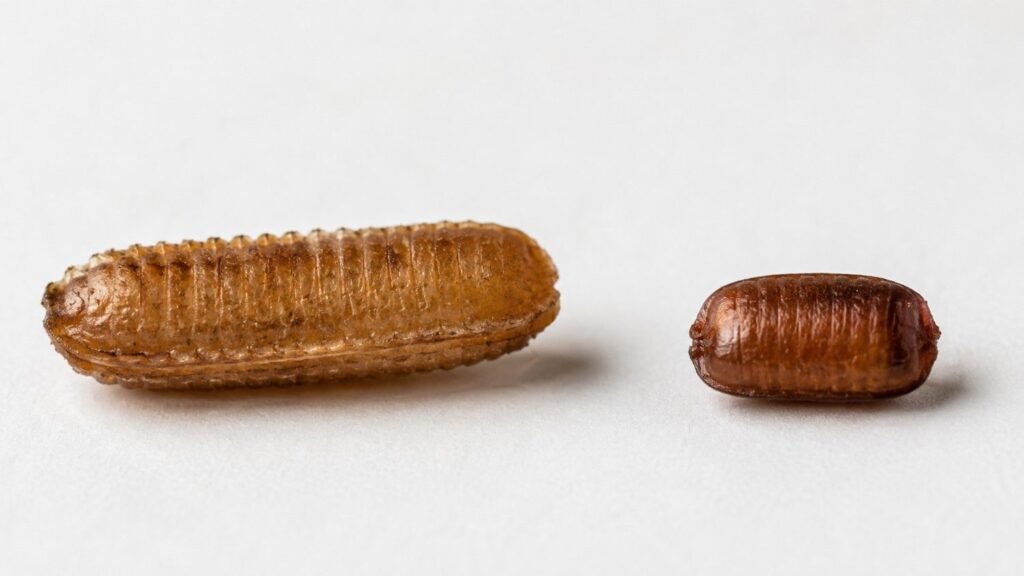
German roach eggs and American roach eggs both develop inside protective egg cases called oothecae, but they differ in color, egg count, carrying behavior, hatching timeline, and hiding location. German roach egg cases are usually light tan to brown, about 6–9 mm long, and contain about 30–40 eggs. American roach egg cases are darker brown to blackish-brown, about 8 mm long and 5 mm high, and contain about 14–16 eggs.
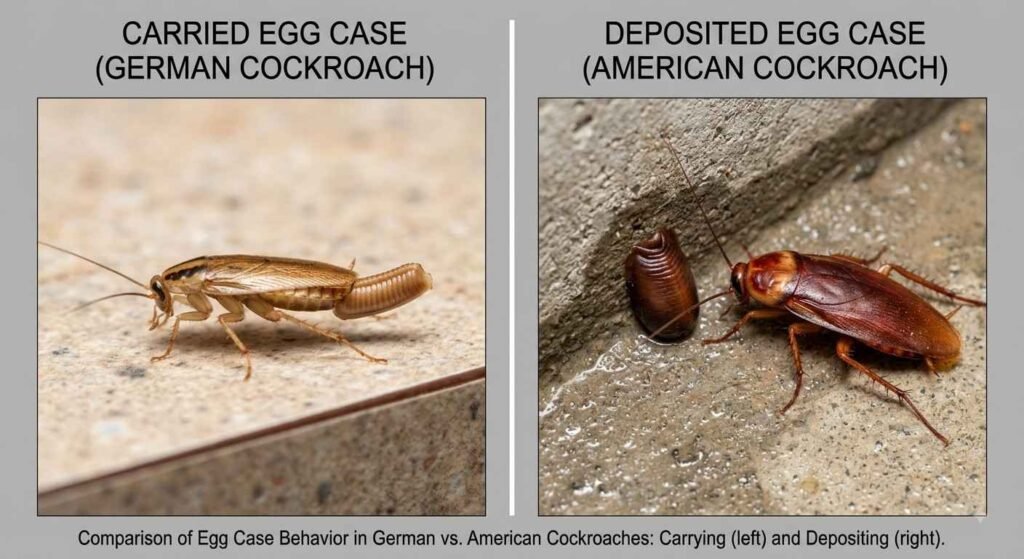
The fastest difference is behavior. A female German cockroach usually carries her ootheca until just before the eggs hatch, while an American cockroach deposits or glues her ootheca in a hidden damp place soon after it forms.
If you found a light tan egg case attached to a small roach in a kitchen or bathroom, German roaches are more likely. If you found a dark, purse-shaped capsule in a basement, drain area, utility room, or damp wall void, American roaches are more likely.
Quick Comparison: German vs American Roach Eggs
| Feature | German Roach Eggs | American Roach Eggs |
|---|---|---|
| Scientific name | Blattella germanica | Periplaneta americana |
| Egg structure | Ootheca, protective egg case | Ootheca, protective egg case |
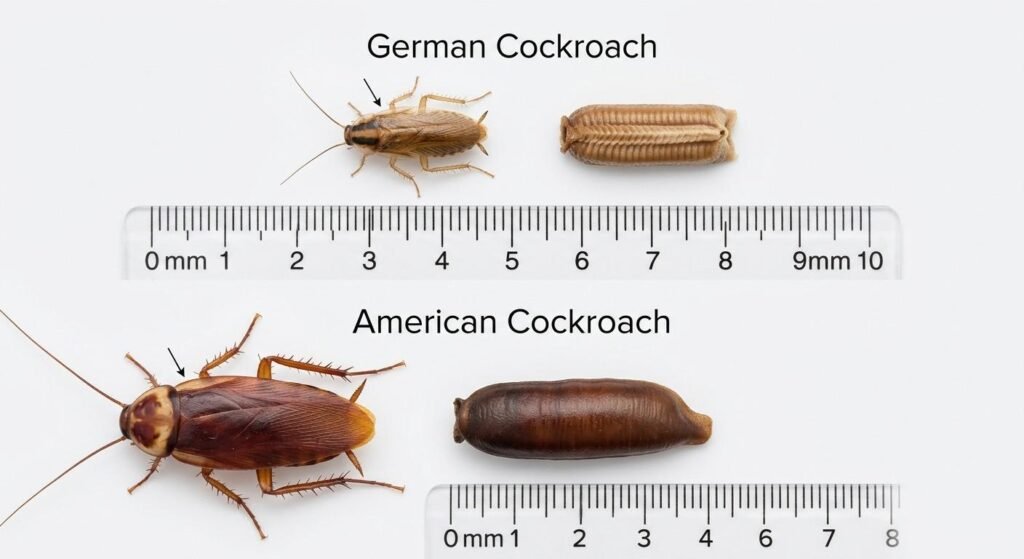
| Size | About 6–9 mm long; often around 8 mm | About 8 mm long and 5 mm high |
| Color | Light tan, amber, yellowish-brown, or brown | Brown when deposited; dark brown to blackish-brown after aging |
| Shape | Narrow, ridged, purse-shaped capsule | Thicker, hardened, purse-shaped capsule |
| Eggs per case | About 30–40, sometimes more | About 14–16 |
| Female behavior | Carries ootheca until near hatch | Deposits or glues ootheca in a hidden place |
| Hatching time | Often about 28–30 days | Usually about 6–8 weeks |
| Common location | Kitchens, bathrooms, cabinet hinges, appliances, sink areas | Basements, drains, crawl spaces, utility rooms, sewers, damp concealed areas |
| Infestation risk | Very high because egg count and reproduction speed are high | Serious, especially in damp or sewer-connected buildings |
Rutgers NJAES states that a typical German cockroach egg case contains about 40 eggs and measures about 8 mm by 3 mm by 2 mm Rutgers NJAES. University of Florida IFAS states that American cockroach egg cases contain 16 eggs, are brown when deposited, turn black in a day or two, and measure about 8 mm long and 5 mm high UF IFAS American cockroach profile.
For a general visual guide, read what roach eggs look like.
What German and American Roach Eggs Have in Common
German and American roach eggs are both protected inside oothecae. An ootheca is a firm, leathery capsule that holds multiple embryos and protects them until nymphs emerge.
Neither species usually leaves loose individual eggs scattered around the home. When homeowners say they found “roach eggs,” they usually found the egg case.
Both German and American roach egg cases usually share these features:
- Capsule-like shape
- Brownish color range
- Firm or leathery texture
- Visible seam or ridge
- Multiple eggs inside one case
- Hidden placement near shelter
- Potential to release many baby roaches
The University of Florida IFAS cockroach management guide explains that cockroach eggs are deposited in groups inside a leathery case or capsule called an ootheca UF IFAS Cockroaches and Their Management.
For basic ootheca biology, read what are roach eggs?.
German Roach Eggs: Key Identification Features
German roach eggs are enclosed inside a light tan to brown ootheca that the female carries until the eggs are close to hatching. This carrying behavior is one of the strongest identification clues.
A German roach egg case usually has these traits:
- Size: about 6–9 mm long
- Color: light tan, amber, yellowish-brown, or brown
- Shape: narrow, purse-shaped, and ridged
- Egg count: about 30–40 eggs per case
- Texture: firm, leathery, and visibly segmented
- Female behavior: carried on the end of the abdomen until near hatch
- Common rooms: kitchens and bathrooms
- Common hiding spots: cabinet hinges, drawer tracks, behind appliances, under sinks
University of Florida IFAS describes the German cockroach ootheca as a tiny brown purse-shaped capsule about 8 mm long, 3 mm high, and 2 mm wide, typically containing 30–40 eggs UF IFAS German cockroach profile.
For a complete species guide, read our German roach eggs guide.
American Roach Eggs: Key Identification Features
American roach eggs are enclosed inside a darker, thicker, purse-shaped ootheca that is deposited or glued in a hidden place. American roach egg cases are often found in damp, protected environments rather than carried until hatch.
An American roach egg case usually has these traits:
- Size: about 8 mm long and 5 mm high
- Color: brown when deposited, dark brown or blackish-brown after aging
- Shape: hardened, purse-shaped capsule
- Egg count: about 14–16 eggs per case
- Texture: firm, leathery, and protective
- Female behavior: carried briefly, then deposited or glued near food and moisture
- Common rooms: basements, utility rooms, bathrooms, laundry rooms, commercial kitchens
- Common hiding spots: drains, pipe gaps, water heaters, crawl spaces, damp wall voids
UF IFAS describes American cockroach females as depositing the ootheca near a food source and sometimes gluing it to a surface with a secretion from the mouth UF IFAS American cockroach profile.
For the full species page, read American Roach Eggs.
Size Difference: German vs American Roach Egg Cases
German and American roach egg cases can be similar in length, but American oothecae usually look thicker and darker. German oothecae are narrower and more visibly ridged.
| Measurement | German Roach Egg Case | American Roach Egg Case |
|---|---|---|
| Length | About 6–9 mm | About 8 mm |
| Height | About 3 mm | About 5 mm |
| Width | About 2 mm | Thicker, more robust profile |
| Visual comparison | Narrow rice-grain-like capsule | Darker, thicker purse-like case |
This is why size alone can mislead you. A German and American egg case may both be around 8 mm long, but the German case is usually lighter, narrower, and carried by the female. The American case is usually darker, thicker, and deposited in damp protected areas.
For a broader chart, read How big are roach egg cases?.
Color Difference: German Roach Eggs Are Lighter
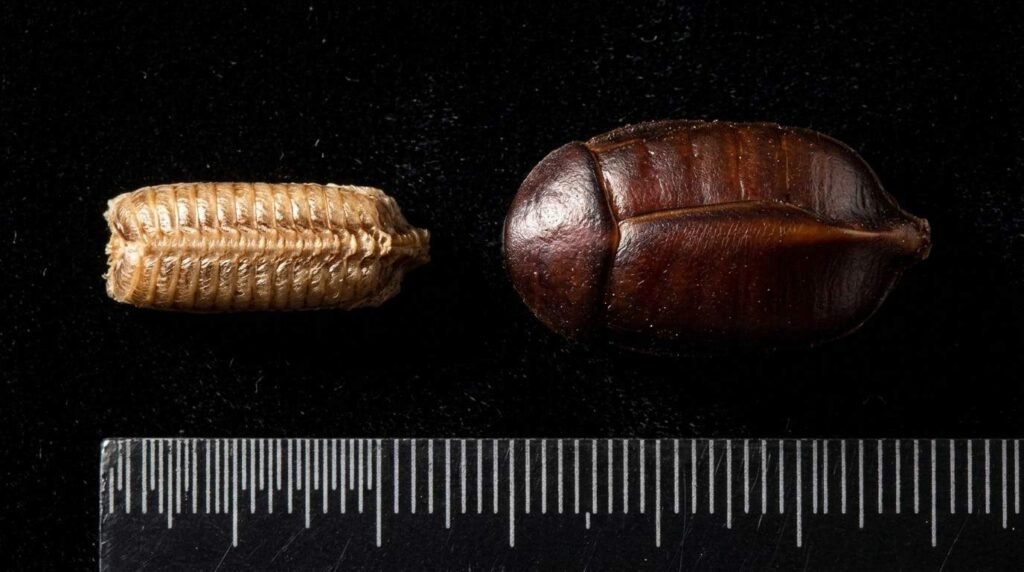
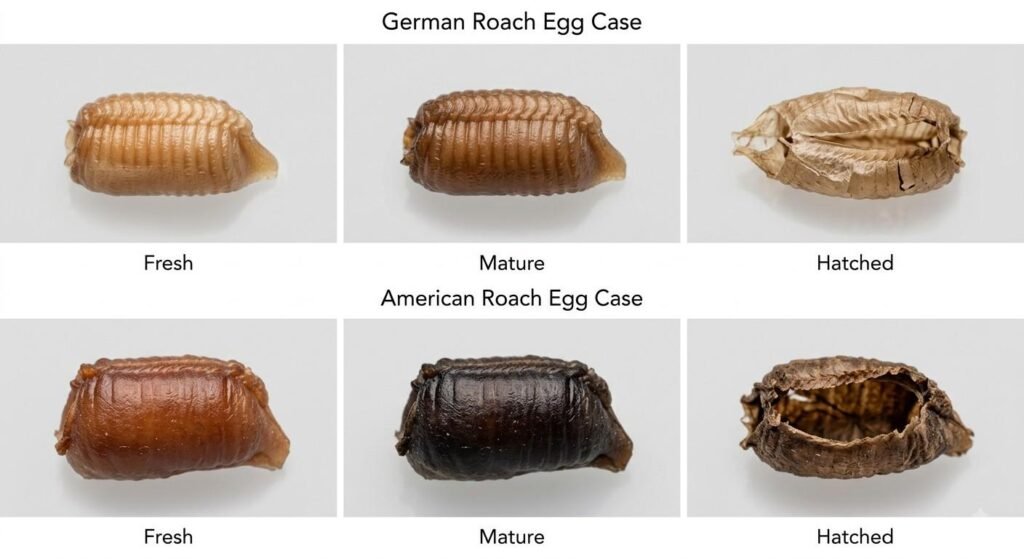
German roach egg cases are usually lighter than American roach egg cases. German oothecae commonly appear light tan, amber, yellowish-brown, or medium brown. American oothecae are usually brown at first and then dark brown or blackish-brown after aging.
| Stage | German Roach Eggs | American Roach Eggs |
|---|---|---|
| Fresh | Pale tan, amber, light brown | Brown or reddish-brown |
| Mature | Brown or darker tan | Dark brown to blackish-brown |
| Hatched | Lighter, papery, flattened, split | Dark, dry, split, hollow, or brittle |
Do not judge only by color. A dark American case may still be active if the seam is closed and the body is full. A light German case may be close to hatching if the female has been carrying it.
For color-stage details, read What color are roach eggs?.
Shape and Texture Difference
German roach egg cases are narrow, ridged, and purse-shaped. American roach egg cases are thicker, hardened, and purse-shaped, with a more robust appearance.
German Ootheca Shape Clues
A German ootheca usually looks:
- Narrow
- Light brown
- Ridged or segmented
- Attached to the female’s abdomen when active
- Like a small tan purse or ridged capsule
American Ootheca Shape Clues
An American ootheca usually looks:
- Darker
- Thicker
- Hardened
- Purse-shaped
- Deposited or glued in a protected location
- Like a small dark bean or leathery capsule
Both species produce firm, leathery oothecae. If the object is a tiny black speck, it is more likely droppings than an egg case.
For texture detail, read Are roach eggs hard, soft, sticky, or brittle?.
Egg Count Difference: German Roach Cases Hold More Eggs
German roach egg cases contain more eggs than American roach egg cases. This is one reason German roach infestations grow so quickly indoors.
| Species | Eggs Per Ootheca | Infestation Meaning |
|---|---|---|
| German cockroach | About 30–40, sometimes more | High reproduction risk in kitchens and bathrooms |
| American cockroach | About 14–16 | Serious risk in damp, sewer-connected, or utility areas |
Rutgers NJAES notes that a female German cockroach produces 5–8 oothecae with a total of 200–250 eggs in her lifetime Rutgers NJAES. UF IFAS notes that an American cockroach female produces one egg case a month for ten months on average, with 16 eggs per case UF IFAS.
For more egg-count data, read How many eggs do roaches lay?.
Hatching Time Difference
German roach eggs usually hatch faster than American roach eggs. German oothecae often hatch in about 28–30 days, while American oothecae often hatch in about 6–8 weeks.
| Species | Typical Hatching Time | Development Notes |
|---|---|---|
| German cockroach | About 28–30 days | Female carries the ootheca until near hatch |
| American cockroach | About 6–8 weeks | Egg case is deposited in damp protected areas |
UF IFAS states that American cockroach nymphs emerge from the egg case after about six to eight weeks UF IFAS. German roach development is faster, and Rutgers describes the entire German cockroach life cycle as completed in about 100 days Rutgers NJAES.
For a full hatch-time guide, read How long do roach eggs take to hatch?.
Carrying Behavior: The Biggest Difference
Carrying behavior is the clearest difference between German and American roach eggs. German cockroach females carry their egg case until the eggs are almost ready to hatch. American cockroach females deposit the egg case in a hidden location much earlier.
German Female Behavior
German cockroach females keep the ootheca attached to the end of the abdomen. You may see a small tan capsule sticking out behind the female. This means the egg case is likely active and close to hatching.
UF IFAS states that German cockroach eggs are carried in an egg case by the female until just before hatch, and nymphs may hatch while the female is still carrying the ootheca UF IFAS German cockroach profile.
American Female Behavior
American cockroach females carry the ootheca for a shorter time and then place it in a sheltered area. The case may be glued to a surface near food or moisture.
This means a loose dark American egg case may still be viable if the seam is closed and the body is full.
Location Difference: Kitchen vs Damp Utility Areas
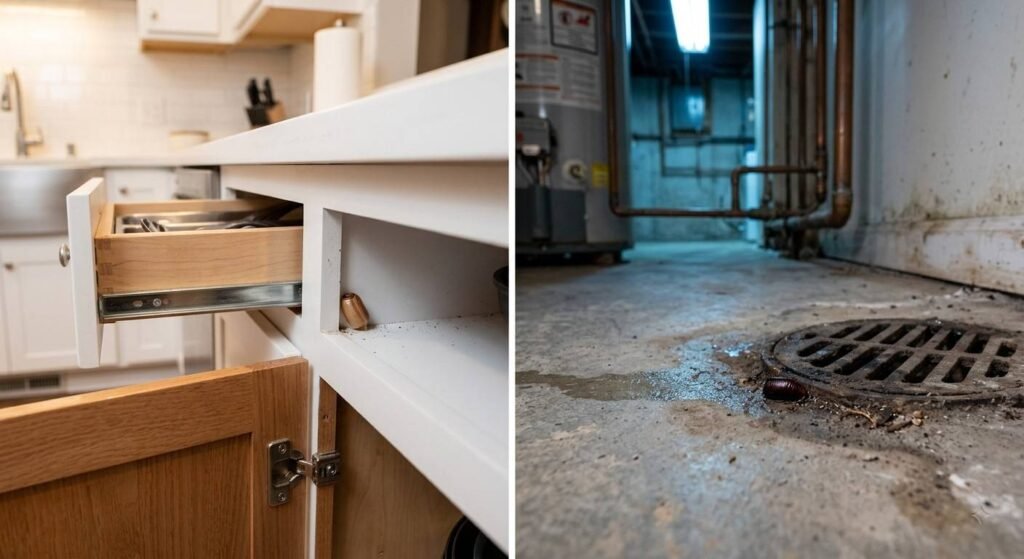
German roach eggs are more strongly associated with indoor kitchens and bathrooms. American roach eggs are more strongly associated with damp, outdoor-connected, basement, utility, sewer, and drain areas.
| Location | More Likely Species | Why |
|---|---|---|
| Cabinet hinges | German roach | Warm, tight, food-adjacent harborage |
| Behind refrigerator | German roach | Heat, food debris, hiding space |
| Under kitchen sink | German or American | Moisture and shelter overlap |
| Bathroom vanity | German or American | Moisture and cracks |
| Basement floor drain | American roach | Damp, protected, sewer-connected area |
| Water heater area | American roach | Warm, humid utility shelter |
| Sewer or steam tunnel | American roach | Common habitat for large peridomestic roaches |
| Apartment kitchen | German roach | Common indoor breeding environment |
UF IFAS states that American cockroaches are found mainly in basements, sewers, steam tunnels, and drainage systems UF IFAS. Rutgers NJAES states that German cockroaches are mostly found in kitchens and bathrooms where food and water are available Rutgers NJAES.
For kitchen-focused inspection, read Find cockroach eggs in the kitchen.
German vs American Roach Eggs in Apartments
German roach eggs are usually the bigger apartment concern because German cockroaches spread through shared walls, plumbing lines, hallways, and utility gaps. American roaches can infest apartment buildings too, especially where basements, drains, garbage rooms, or sewer access are involved.
A light tan egg-bearing female in a kitchen cabinet usually points to German roaches. A dark ootheca near a basement drain, boiler room, laundry area, or trash chute may point to American roaches.
In apartments, inspect both:
- Unit-level areas: kitchen cabinets, sink plumbing, stove, refrigerator, bathroom vanity
- Building-level areas: trash rooms, basement drains, utility rooms, pipe chases, laundry rooms
Hatched German vs Hatched American Roach Egg Cases
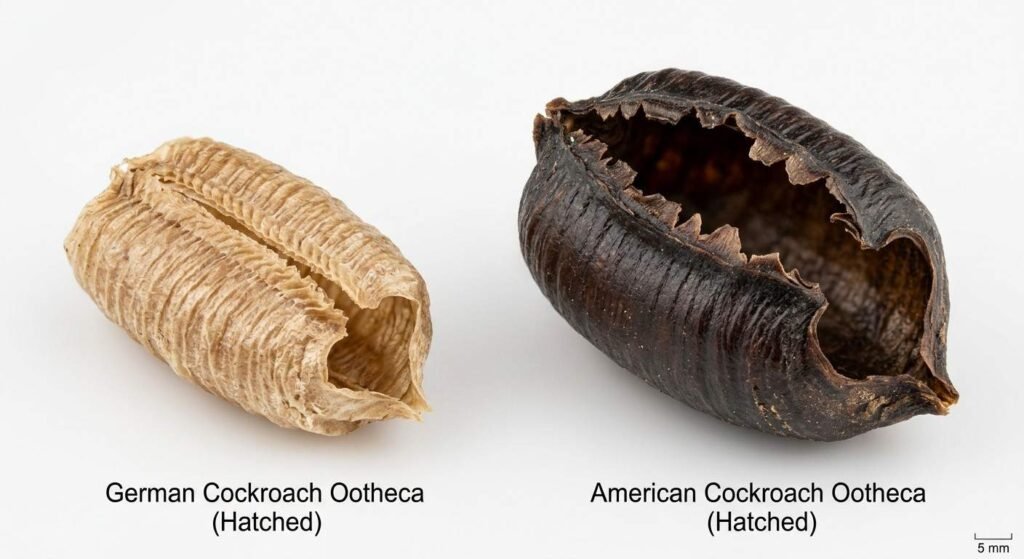
Hatched German and American roach egg cases both show a split seam, hollow body, and dry or papery texture. The difference is usually size, color, and location.
| Feature | Hatched German Ootheca | Hatched American Ootheca |
|---|---|---|
| Color | Light brown, tan, faded, papery | Dark brown, blackish-brown, dry, brittle |
| Shape | Narrow, ridged, flattened | Thicker, purse-shaped, hollow |
| Location | Kitchen/bathroom cracks and appliance areas | Damp basements, drains, utility areas |
| Nearby nymphs | Many tiny nymphs possible | Fewer nymphs per case, but still serious |
A hatched case will not hatch again, but it proves nymphs may already be active nearby. Read What do hatched roach egg cases look like? for more detail.
German vs American Roach Eggs vs Droppings
German and American roach egg cases can both be confused with droppings. The difference is structure. Egg cases are capsules. Droppings are specks, smears, or pellets.
| Evidence | Appearance | Meaning |
|---|---|---|
| German ootheca | Light tan to brown ridged capsule | German roach reproduction |
| American ootheca | Dark brown purse-shaped capsule | American roach reproduction |
| German droppings | Tiny black specks like pepper or coffee grounds | German roach movement and feeding |
| American droppings | Larger dark ridged pellets | American roach movement and feeding |
If you found black dots instead of capsules, read Are black dots roach eggs or poop?.
Which Is Worse: German or American Roach Eggs?
German roach eggs are usually more urgent inside kitchens and apartments because they contain more eggs, hatch faster, and are tied to rapid indoor population growth. American roach eggs are still serious, especially in damp buildings, basements, sewers, restaurants, storage areas, and utility spaces.
German roach risk factors:
- Higher egg count per case
- Faster indoor breeding
- Females carry oothecae until near hatch
- Strong kitchen and bathroom association
- Common apartment pest
American roach risk factors:
- Larger adult roaches
- Strong sewer and drain association
- Damp building infestations
- Oothecae hidden in utility areas
- Movement from outdoors or infrastructure into buildings
The “worse” species depends on the location. In an apartment kitchen, German roaches are usually more concerning. In a basement with drains, leaks, and sewer access, American roaches may be the main issue.
What to Do If You Find German or American Roach Eggs
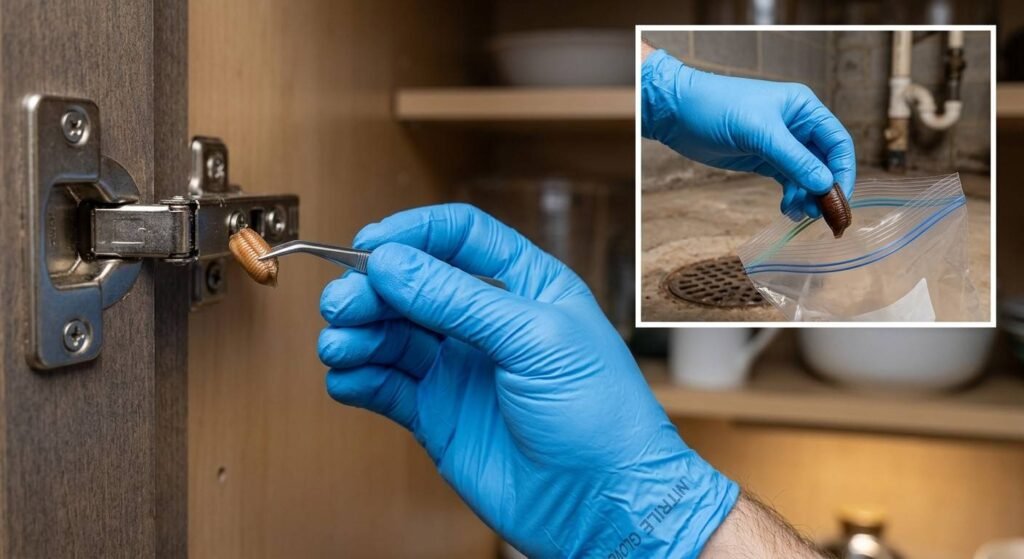
Any roach egg case should be removed and followed by inspection. Do not leave an intact ootheca in place.
Follow this action plan:
- Put on disposable gloves.
- Photograph the egg case before removing it.
- Note the location. Kitchen/bathroom suggests German; damp basement/drain suggests American.
- Pick it up with tape, tweezers, or a paper towel.
- Seal it in a plastic bag.
- Dispose of it outdoors.
- Vacuum nearby cracks and crevices.
- Clean droppings and stains with hot, soapy water.
- Inspect the surrounding 6–10 feet for more cases.
- Place sticky monitors near the discovery area.
- Remove food, water, cardboard, and clutter.
- Use baits and insect growth regulators where appropriate.
For treatment options, read What kills roaches and their eggs?.
Final Verdict: German vs American Roach Eggs
German roach eggs and American roach eggs both develop inside oothecae, but they signal different infestation patterns. German roach egg cases are lighter, narrower, often carried by the female, contain about 30–40 eggs, and are most common in kitchens and bathrooms. American roach egg cases are darker, thicker, deposited or glued in hidden damp areas, contain about 14–16 eggs, and are common in basements, drains, sewers, and utility spaces.
If the egg case is light tan and attached to a small roach in a kitchen, suspect German roaches. If the case is dark brown, purse-shaped, and hidden near damp utility areas, suspect American roaches.
Either finding means the same next step: remove the egg case, inspect nearby harborages, clean droppings, place monitors, and start lifecycle-based control.
Frequently Asked Questions
What is the difference between German and American roach eggs?
German roach egg cases are usually light tan to brown, about 6–9 mm long, and contain about 30–40 eggs. American roach egg cases are darker, about 8 mm long and 5 mm high, and contain about 14–16 eggs.
Are German roach eggs bigger than American roach eggs?
No. German and American egg cases can be similar in length, but American oothecae are usually thicker and darker. German oothecae are usually narrower and more ridged.
Which roach egg case has more eggs?
German roach egg cases have more eggs. A German ootheca commonly contains about 30–40 eggs, while an American ootheca contains about 14–16 eggs.
What color are German roach eggs?
German roach egg cases are usually light tan, amber, yellowish-brown, or brown. They are usually lighter than American roach egg cases.
What color are American roach eggs?
American roach egg cases are brown when deposited and often turn dark brown or blackish-brown after aging.
Where do German roaches hide egg cases?
German roaches usually hide near kitchens and bathrooms, especially around cabinet hinges, drawer tracks, appliances, sink plumbing, and food or water sources.
Where do American roaches hide egg cases?
American roaches hide egg cases in damp protected places such as basements, drains, utility rooms, crawl spaces, sewers, water heater areas, and pipe gaps.
Do German roaches carry their egg cases?
Yes. Female German cockroaches carry the ootheca until just before hatching, and nymphs may hatch while the female is still carrying it.
Do American roaches carry their egg cases?
American cockroach females carry the ootheca only briefly, then deposit or glue it in a protected place near food and moisture.
Which egg case hatches faster, German or American?
German roach egg cases usually hatch faster, often around 28–30 days. American roach egg cases usually hatch in about 6–8 weeks.