

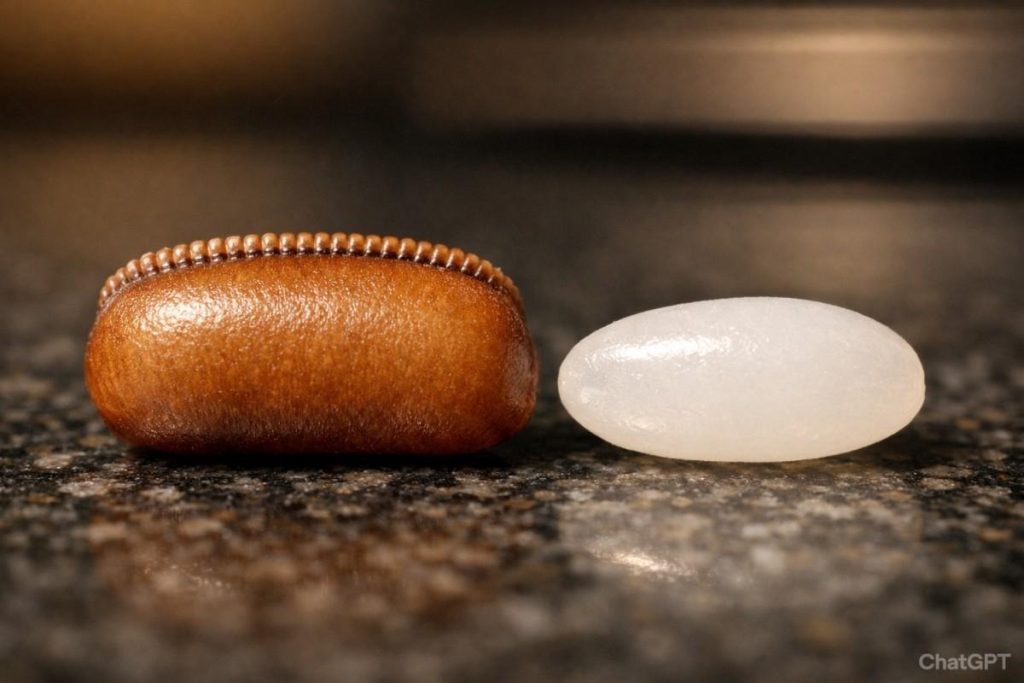
One tiny tan capsule, smaller than a grain of rice, can release up to 48 baby cockroaches into your kitchen in under a month. That capsule is the German roach egg sac, technically called an ootheca, and it’s the single biggest reason German cockroach infestations spiral out of control faster than any other household pest.
Here’s what makes it so dangerous: a single female Blattella germanica produces 4 to 8 of these egg cases in her lifetime. She carries each one protruding from her abdomen for nearly a month, protecting the developing embryos until they’re ready to hatch. By the time you spot one egg sac, there are almost certainly others you haven’t found.
Recognizing this small, purse-shaped capsule and knowing exactly how to eliminate it is the difference between a minor nuisance and a full-scale infestation. This guide covers everything: what the German cockroach egg sac looks like, where females hide them, how to destroy them, and how to make sure no new ones appear.
What Is a German Roach Egg Sac?
The German roach egg sac is a protective capsule called an ootheca (plural: oothecae). It’s a biological structure produced by the female cockroach’s collateral glands, which secrete proteins that harden into a tough, leathery shell around a cluster of fertilized eggs.
Think of the ootheca as a tiny armored nursery. Its outer casing shields the developing embryos from physical damage, desiccation, and many common pesticides. Inside, individual eggs sit in neatly organized compartments separated by thin membranes, each embryo developing independently within its own chamber.
German cockroaches (Blattella germanica) are classified as oviparous insects; they produce eggs enclosed in an external case rather than giving live birth. However, their egg-carrying behavior sets them apart from most other cockroach species, a distinction we’ll explore in detail below.
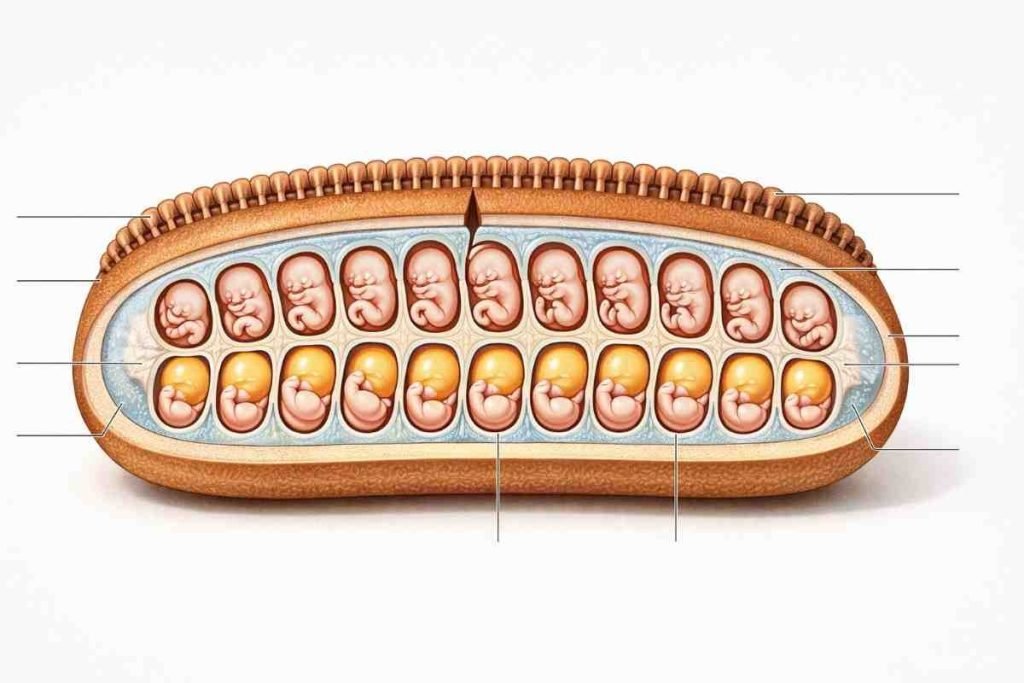
Key Takeaway: The ootheca isn’t just a container. It’s a purpose-built survival capsule that gives German cockroach offspring one of the highest survival rates among indoor pest species.
What Does a German Cockroach Egg Sac Look Like?
Identifying a German cockroach egg capsule quickly and accurately is your first step toward control. Here’s exactly what to look for.
Physical Appearance
A German roach ootheca has a distinctive set of characteristics:
Shape: Elongated and slightly curved, often described as purse-shaped or pill-shaped. Some observers compare it to a tiny wallet or a miniature kidney bean.
Color: Light tan to medium brown when freshly produced, gradually darkening to a deeper brown as embryos mature inside. A newly formed ootheca may appear almost off-white before the casing hardens and oxidizes.
Size: Approximately 5–9 mm long (roughly ¼ inch) and about 3 mm wide. It’s one of the smaller cockroach oothecae, proportional to the German cockroach’s compact adult body.
Texture: Smooth and slightly leathery on the outside. Not rough or bumpy like some other species’ egg cases.
Surface features: A visible keel (ridged seam) runs along one edge. This ridge is the suture line where the ootheca will eventually split open during hatching, allowing nymphs to emerge.
What It Looks Like Attached to a Female
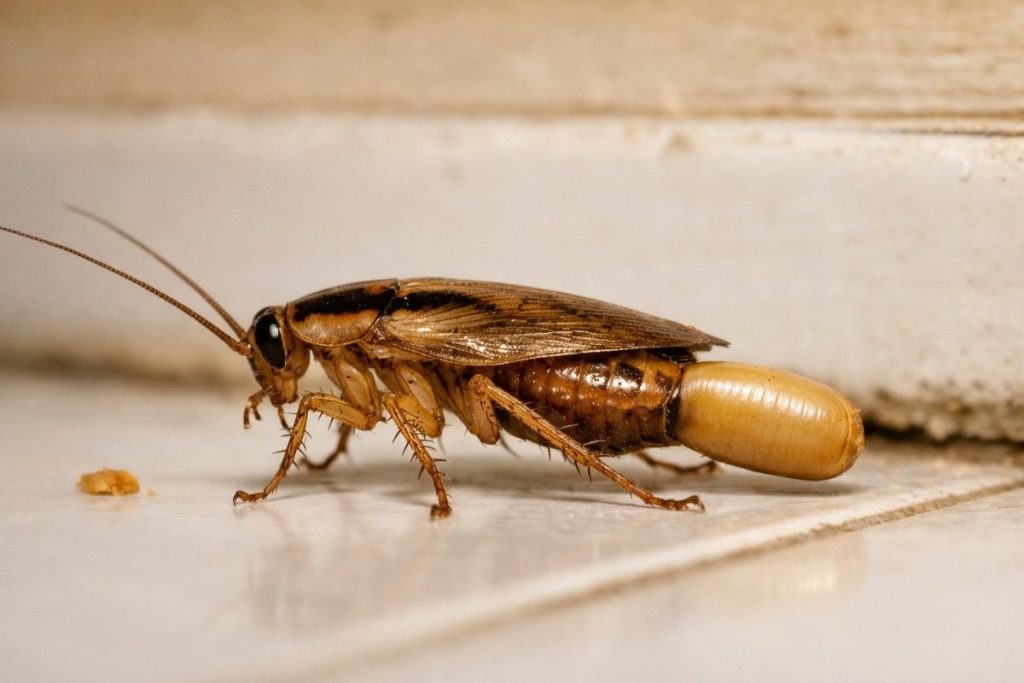
When a female German cockroach is carrying her egg sac, you’ll see a small, tan capsule protruding from the tip of her abdomen. It extends roughly half the length of her body and is clearly visible to the naked eye, making an egg-carrying female one of the easiest signs of active breeding to identify.
Unlike American or Oriental cockroaches that deposit their oothecae shortly after production, the German cockroach female carries hers externally for the entire incubation period. She goes about her regular activities, foraging, hiding, and moving through crevices, with the egg sac visibly attached.
How to Distinguish It From Droppings or Debris
People frequently mistake German roach oothecae for:
Rodent droppings Mouse droppings are similar in size but tapered at both ends, smooth, and dark black. An ootheca is flat-sided with a ridged keel.
Seeds or food debris: Caraway seeds, cumin, and small dried bean fragments resemble oothecae. The keel ridge and segmented structure distinguish the egg case.
Other insect egg cases, praying mantis oothecae, are much larger and foamy in texture. Carpet beetle larvae casings are fuzzy and irregularly shaped.
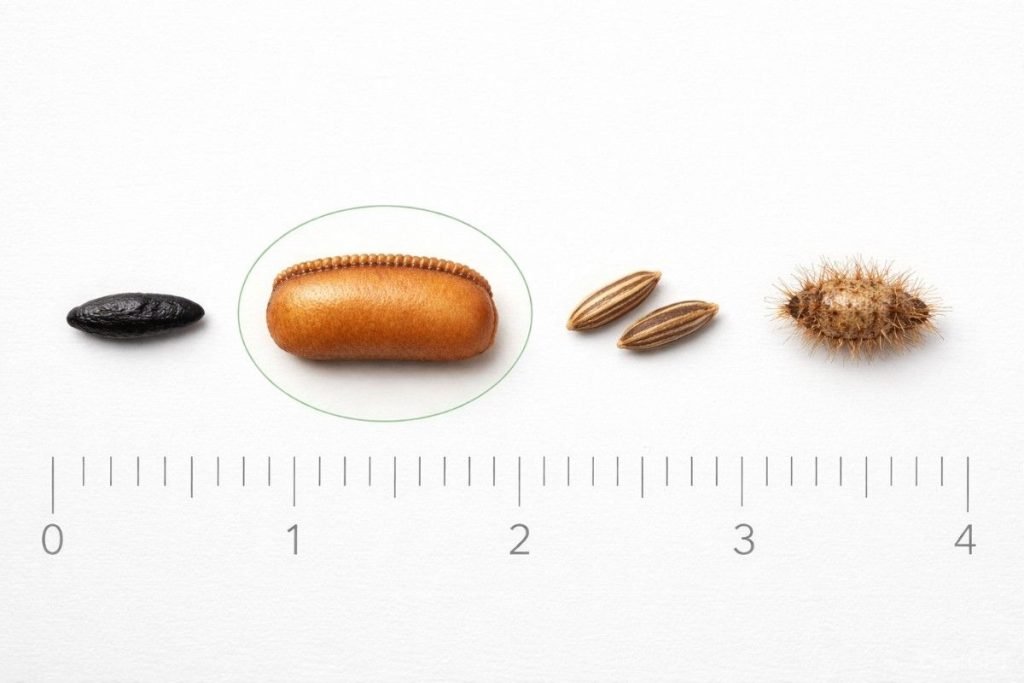
Pro Tip: If you find a small, light-brown, symmetrical capsule with a visible ridge along one edge in a kitchen or bathroom, treat it as a German cockroach ootheca until proven otherwise. Crush it immediately and inspect the surrounding area for more.
How Many Eggs Are Inside a German Roach Ootheca?
This is where the German cockroach earns its reputation as the most prolific indoor pest species. Each ootheca contains 30 to 48 individual eggs, with most cases averaging around 37–40.
The Numbers in Context
To grasp why this matters, consider the full reproductive output of one female German cockroach:
| Metric | Value |
|---|---|
| Eggs per ootheca | 30–48 (avg. ~37) |
| Oothecae per lifetime | 4–8 |
| Total offspring per female | 120–384 |
| Time between egg cases | ~30 days |
| Adult female lifespan | 100–200 days |
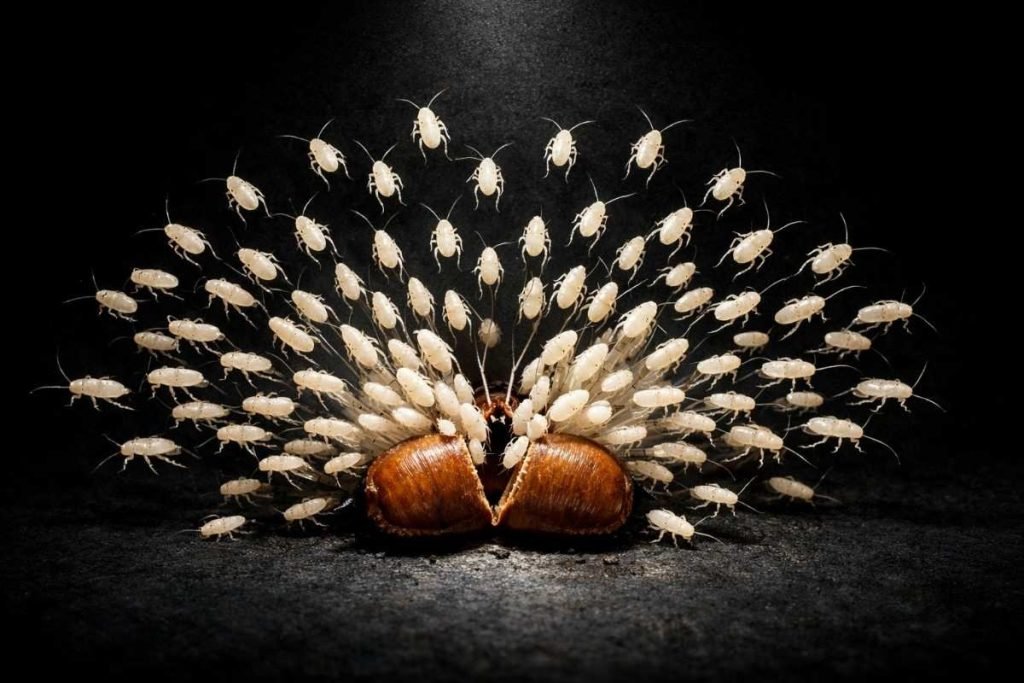
According to data published by the University of Florida Entomology Department, a single mated female German cockroach has the theoretical capacity to generate over 300 offspring in her lifetime. Under ideal conditions of consistent warmth, humidity, and food access, her descendants can produce thousands of roaches within a single year because of generational overlap.
Dr. Coby Schal at NC State University has documented that German cockroach populations can double in as few as 36 days when conditions are favorable, primarily because of the high egg count per ootheca and the short development time from nymph to reproductive adult.
Why the German Roach Outbreeds Other Species
The German cockroach produces significantly more eggs per case than its closest domestic competitors:
German cockroach: 30–48 eggs per ootheca
American cockroach: 14–16 eggs per ootheca
Oriental cockroach: 16–18 eggs per ootheca
Brown-banded cockroach: 10–18 eggs per ootheca
Combined with a carrying behavior that protects developing embryos and a short 28-day incubation period, the German cockroach’s reproductive system is engineered for explosive population growth.
German Roach Egg Sac vs. Other Species
If you’ve found an egg case in your home, identifying the species tells you exactly what you’re dealing with and which control strategy fits best. German cockroach oothecae have several distinguishing features.
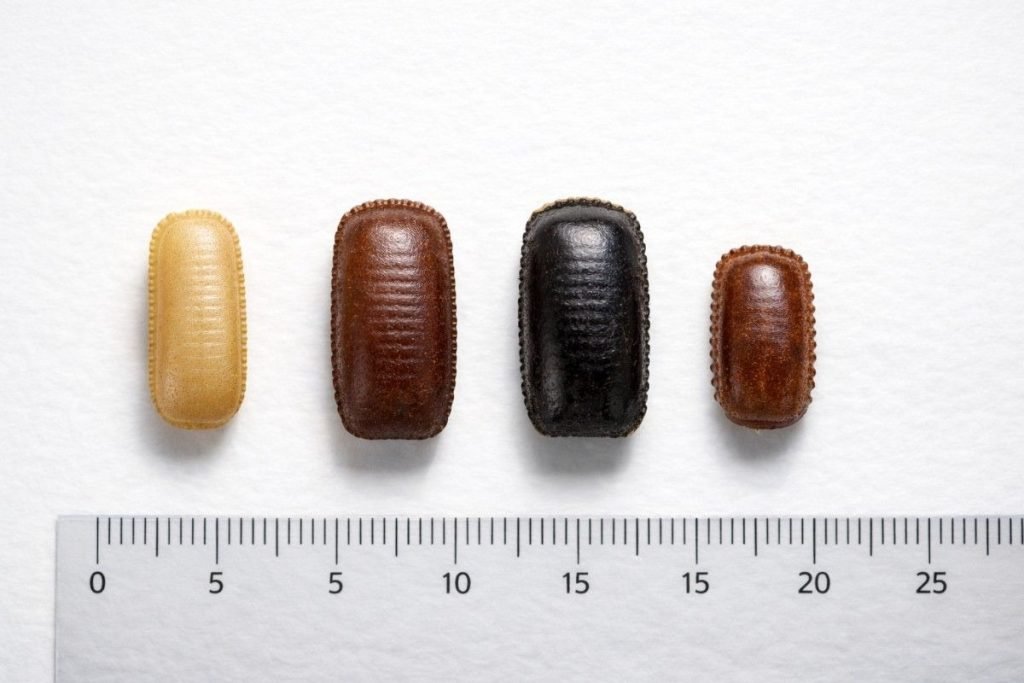
Species Comparison Table
Feature | German Roach | American Roach | Oriental Roach | Brown-Banded Roach
| Feature | Type 1 | Type 2 | Type 3 | Type 4 |
|---|---|---|---|---|
| Color | Light tan/brown | Dark reddish-brown | Dark brown/black | Reddish-brown |
| Size | 5–9 mm | 8–10 mm | 8–10 mm | 5–7 mm |
| Shape | Purse/wallet-like | Rounded, symmetrical | Inflated, blunt | Rounded, compact |
| Eggs inside | 30–48 | 14–16 | 16–18 | 10–18 |
| Carrying behavior | Carried until near hatching | Deposited and glued quickly | Dropped in sheltered area | Glued to elevated surfaces |
| Surface | Smooth, leathery | Rough, textured | Rough, dark | Smooth, small |
The Key Differentiator: Carrying Behavior
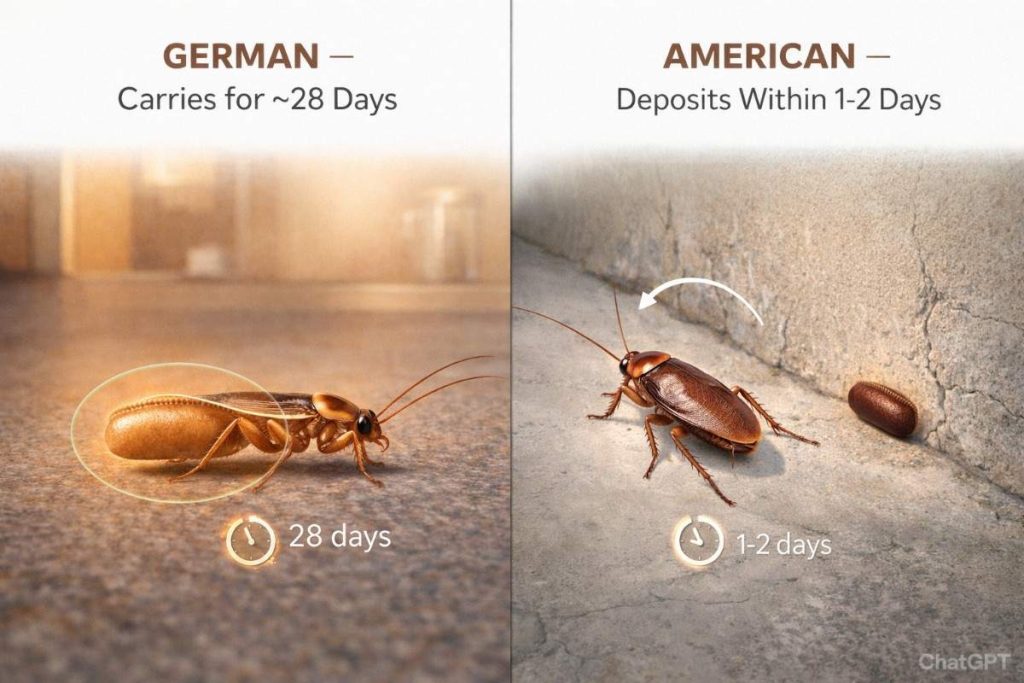
The most diagnostic feature of the German cockroach egg sac isn’t its appearance; it’s what the female does with it. German cockroaches are the only common domestic species that carry the ootheca for nearly the entire incubation period (approximately 24–28 days).
American cockroaches produce an ootheca and glue it to a hidden surface within a day or two. Oriental cockroaches drop theirs in sheltered areas shortly after formation. Brown-banded cockroaches cement themselves to upper walls and ceilings.
Only the German cockroach mother keeps her egg sac attached to her body, releasing it just 24–36 hours before the nymphs are ready to emerge. This extended maternal protection dramatically boosts nymph survival rates, and it explains why German cockroach infestations are the most challenging to control.
Key Takeaway: If you see a cockroach carrying a visible egg case on its abdomen, you’re almost certainly looking at a German cockroach female. Eliminating her removes not just one adult but an entire generation of 30–48 potential offspring.
How Long Do German Roaches Carry Their Egg Sac?
The carrying period is one of the most critical windows in the German cockroach lifecycle and one of the best opportunities for targeted intervention.
The Timeline
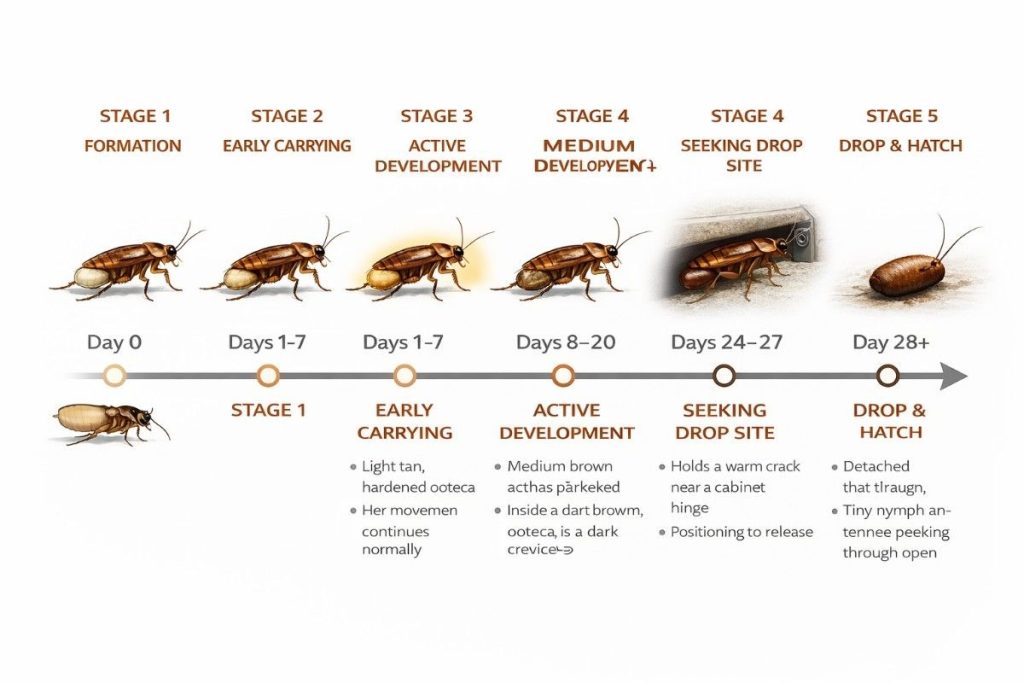
Day 0: The female produces a fully formed ootheca. The protein casing hardens within hours and changes from off-white to light tan.
Days 1–24: She carries the egg sac protruding from her abdomen while continuing normal activities. Embryos develop inside the protected capsule, drawing nutrition from yolk material within each egg chamber.
Days 24–27: Embryos reach full development. The female begins seeking a warm, dark, protected location to drop the case.
Day 28 (approximately): She deposits the ootheca in a crack, crevice, or secluded spot. Within 24–36 hours, nymphs emerge through the keel suture line.
Why This Behavior Matters for Control
The carrying behavior creates both a challenge and an opportunity:
The challenge: Because the female keeps her eggs with her, you can’t simply locate and destroy deposited egg cases the way you can with American or Oriental cockroach oothecae. The eggs travel wherever she goes.
The opportunity: An egg-carrying female is easier to identify visually. She’s also slightly slower and bulkier than non-carrying females, making her more likely to be caught by sticky traps or to consume bait. Targeting her eliminates both the adult and the entire egg case in a single action.
Professional pest control technicians from companies like Pestech Pest Solutions and Orkin Canada consistently emphasize that identifying and eliminating egg-carrying females should be a top priority during any German cockroach treatment program.
Where German Roaches Drop Their Egg Cases
When a female German cockroach finally releases her ootheca, she doesn’t leave it just anywhere. She selects a location that maximizes the survival chances of her offspring.
Preferred Drop Locations
Based on field research from Virginia Tech and inspection reports from professional exterminators, German roach oothecae are most commonly found in:
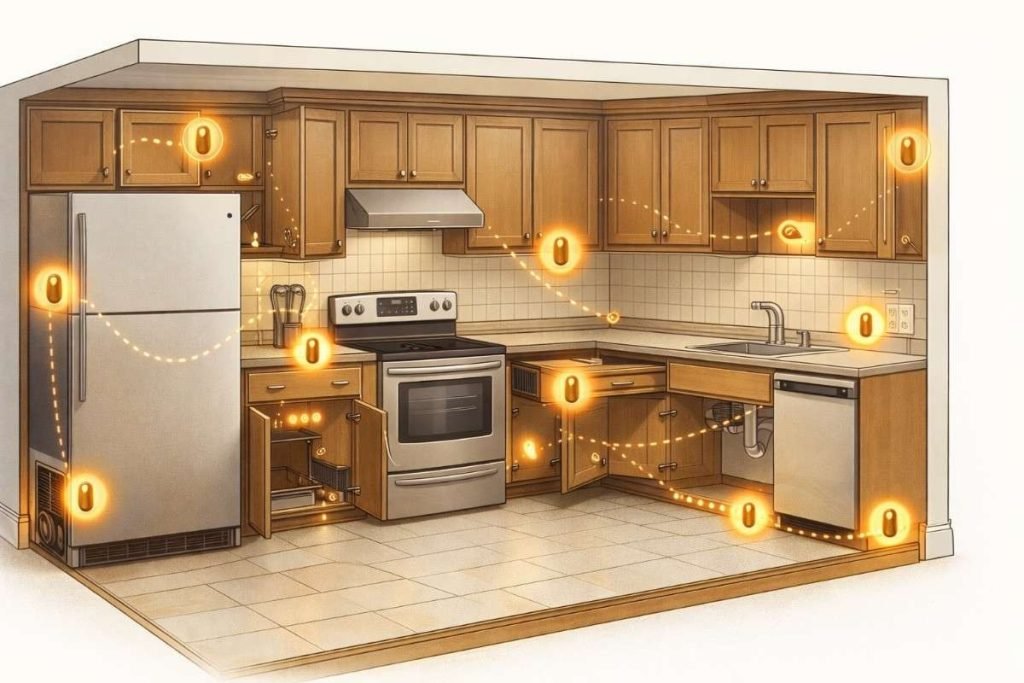
Kitchen cabinet crevices Hinges, shelf supports, and the gap between the cabinet and the wall
Behind and under refrigerators Warm motor housing provides consistent heat for incubation
Inside cracks near stoves, grease residue, and warmth create ideal conditions
Under sinks Moisture from plumbing provides the humidity embryos need
Behind baseboards Narrow gaps offer protection from disturbance and predators
Inside electrical outlet boxes, enclosed, dark, and warm
Drawer joints in wooden furniture Back corners of kitchen and bathroom drawers
Around pipe penetrations Gaps where plumbing enters walls
The Environment Checklist
Every drop location shares common environmental traits:
Dark Minimal light exposure
Warm, ideally 75–85°F (24–29°C)
Moderate humidity accelerates embryo development
Protected Narrow crevices or enclosed spaces that prevent crushing
Near food and water So emerging nymphs can begin foraging immediately
In my experience reviewing pest inspection findings, the most overlooked drop locations are the undersides of kitchen drawer rails, the motor compartment of refrigerators, and gaps behind bathroom medicine cabinets. These areas combine all five environmental factors and rarely get cleaned or inspected.
Pro Tip: When searching for German roach egg sacs, focus your flashlight on the first six inches of any crack or crevice within three feet of a water source. That narrow zone is statistically where the highest concentration of oothecae is deposited.
How to Destroy German Cockroach Egg Sacs
Eliminating existing oothecae is a critical step that many homeowners skip, focusing only on killing visible adults. Here are the most effective methods, ranked by immediacy and thoroughness.
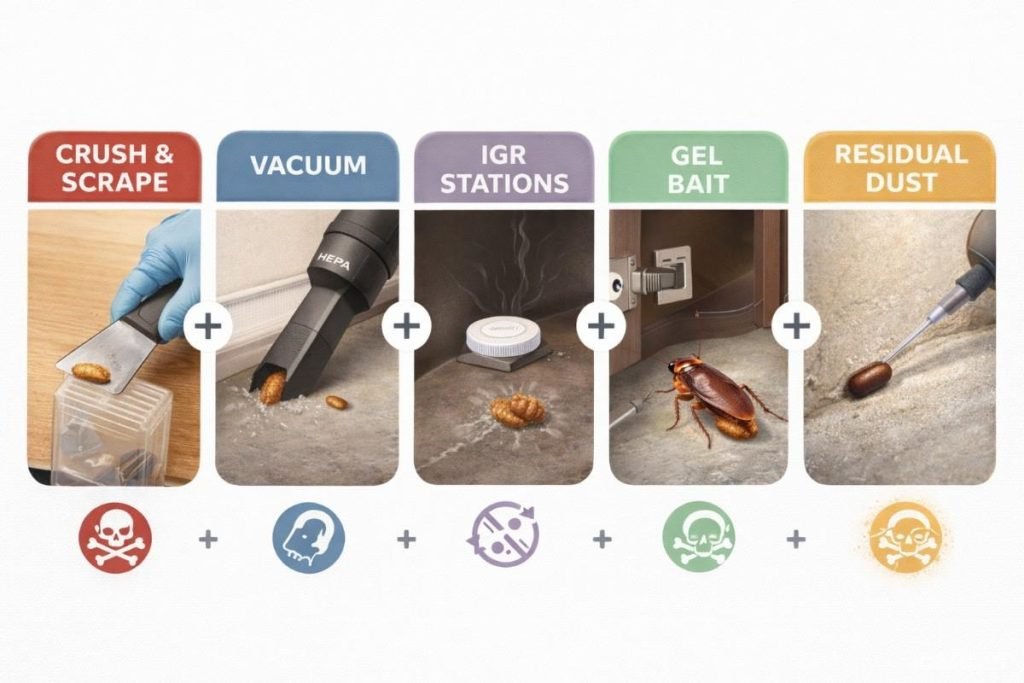
1. Physical Removal and Crushing
The fastest way to deal with a German roach egg sac is direct destruction. Scrape visible oothecae off surfaces using a putty knife, stiff card, or even a flathead screwdriver. Crush them firmly to rupture the protective casing and destroy the embryos inside.
Dispose of crushed egg cases in a sealed plastic bag. Don’t leave them in an open trash can; damaged oothecae can still occasionally produce viable nymphs if the destruction wasn’t thorough.
2. Vacuum Extraction
Use a vacuum with a crevice attachment to reach egg cases inside cracks, behind appliances, and along baseboard gaps. A HEPA-filtered vacuum prevents allergens from the crushed ootheca from recirculating into your air.
Critical step: seal and discard the vacuum bag immediately after use, or empty the canister into a sealed bag and take it to an outdoor bin. Nymphs can hatch inside a vacuum bag and reinfest your home.
3. Insect Growth Regulators (IGRs)
Products containing hydroprene-like Gentrol Point Source stations or Gentrol Aerosol are the most targeted chemical approach to German cockroach egg elimination. IGRs mimic juvenile hormones, disrupting embryonic development inside the ootheca and preventing surviving nymphs from reaching reproductive maturity.
IGRs don’t provide instant kill. Instead, they collapse the reproductive cycle over 60–90 days by sterilizing the next generation. Research from NC State University confirms that IGR-bait combinations significantly outperform baits alone in reducing German cockroach populations long-term.
4. Gel Bait Systems
Gel baits like Maxforce FC Roach Killer Bait Gel and Dupont Advion Roach Gel Bait target the adults, including egg-carrying females. When a baited female dies, her ootheca is no longer protected and can be located and destroyed.
Some formulations, like Vendetta Plus, combine insecticide with an IGR, attacking both the adult and the viability of her eggs in one product.
Place bait dots strategically:
Near identified egg-drop locations
Along roach travel paths (look for fecal streaks, tiny dark pepper-like specks)
Inside cabinet hinges and under sink edges
Behind appliances
5. Boric Acid and Diatomaceous Earth
These residual dusts don’t penetrate the ootheca shell, but they intercept nymphs at the moment of emergence. A thin film of boric acid powder or food-grade diatomaceous earth applied around identified egg-drop zones kills nymphs as they crawl through the treated area during their first foraging attempts.
Apply with a bulb duster for precise placement. The application should be barely visible; a light dusting, not a pile. German cockroaches avoid heavy accumulations of powder.
Method Effectiveness Summary
| Method | Kills Eggs Directly? | Kills Emerging Nymphs? | Disrupts Reproduction? | Best For |
|---|---|---|---|---|
| Crushing/scraping | ✅ Yes | N/A | No | Immediate visible egg cases |
| Vacuuming | ✅ Yes (removal) | N/A | No | Hard-to-reach crevices |
| IGRs (Gentrol) | Partially | ✅ Yes | ✅ Yes | Long-term cycle disruption |
| Gel baits | No | ✅ Yes | ✅ Yes (kills breeding adults) | Active infestation control |
| Boric acid / DE | No | ✅ Yes | No | Residual nymph interception |
Important: No single method eliminates German cockroach eggs. The University of Kentucky Entomology department recommends combining physical removal with IGRs and gel baits for comprehensive results, a strategy consistent with integrated pest management (IPM) principles.
Why German Roach Eggs Are So Hard to Kill
Understanding the obstacles helps you set realistic expectations and choose the right tools.
The Protein Shell Barrier
The ootheca’s outer casing is composed of hardened proteins secreted by the female’s collateral glands. This shell is specifically designed to resist:
Contact pesticides. Most pyrethroid sprays can’t penetrate the casing to reach the embryos inside.
Desiccation: The sealed structure retains internal moisture, keeping embryos viable even in dry conditions.
Physical pressure: The casing has surprising structural integrity for its size, though deliberate crushing does overcome it.
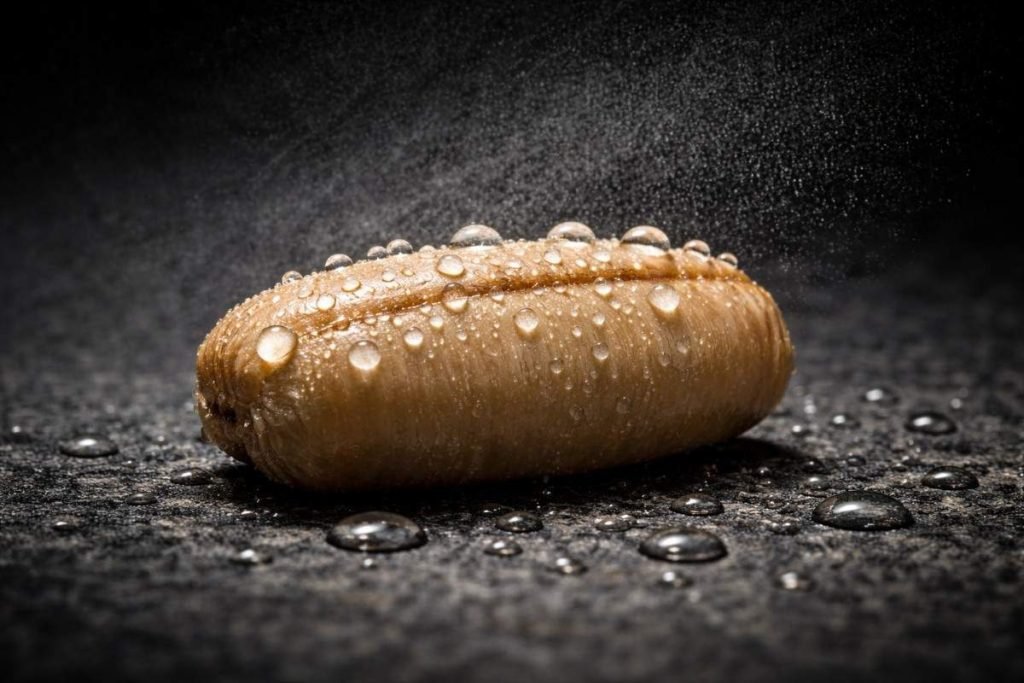
Dr. Dini Miller at Virginia Tech has noted that the German cockroach ootheca’s protein matrix provides more effective pesticide resistance than the egg cases of most other domestic cockroach species, partly because the German roach’s smooth, compact casing has fewer surface irregularities where chemical residues could accumulate.
The Carrying Behavior Shield
Because German cockroach females carry their oothecae until shortly before hatching, the eggs receive an additional layer of protection. The mother’s body shields the case from surface treatments, and her mobility means the eggs never sit in one treatable location long enough for residual pesticides to act.
This is a fundamentally different challenge from treating American cockroach eggs, which are deposited and stationary for weeks. German roach eggs are essentially mobile targets until the final 24–36 hours before hatching.
The Timing Gap
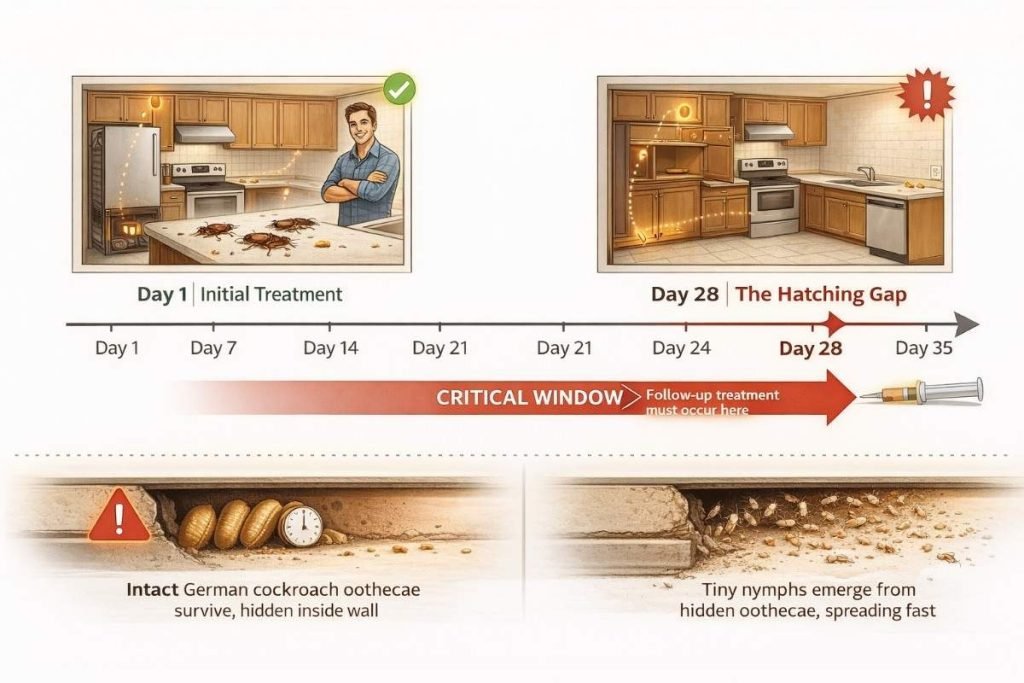
Even after successful treatment kills every visible adult, egg cases deposited in hidden crevices days or weeks earlier continue developing. German cockroach eggs hatch in approximately 28 days. If you don’t apply follow-up treatment within that window, a new generation of nymphs emerges into an untreated environment, and the infestation rebounds.
This 28-day hatching cycle is why pest control professionals universally recommend at least one follow-up treatment 3–4 weeks after the initial application.
How to Stop German Roaches From Producing More Eggs
Destroying existing egg sacs solves the immediate problem. Preventing new ones requires eliminating the conditions that support German cockroach breeding in the first place.
Target Reproductive Females First
Every female German cockroach you remove from the population prevents 120–384 potential offspring. Prioritize control measures that reach breeding-age females:
Place gel baits in harborage areas where females nest, not just along baseboards where scouts forage.
Use sticky traps to monitor which areas show the highest female activity.
Pay special attention to any roach spotted carrying an ootheca. That’s your highest-value target.
Deploy IGRs for Long-Term Suppression
Insect growth regulators remain the most effective tool for breaking the German cockroach reproductive cycle chemically. Gentrol Point Source stations placed in kitchens and bathrooms create a zone of reproductive disruption that:
Causes females to produce malformed, nonviable oothecae
Prevents nymphs from molting into fertile adults
Reduces population growth even when some adults survive treatment
Replace IGR stations every 90 days for continuous protection.
Eliminate Environmental Support
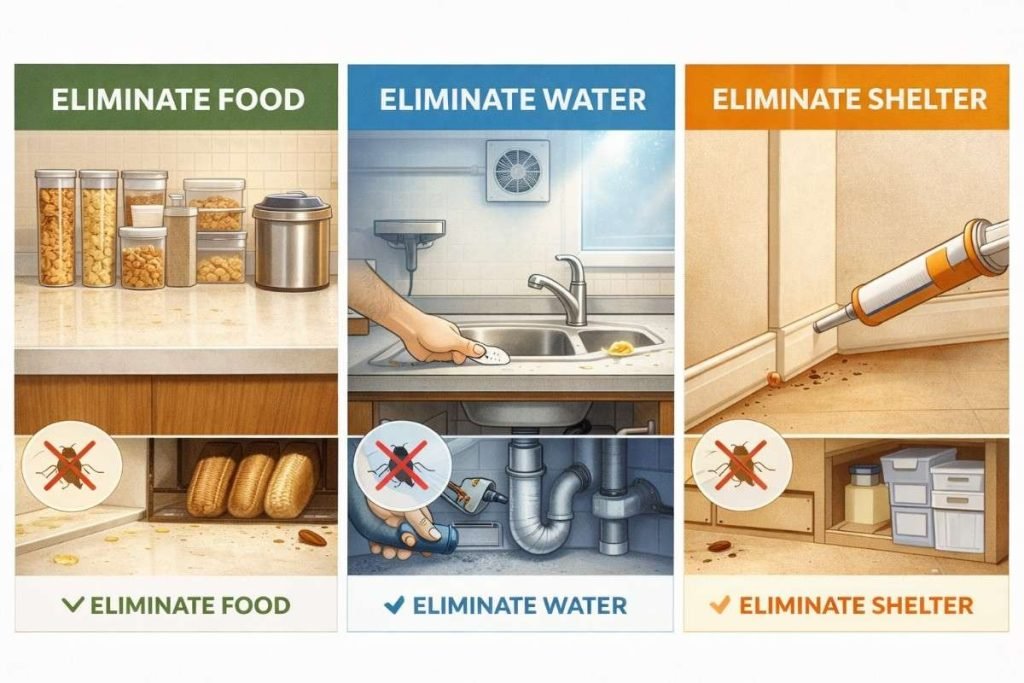
German cockroaches require three things to sustain a breeding population: food, water, and shelter. Remove any one of these, and reproductive success drops sharply.
Food control:
Clean all kitchen surfaces nightly. Crumbs and grease residue are primary food sources.
Store all food in sealed, airtight containers.
Empty trash cans daily. Use cans with tight-fitting lids.
Don’t leave pet food bowls out overnight.
Moisture control:
Fix every leaking faucet and pipe. German cockroaches can survive about a month without food but only one week without water.
Wipe down sinks and counters before bed.
Use exhaust fans in bathrooms to reduce humidity.
Address condensation on pipes with foam insulation sleeves.
Shelter elimination:
Seal cracks around baseboards, cabinets, and pipe penetrations with caulk.
Remove unnecessary cardboard and paper; these are both food sources and harborage.
Organize storage areas so nothing stays undisturbed for weeks.
Pull appliances away from walls periodically for inspection and cleaning.
Follow-Up Treatment Schedule
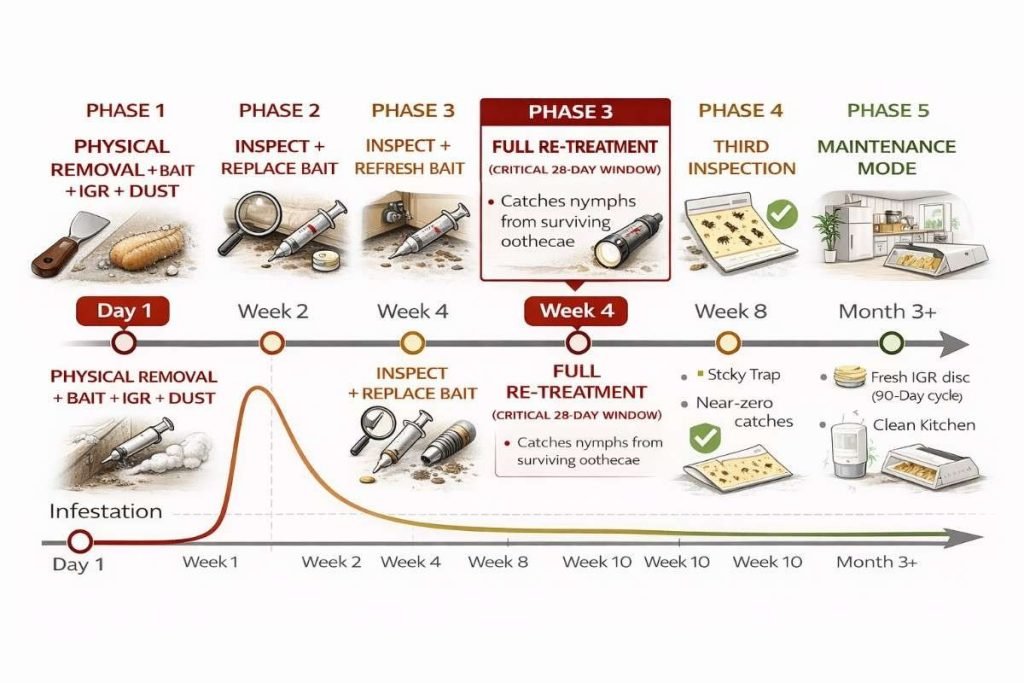
For a German cockroach infestation confirmed by egg sac discovery, follow this timeline:
1. Day 1: Physical removal of all visible oothecae. Place gel baits and IGR stations. Apply boric acid or DE dust into cracks and crevices.
2. Week 2: Inspect and replace consumed bait dots. Vacuum new fecal evidence.
3. Week 4: Full re-inspection and second treatment application to catch newly hatched nymphs from any missed egg cases.
4. Week 8: Third inspection. By now, surviving eggs from the initial infestation period should have hatched. If sticky traps show zero or near-zero captures, the population is collapsing.
5. Month 3+: Maintain IGR stations and monitoring traps. Continue sanitation protocols indefinitely.
Pro Tip: If monitoring traps still show egg-carrying females after 8 weeks of treatment, consider calling a licensed pest control professional. Companies like Rentokil-Terminix and EcoGuard Pest Management use commercial-grade products and resistance management protocols that outperform consumer-grade treatments, especially against established German cockroach colonies showing signs of pesticide resistance.
Frequently Asked Questions
What does a German roach egg sac look like?
A German cockroach ootheca is a small, light tan to brown, purse-shaped capsule about 5–9 mm long (¼ inch). It has a smooth, leathery texture and a visible ridged seam (keel) along one edge. Females carry it protruding from the tip of their abdomen.
How many eggs are inside a German roach egg case?
Each German cockroach ootheca contains 30 to 48 eggs, with an average of about 37. A single female produces 4–8 egg cases in her lifetime, meaning one roach can generate over 300 offspring if left unchecked.
How long does it take German roach eggs to hatch?
German cockroach eggs incubate for approximately 28 days. The female carries the ootheca for most of this period, dropping it 24–36 hours before the nymphs emerge through the keel suture line.
Can bug spray kill German roach eggs?
Most contact sprays cannot penetrate the ootheca’s protective protein shell. Standard aerosol insecticides kill adults but leave eggs unharmed. Insect growth regulators (IGRs) like Gentrol are specifically designed to disrupt egg development and are far more effective against oothecae.
Where do German roaches hide their egg sacs?
German cockroaches drop oothecae in dark, warm, humid crevices close to food and water. Common locations include kitchen cabinet hinges, behind refrigerators, under sinks, inside electrical outlet covers, and in cracks along baseboards. They prefer spots within three feet of a water source.
Do German roaches drop eggs when killed?
A female carrying an ootheca may release it when crushed or stressed. The egg case doesn’t burst; it detaches as an intact capsule. Always check around any killed female cockroach for a dropped ootheca and destroy it separately.
How can I tell if a German roach egg sac has already hatched?
A hatched ootheca appears lighter in color and slightly collapsed or flattened, and the keel suture line will be visibly split open. An intact, plump, dark tan case likely still contains developing embryos or is ready to hatch soon.
Key Takeaways
The German roach egg sac is a small capsule with enormous consequences. Here’s what you need to remember:
Identification is straightforward once you know what to look for. A light tan, purse-shaped capsule about ¼ inch long with a ridged keel. If you see a roach carrying one on her abdomen, you’ve confirmed an active German cockroach breeding population.
Each egg case holds 30–48 potential cockroaches. With females producing 4–8 oothecae across their 100–200-day adult lifespan, a single breeding female can seed an infestation of hundreds. The math explains why German cockroach populations explode so rapidly.
The protective shell resists most pesticides. Contact sprays and foggers won’t kill eggs inside the ootheca. Effective elimination requires physical removal, insect growth regulators, gel baits targeting egg-carrying females, and residual dusts to intercept emerging nymphs.
Follow-up treatment at 4 weeks is non-negotiable. The 28-day incubation period means eggs deposited before your initial treatment hatch into a fresh generation of nymphs. Missing this window allows the cycle to restart.
Prevention means eliminating food, water, and shelter. Seal cracks, fix leaks, clean religiously, and remove cardboard and clutter. Without these resources, German cockroaches can’t sustain a breeding population, no matter how many eggs they produce.
Don’t underestimate that tiny tan capsule. Every day, an intact German cockroach ootheca sits undiscovered in your home, bringing it closer to releasing dozens of nymphs that will mature, breed, and produce egg sacs of their own within weeks. Inspect your kitchen and bathroom tonight, destroy every egg case you find, and put a treatment plan in place before that 28-day clock runs out.