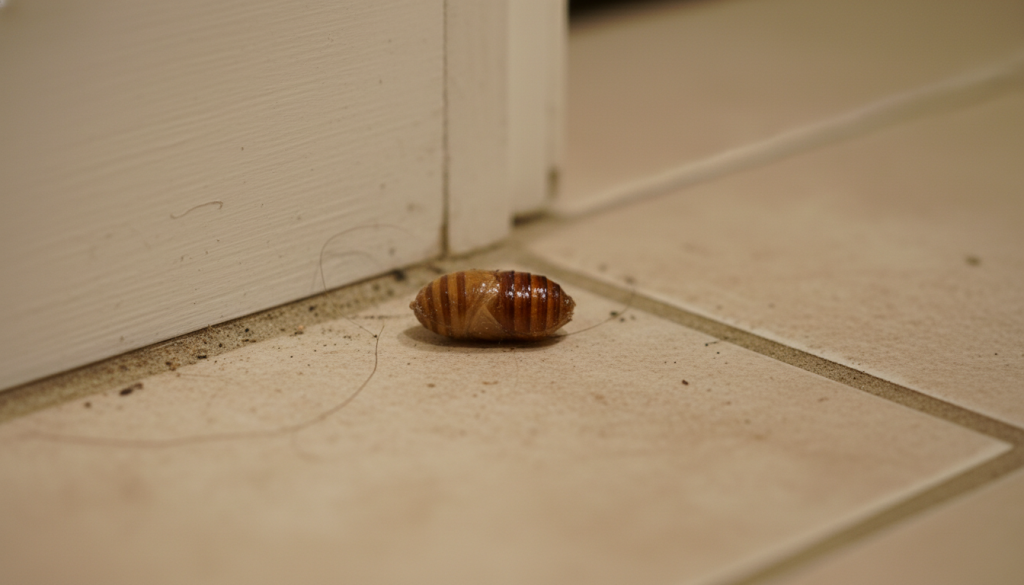
Roach eggs and pantry moth eggs look different in structure, size, color, and placement. Roach eggs are usually found inside a brown capsule-shaped egg case called an ootheca, while pantry moth eggs are tiny whitish or grayish-white individual eggs laid on or near stored foods such as flour, cereal, grains, nuts, dried fruit, bird seed, and pet food.
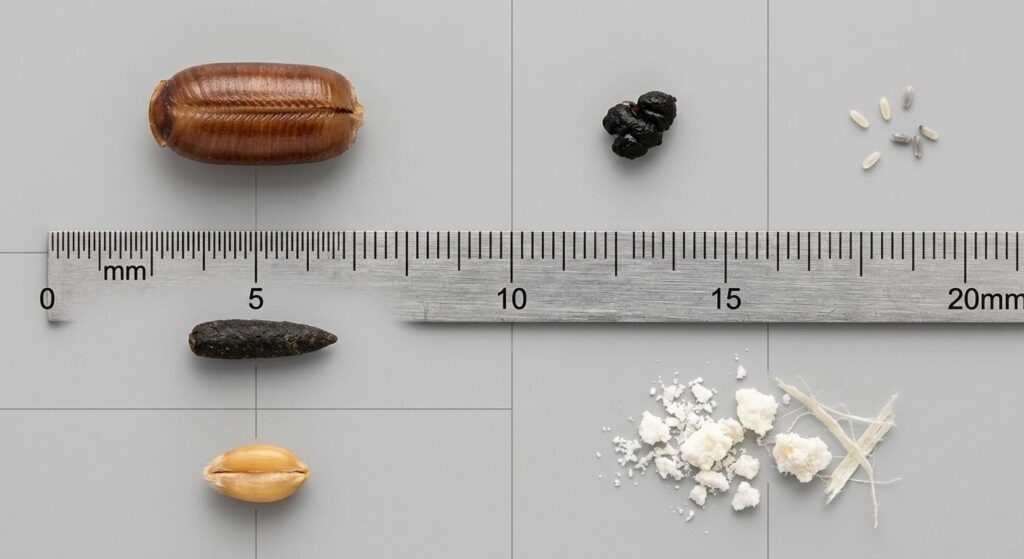
The fastest way to tell them apart is structure. A roach egg case is a visible brown capsule that may measure about 5–10 mm long, depending on the cockroach species. Pantry moth eggs are much smaller, usually about 0.3–0.5 mm for Indianmeal moths, and they are difficult to see without magnification.
Correct identification matters because the source is different. Roach eggs usually point to cockroach harborages near food, water, warmth, and shelter. Pantry moth eggs usually point to an infested dry food product, spilled grain, pet food bag, bird seed container, or forgotten pantry item.
Quick Comparison: Roach Eggs vs Pantry Moth Eggs
| Feature | Roach Eggs / Oothecae | Pantry Moth Eggs |
| Main structure | Multi-egg capsule called an ootheca | Individual eggs laid singly or in clusters |
| Typical size | About 5–10 mm long depending on species | About 0.3–0.5 mm for Indianmeal moth eggs |
| Color | Tan, brown, reddish-brown, dark brown, or blackish | White, whitish, grayish-white, or dirty white |
| Shape | Capsule-shaped, purse-shaped, bean-shaped, or pill-like | Tiny oval, flattened, or speck-like |
| Texture | Firm, leathery, sometimes ridged with a seam | Tiny, delicate, hard to see without magnification |
| Egg count | One ootheca can contain 10–50 eggs depending on species | Females may lay dozens to hundreds of eggs on food materials |
| Common locations | Cabinets, appliance gaps, sinks, drains, bathrooms, basements, cardboard, cracks | Flour, cereal, rice, cornmeal, nuts, dried fruit, pet food, bird seed, chocolate, spices, food packaging seams |
| Main damage sign | Roach droppings, egg cases, nymphs, musty odor, live roaches | Webbing in food, larvae in packages, moths flying in pantry, clumped grains |
| Best first action | Remove oothecae and inspect roach harborages | Locate and discard or heat/freeze infested food source |
For a full cockroach egg identification guide, see our article on what roach eggs look like.
Roach Eggs Are Usually Brown Oothecae
Roach eggs are usually enclosed inside a protective egg case called an ootheca. The ootheca is a hardened capsule that protects multiple cockroach embryos inside one visible structure.
Most homeowners do not find loose cockroach eggs. They find the ootheca, which may look like a tiny brown purse, seed, bean, pill, or capsule. This is why people often say “roach eggs” when they actually mean the egg case.
A typical roach egg case has these identifying features:
- Brown color: tan, amber, reddish-brown, dark brown, or blackish depending on species and age.
- Capsule shape: elongated, purse-shaped, bean-like, or slightly rectangular with rounded ends.
- Visible size: usually large enough to see and pick up without magnification.
- Protective seam: many oothecae have a ridge or seam where nymphs emerge.
- Hidden placement: common near dark, warm, protected spaces with food and moisture access.
If you need the basic biology behind cockroach oothecae, read our guide on what roach eggs are.
Pantry Moth Eggs Are Tiny Pale Eggs on or Near Food
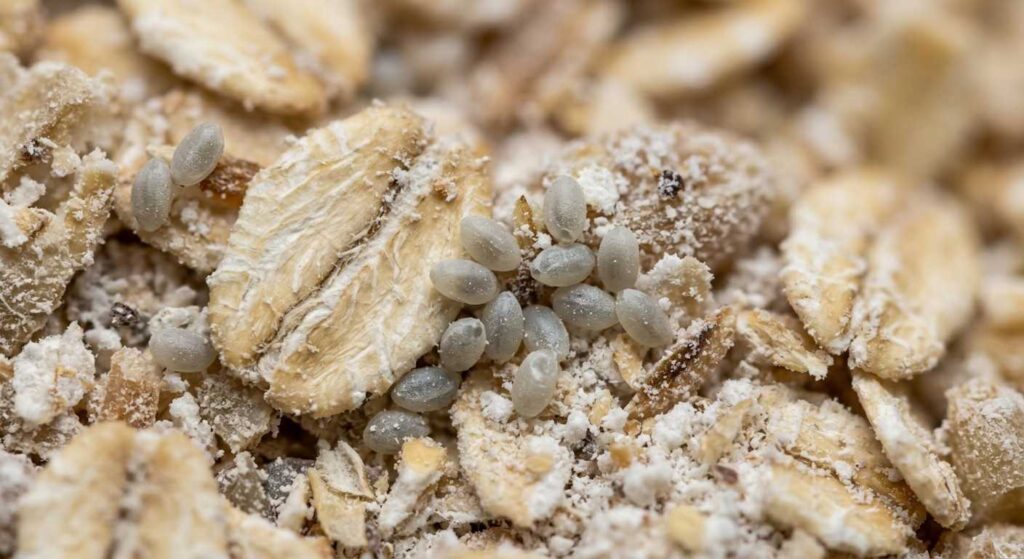
Pantry moth eggs are tiny individual eggs laid on or near stored food products. The most common pantry moth in homes is the Indianmeal moth, Plodia interpunctella, a stored-product pest whose larvae feed on grains, grain products, seeds, dried fruit, dog food, and spices.
The University of Florida IFAS Extension describes Indianmeal moth eggs as grayish-white and 0.3–0.5 mm long. IFAS also notes that eggs are laid singly or in clusters, generally directly on the larval food source University of Florida IFAS.
University of Wisconsin Extension explains that female Indian meal moths lay 40–350 eggs singly or in groups on or adjacent to food materials, and that the eggs are white, flattened sideways, and too small to be easily seen with the naked eye University of Wisconsin Extension.
This means pantry moth eggs are rarely the first sign people notice. Most homeowners first notice adult moths flying near the pantry, webbing inside food, or small off-white larvae crawling away from the food source.
Size Difference: Roach Egg Cases Are Much Larger
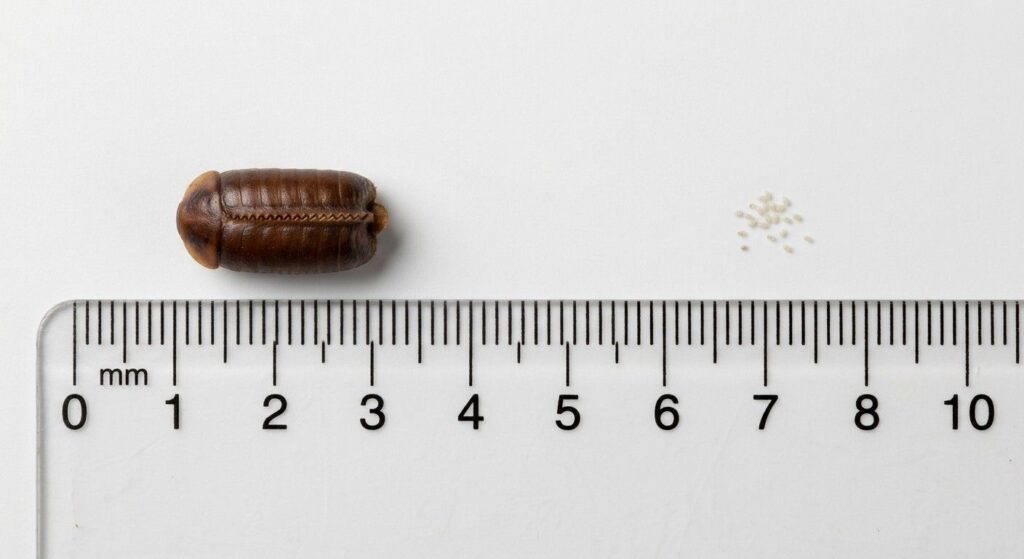
Size is the clearest difference between roach eggs and pantry moth eggs. Roach egg cases are several millimeters long, while pantry moth eggs are fractions of a millimeter.
Common roach ootheca sizes include:
- German roach eggs: about 6–9 mm long.
- American roach eggs: about 8–10 mm long.
- Oriental roach eggs: about 8–10 mm long.
- Brown-banded roach eggs: about 5 mm long.
Indianmeal moth eggs are much smaller, usually about 0.3–0.5 mm long. Colorado State University describes Indian meal moth eggs as small, about 1/2 mm Colorado State University.
Simple Size Rule
If the object is a brown capsule about the size of a small rice grain, seed, or tiny bean, it is more likely a roach egg case. If the object is a tiny pale speck on flour, cereal, grain, or packaging, it is more likely a pantry moth egg or stored-product pest evidence.
Color Difference: Roach Eggs Are Brown, Pantry Moth Eggs Are Pale
Roach eggs and pantry moth eggs usually differ by color. Roach oothecae are usually brown or dark, while pantry moth eggs are pale and easy to miss against flour, cereal dust, or grain particles.
Roach egg cases may appear:
- Light tan
- Amber
- Brown
- Reddish-brown
- Dark brown
- Nearly black when old or species-specific
Pantry moth eggs may appear:
- White
- Whitish
- Grayish-white
- Dirty white
- Pale and speck-like
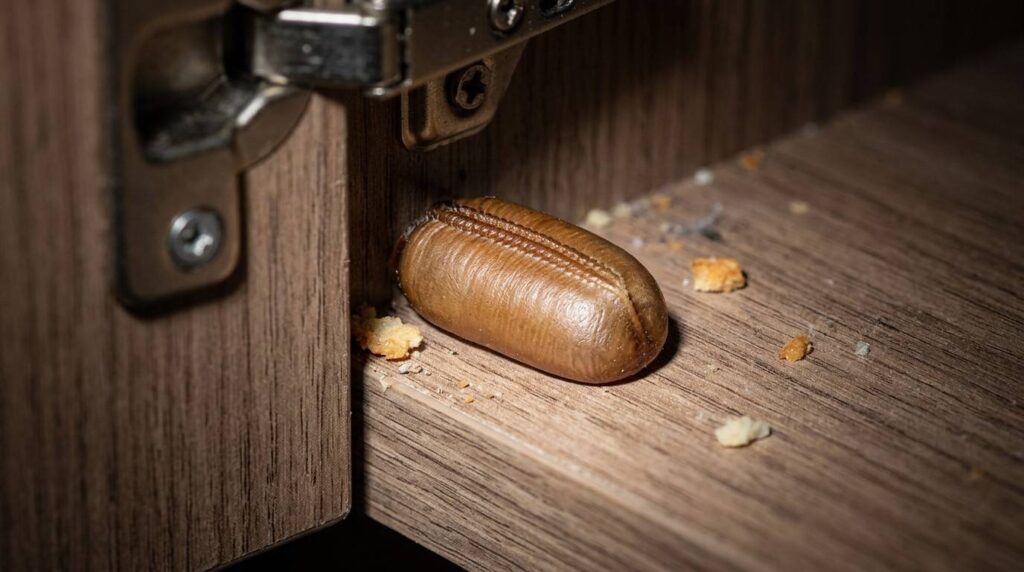
A brown capsule in a cabinet hinge or behind an appliance is more consistent with a roach ootheca. Pale specks on stored food are more consistent with pantry moth eggs, flour beetle eggs, grain pest eggs, dust, or food particles.
Do not rely on color alone. Flour dust, packaging fibers, crumbs, and mold can all create confusing pale specks in dry foods.
Shape Difference: Roach Eggs Look Like Capsules, Pantry Moth Eggs Look Like Tiny Specks
Roach egg cases have a capsule-like shape because the ootheca encloses multiple eggs. Many oothecae look like tiny purses, beans, flattened pills, or ridged cases.
Pantry moth eggs are individual eggs. They are tiny, oval or flattened, and often look like pale specks rather than a recognizable egg shape. Because they are so small, people usually identify pantry moth infestations by larvae, webbing, or flying moths rather than by seeing the eggs themselves.
Roach Egg Shape Clues
A roach egg case often has:
- A firm capsule body
- Brown coloration
- A visible seam or ridge
- A bean-like or purse-like profile
- A size large enough to see without magnification
Pantry Moth Egg Shape Clues
Pantry moth eggs often have:
- Tiny oval or flattened shape
- Whitish or grayish-white color
- Placement on or near dry food
- No large protective capsule
- Visibility only under close inspection or magnification
Location Difference: Roach Eggs Are Hidden Near Food, Water, Warmth, and Shelter
Roach egg cases are usually hidden in protected locations near food, water, and warmth. Kitchens are common, but roaches also lay eggs in bathrooms, basements, laundry rooms, wall cracks, cardboard, and cluttered storage.
Inspect these locations for roach oothecae:
- Behind refrigerators, stoves, dishwashers, and microwaves
- Under kitchen sinks and bathroom sinks
- Inside cabinet corners, hinges, and drawer tracks
- Around pipes, drains, and plumbing gaps
- Along baseboards and wall cracks
- Inside cardboard boxes and paper bags
- Near garbage cans and recycling areas
- Behind or inside appliances and electronics
- In damp basement corners or laundry areas
Rutgers NJAES explains that German cockroaches are mostly found in kitchens and bathrooms where food and water are available, with common harborages around stoves, refrigerators, cabinets, drawers, and sinks Rutgers NJAES.
If the suspected egg case is in your kitchen, use our detailed inspection guide on how to find cockroach eggs in the kitchen.
Location Difference: Pantry Moth Eggs Are Laid on Stored Foods
Pantry moth eggs are usually laid directly on or near larval food materials. That location is the biggest clue.
Common pantry moth egg and larval food sources include:
- Flour
- Cornmeal
- Rice
- Oats
- Cereal
- Pasta
- Crackers
- Cookies
- Bread crumbs
- Dried fruit
- Nuts
- Seeds
- Bird seed
- Dry dog food
- Dry cat food
- Fish food
- Powdered milk
- Chocolate
- Spices and dried peppers
- Herbal tea
- Decorative dried plant material
Oklahoma State University Extension states that Indianmeal moth larvae infest stored grains, flour, cornmeal, nuts, dried fruits, powdered milk, candy, chili pepper, fish food, dry dog and cat food, seeds, and chocolate Oklahoma State University Extension.
University of Wisconsin Extension also notes that eggs may be placed directly on the exterior of packaging material, which means a sealed-looking package can still be part of the infestation if eggs or larvae are present around seams or damaged packaging University of Wisconsin Extension.
Simple Location Rule
A brown capsule behind an appliance usually points toward roaches. Tiny pale eggs, webbing, or larvae inside flour, grain, nuts, cereal, pet food, or bird seed usually point toward pantry moths.
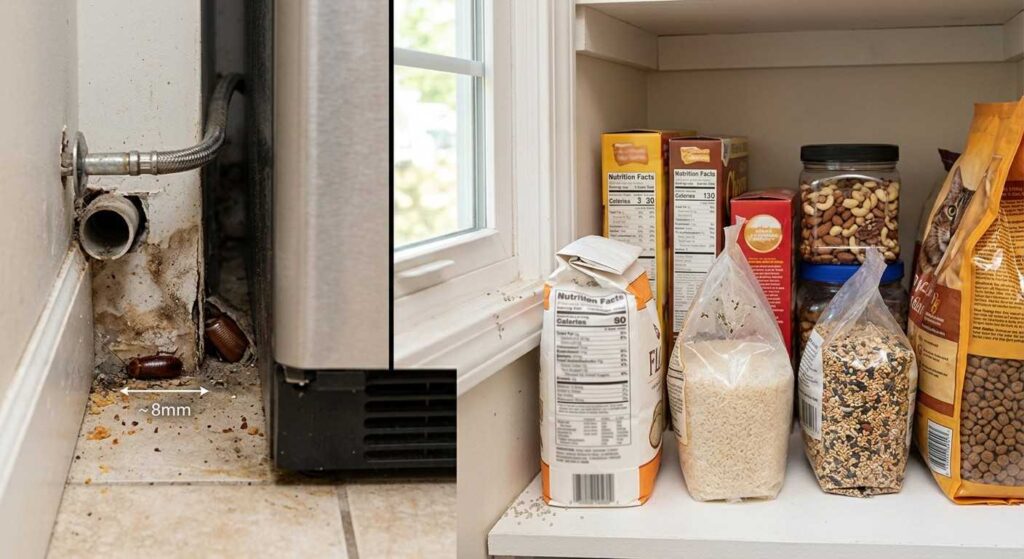
Damage Signs: Roaches Leave Droppings and Oothecae, Pantry Moths Leave Webbing
Roach activity and pantry moth activity create different evidence patterns. Use the surrounding signs to confirm what you are seeing.
Signs That Support Roach Eggs
Roach egg cases are more likely if you also find:
- Pepper-like droppings or dark cylindrical droppings
- Musty or oily odor in cabinets or under sinks
- Live roaches at night
- Small pale nymphs near cracks or appliances
- Shed skins
- Brown capsule-shaped oothecae
- Activity near water, grease, crumbs, or garbage
If you found dark specks and are not sure whether they are eggs, read our guide: Are black dots roach eggs?
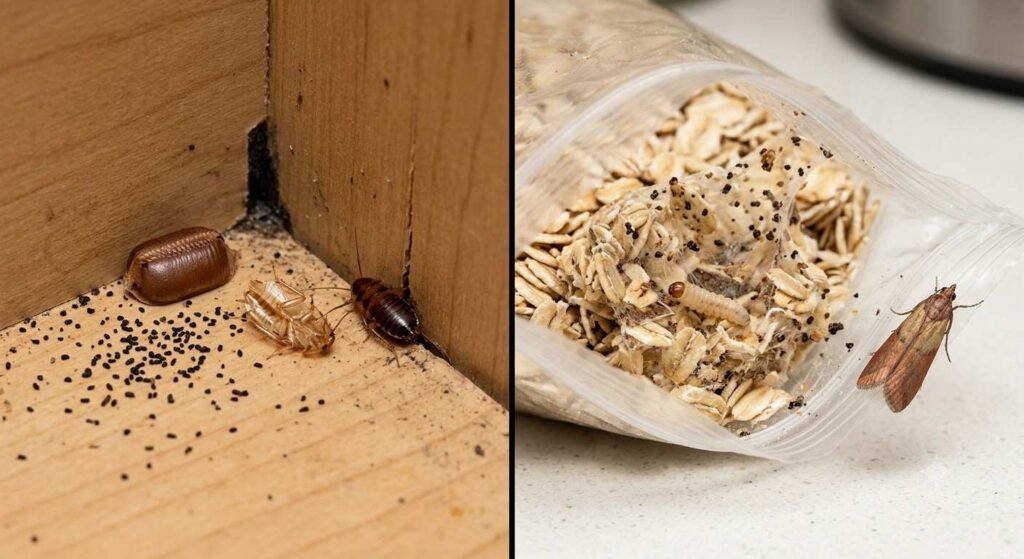
Signs That Support Pantry Moth Eggs
Pantry moth eggs are more likely if you also find:
- Small moths flying near pantry shelves
- Webbing inside food packages
- Clumped flour, grain, cereal, or nuts
- Off-white caterpillar-like larvae with brown heads
- Larvae crawling on walls, ceilings, or pantry shelves
- Cocoons in package seams, cracks, or shelf corners
- Frass and food debris stuck in silk webbing
University of Florida IFAS notes that Indianmeal moth larvae cause stored-product damage by spinning silk that accumulates fecal pellets, cast skins, and eggshells in food products University of Florida IFAS.
Reproductive Difference: One Roach Ootheca Holds Many Eggs, Pantry Moths Scatter Eggs on Food
Roaches and pantry moths reproduce in different ways. Cockroaches use a protective egg capsule. Pantry moths lay tiny eggs directly on the food their larvae will eat.
A German cockroach ootheca can contain about 40 eggs. Rutgers NJAES states that a typical German cockroach egg case contains about 40 eggs and is carried by the female until just before hatch Rutgers NJAES.
An American cockroach ootheca contains fewer eggs. University of Florida IFAS states that American cockroach females lay 16 eggs per egg case and that the case is brown when deposited, turning black in a day or two University of Florida IFAS American cockroach profile.
Pantry moths do not use a roach-like ootheca. Oklahoma State University Extension states that female Indianmeal moths can lay 200–400 eggs over 1–18 days, and the eggs hatch in 2–14 days Oklahoma State University Extension.
The practical difference is simple: one roach ootheca is a concentrated capsule of multiple embryos, while pantry moth eggs are tiny and distributed on or near food materials.
Roach Eggs vs Pantry Moth Larvae: A Common Mix-Up
Many homeowners do not see pantry moth eggs. They see larvae and mistake them for “eggs” or maggots.
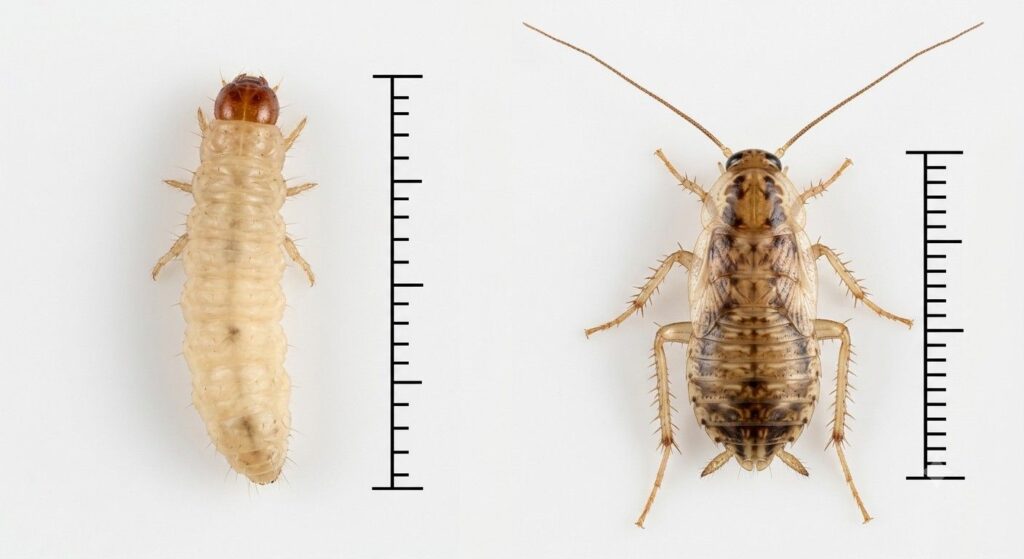
Pantry moth larvae are small caterpillars. They are usually off-white, cream, pinkish, greenish, or yellowish depending on food source, with a brown head. Mature larvae may crawl away from food and appear on walls, ceilings, shelves, or package edges.
Roach nymphs look like tiny roaches, not worms. Freshly hatched cockroach nymphs may be pale at first, but they soon darken and develop the flattened roach body shape.
Use this distinction:
- Worm-like larva in cereal or pet food: likely pantry moth or another stored-product pest.
- Small roach-shaped nymph near appliance cracks: likely cockroach reproduction.
- Brown capsule in a dark cabinet gap: likely roach ootheca.
- Silk webbing in food: likely pantry moth larvae.
Are Pantry Moth Eggs Found in Kitchen Cabinets?
Yes. Pantry moth eggs can be found in kitchen cabinets, but they are usually tied to stored food, food dust, or packaging rather than plumbing gaps or appliance harborages.
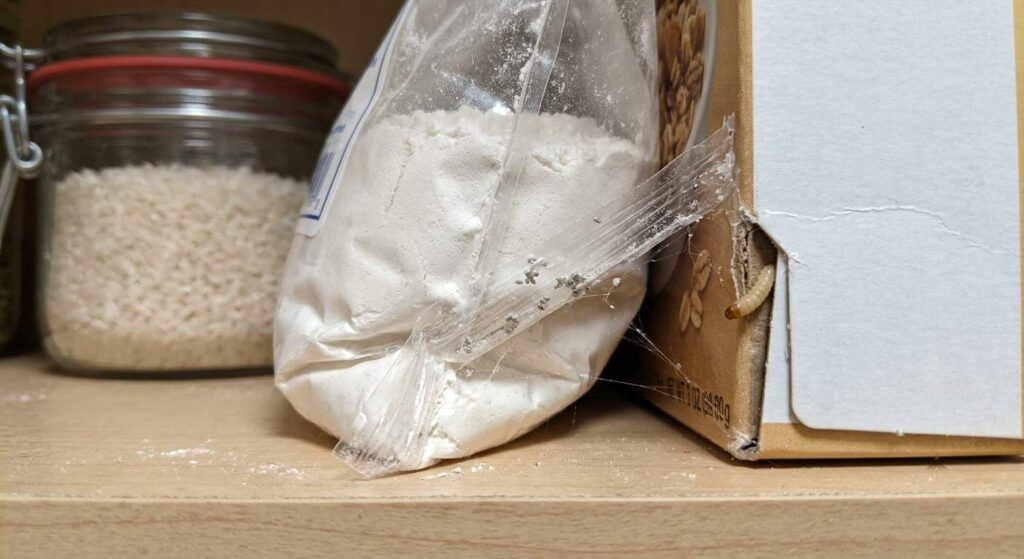
A pantry shelf with flour dust, spilled grain, cereal crumbs, old bird seed, or pet food residue can support pantry moth eggs and larvae. Pantry moth larvae can also leave the food source and pupate in cracks, package seams, folded materials, or shelf corners.
University of Wisconsin Extension notes that Indian meal moth cocoons are often found in package seams, cracks and crevices, folded napkins, or other protected sites University of Wisconsin Extension.
This means you should inspect both the food source and nearby protected pupation sites.
Are Roach Eggs Found in Flour or Cereal?
Roach egg cases are not usually laid inside flour or cereal the way pantry moth eggs are laid on food. Cockroaches may contaminate food areas with droppings, shed skins, and bacteria, but their oothecae are more commonly hidden in cracks, crevices, cabinet voids, appliance gaps, and protected surfaces.
If you find webbing, larvae, or pale specks inside dry food, pantry moths or another stored-product pest are more likely than roach eggs. If you find a brown capsule attached or tucked into a cabinet hinge, drawer track, or appliance gap near food storage, roaches are more likely.
What to Do If You Find Roach Eggs
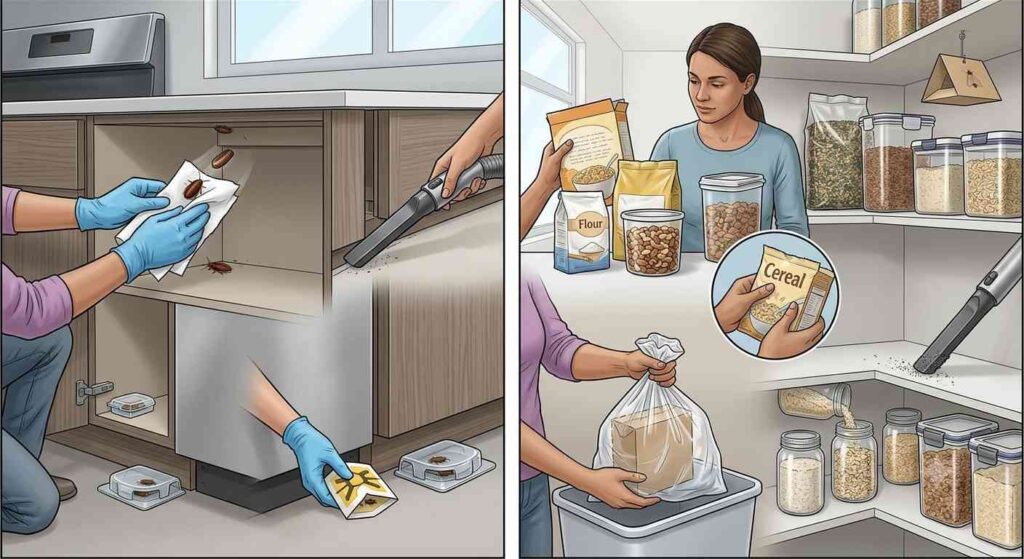
If you find a roach egg case, remove it carefully and inspect the surrounding area for more egg cases, nymphs, droppings, and live adults.
Use this roach response plan:
- Photograph the object first so you can compare size, shape, and color.
- Pick it up with tape, gloves, or a paper towel instead of crushing it into the surface.
- Seal it in a plastic bag and dispose of it outdoors.
- Vacuum cracks, cabinet corners, and appliance gaps.
- Remove crumbs, grease, cardboard, moisture, and clutter.
- Place sticky monitors near suspected roach harborages.
- Use baits and insect growth regulators where appropriate.
- Continue monitoring for several weeks because hidden oothecae may still hatch.
For treatment options, read our full guide on what kills roaches and their eggs. If the ootheca looks light tan and you suspect German cockroaches, read our German roach eggs guide.
What to Do If You Find Pantry Moth Eggs or Larvae
If you find pantry moth eggs, larvae, or webbing, the main goal is source removal. Spraying shelves without finding the infested food source usually fails.
Use this pantry moth response plan:
- Inspect every susceptible food item, including unopened paper, cardboard, and thin plastic packaging.
- Check pet food, bird seed, dried fruit, nuts, cereal, grains, spices, and decorative dried plant materials.
- Discard heavily infested products in a sealed outdoor trash bag.
- Freeze questionable items if you want to salvage them and the product allows it.
- Vacuum shelves, corners, cracks, and package debris thoroughly.
- Wash shelves with soap and water after vacuuming.
- Transfer safe food into airtight glass or hard plastic containers.
- Use pheromone traps for monitoring adults, not as the only control method.
- Keep watching for moths for several weeks because pupae may be hidden away from the food source.
Oklahoma State University Extension recommends locating the infestation source, examining susceptible foods, transferring apparently uninfested contents into tight containers, cleaning cracks and corners, and avoiding insecticide use for Indian meal moth control Oklahoma State University Extension.
Can Pantry Moth Eggs Survive in Sealed Packages?
Pantry moth eggs and larvae can be associated with packaging if the product was already infested or if larvae entered through seams, holes, or weak packaging. Eggs may also be laid on or near exterior packaging surfaces.
University of Wisconsin Extension notes that eggs may be placed directly on the exterior of packaging material. It also warns that Indian meal moth larvae can chew through lightweight plastics, so airtight glass jars and hard plastic containers are better for storage University of Wisconsin Extension.
This is why unopened pantry items should still be inspected during an active infestation, especially paper boxes, cardboard cartons, thin plastic bags, and products with seams.
Common Mistakes When Comparing Roach Eggs and Pantry Moth Eggs
Misidentification usually happens when people focus on one clue instead of the whole evidence pattern. Size, color, shape, location, and surrounding signs should be evaluated together.
Mistake 1: Calling Every Pale Speck an Egg
Flour dust, sugar crystals, grain fragments, salt, packaging fibers, and crumbs can look like tiny eggs. Pantry moth eggs are very small and are usually confirmed by finding larvae, webbing, or adult moths nearby.
Mistake 2: Calling Webbing “Roach Eggs”
Roaches do not create silk webbing in dry food. Webbing in flour, cereal, nuts, bird seed, or pet food strongly suggests pantry moth larvae or another stored-product pest.
Mistake 3: Spraying Pantry Shelves Without Removing Food Sources
Pantry moth control depends on locating and removing the infested product. Residual spraying on shelves does not solve the problem if eggs and larvae remain inside food packages.
Mistake 4: Ignoring Brown Capsules Near Food Storage
A pantry can have both roaches and pantry moths. Brown capsule-shaped cases near cabinet hinges, appliance gaps, or shelf cracks should be treated as possible roach oothecae even if pantry moths are also present.
Mistake 5: Assuming Flying Moths Mean Roaches Are Gone
Flying pantry moths and cockroach activity can occur in the same kitchen. Adult moths point to stored-food inspection, while roach egg cases point to crack-and-crevice inspection near food, water, and warmth.
Final Verdict: How to Tell the Difference Fast
Roach eggs vs pantry moth eggs can be separated quickly by structure, size, color, and location. Roach eggs are usually brown oothecae: visible capsule-shaped cases about 5–10 mm long, hidden in cabinets, appliance gaps, sinks, drains, bathrooms, basements, cardboard, and cracks. Pantry moth eggs are tiny pale individual eggs, often about 0.3–0.5 mm for Indianmeal moths, laid on or near stored food products.
If the object is brown, firm, capsule-shaped, and hidden behind an appliance or inside a cabinet crevice, treat it as a possible roach egg case. If the evidence is tiny pale specks, webbing, larvae, or clumped food inside flour, cereal, nuts, pet food, or bird seed, treat it as a likely pantry moth problem.
The key difference is treatment focus. Roach eggs require roach lifecycle control around harborages. Pantry moth eggs require source removal, pantry sanitation, and airtight food storage.
Frequently Asked Questions
Are roach eggs bigger than pantry moth eggs?
Yes. Roach egg cases are much bigger than pantry moth eggs. A roach ootheca usually measures about 5–10 mm long, while Indianmeal moth eggs are only about 0.3–0.5 mm long.
Are pantry moth eggs brown?
Pantry moth eggs are usually white, whitish, grayish-white, or dirty white. Brown capsule-shaped objects in a pantry are more likely roach oothecae, seeds, droppings, or debris.
Do pantry moths lay eggs in an ootheca like roaches?
No. Cockroaches produce an ootheca, which is a protective egg case containing multiple eggs. Pantry moths lay individual eggs singly or in clusters on or near food materials.
Can pantry moth eggs be seen with the naked eye?
Pantry moth eggs can be technically visible, but they are very difficult to see because they are tiny and pale. Most homeowners notice larvae, webbing, clumped food, or adult moths before they notice eggs.
Can roach eggs be found in cereal or flour?
Roach egg cases are not usually laid directly inside cereal or flour. If you see webbing, larvae, or pale eggs in dry food, pantry moths or another stored-product pest are more likely. Roaches usually hide oothecae in cracks, cabinet voids, appliance gaps, and protected surfaces.
What looks like pantry moth eggs but is not?
Flour dust, sugar, salt, food crumbs, grain fragments, mold, packaging fibers, and mite activity can look like tiny pale eggs. Look for supporting signs such as webbing, larvae, adult moths, or clumped food.
What looks like roach eggs but is not?
Seeds, mouse droppings, roach droppings, beetle cases, food particles, and old insect shells can resemble roach eggs. A true roach ootheca usually has a brown capsule shape and may show a seam or ridge.
Should I throw away food if I find pantry moth eggs?
Heavily infested food should be sealed and discarded outdoors. Questionable dry foods can sometimes be frozen or heated if the product allows it, but all packaging and shelf cracks should still be cleaned to remove hidden eggs, larvae, and pupae.
Can pantry moths and roaches infest the same kitchen?
Yes. Pantry moths can infest stored dry food, while roaches hide near water, grease, crumbs, appliances, and cabinet voids. A complete kitchen inspection should check both food packages and roach harborage.