
Roach eggs: identify what you found, then get rid of it.
That small brown capsule behind your fridge is almost certainly an ootheca, a hard-shelled case holding up to 48 eggs. Which species it belongs to tells you how many roaches are coming and how long you have. Start with size and color, then work down the page.
First, rule out the look-alikes
Most people who think they’ve found roach eggs have found something else. Three quick checks settle it before you spend money on treatment.
Roach eggs come in one sealed case, roughly the size of a rice grain. Scattered black grains that look like ground pepper are droppings, not eggs.
Bed bug eggs are pale, about 1 mm, and laid individually. If you can see a distinct brown capsule without squinting, you’re not looking at bed bugs.
Termite eggs sit deep inside colonies and you almost never see them. A case wedged behind a cabinet hinge points to roaches.
Similar in size, but droppings are pointed at the ends and crumble under pressure. An ootheca holds its shape.
Found in flour, rice and cereal, and almost too small to see. If it’s in your dry goods, check moths first.
Shed larval skins are hollow, bristly and brittle. Egg cases are solid, smooth and leathery.
What roach eggs actually are: The Basics
You will almost never see a single roach egg. What you find is an ootheca: a leathery capsule a female roach produces to carry and protect her eggs while they develop.
The shell does real work. It keeps the eggs from drying out, absorbs physical damage, and blocks most surface sprays from ever reaching the embryos inside. That last point is why infestations survive treatments that seem to work at first.
The University of Florida IFAS Extension reports that a single German cockroach ootheca can carry 30 to 48 eggs, while other household species typically hold 10 to 28.
Worth repeating: one case is never one roach. Find a single ootheca and you may be looking at dozens.
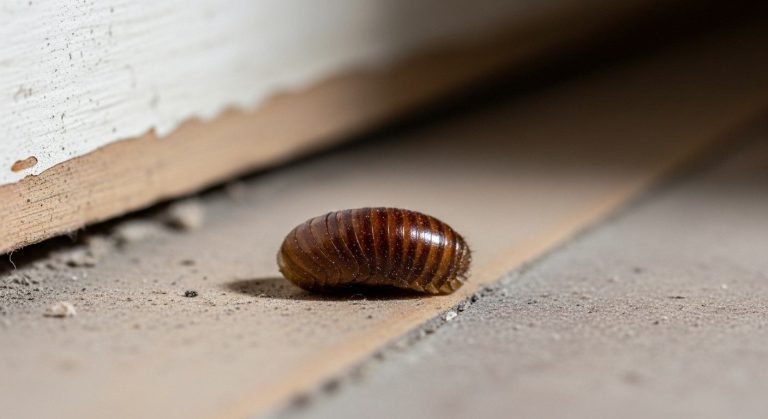
A typical find: an ootheca tucked against a baseboard, where dust and shadow hide it.
What roach eggs look like
Colour and size shift by species and by how close the case is to hatching, but every roach egg case shares the same six traits.
| Trait | What to look for |
|---|---|
| Shape | A capsule, purse or bean form with a ridged seam |
| Size | 5–13 mm a rice grain up to a small bean |
| Colour | Tan, amber, reddish-brown, dark brown or near black |
| Texture | Firm and leathery, sometimes waxy or ridged |
| Seam | A raised line along one edge the exit nymphs push through |
| Location | Wedged into cracks, corners, cardboard, or furniture near food and water |
Swipe the table sideways to see all columns →
Already hatched? Look for a split along the top seam and a dried, hollow feel. An open case means the nymphs are already in your home. Fresh vs mature vs hatched colour guide →
Squeeze test. A fresh case is firm and resists pressure. If it crumbles into dust, it’s droppings or a shed skin. Hard, soft, sticky or brittle? →
Which roach laid it, and what does that cost you
Species is the single most useful thing you can determine. It tells you how many roaches are inside, how long until they hatch, and which rooms to search next.
| Species | Colour | Size | Eggs per case | Hatch time | Usually found in |
|---|---|---|---|---|---|
| German roach | Light brown to tan | 6–9 mm | 30–48 | ~28 days | Kitchens, bathrooms, near food |
| American roach | Dark reddish-brown | ~8 mm | 14–16 | 44–60 days | Basements, sewers, dark voids |
| Oriental roach | Dark brown to black | 8–10 mm | 16 | ~60 days | Damp areas, drains, basements |
| Brown-banded roach | Reddish-brown | ~5 mm | 10–18 | 37–103 days | Furniture, ceilings, bedrooms |
Swipe the table sideways to see all columns →
Close-up identification: colour at each stage, the seam, and how they differ from other tan capsules.
How the female carries it, when she drops it, and what that timing means for your treatment window.
The count per case, per female, per year, and what that compounds to if you wait a month.
Where roaches hide their eggs
Females choose spots that are dark, tight, and close to food, water and warmth, so nymphs survive the moment they hatch. Take a flashlight; most cases sit in gaps that overhead lighting never reaches.
Kitchen
- Behind and under the fridge, stove and microwave
- Inside cabinet hinges, corners and drawer tracks
- Under the sink and around pipe gaps
- Cardboard boxes, paper bags, near the bin
Bathroom
- Under sinks and behind the toilet
- Inside medicine cabinets
- Around plumbing fixtures
- Cracks near the tub and tile edges
Everywhere else
- Behind baseboards, loose trim, peeling wallpaper
- Inside upholstered furniture and electronics
- Behind picture frames and wall decor
- Basements, garages, attics, crawl spaces
Search by species. German roaches stay near kitchen and bathroom moisture. Brown-banded roaches place cases high up, in furniture, ceilings and electronics. American and Oriental roaches prefer damp, below-ground spaces like basements and drains.
Latest from the blog
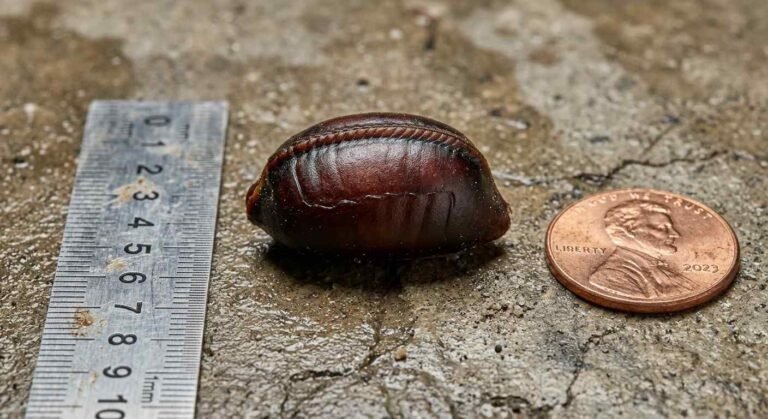
29 July 2026 · Species
American roach eggs sit inside a hardened, purse-shaped case that takes far longer to hatch than a German one. Here’s the full profile.
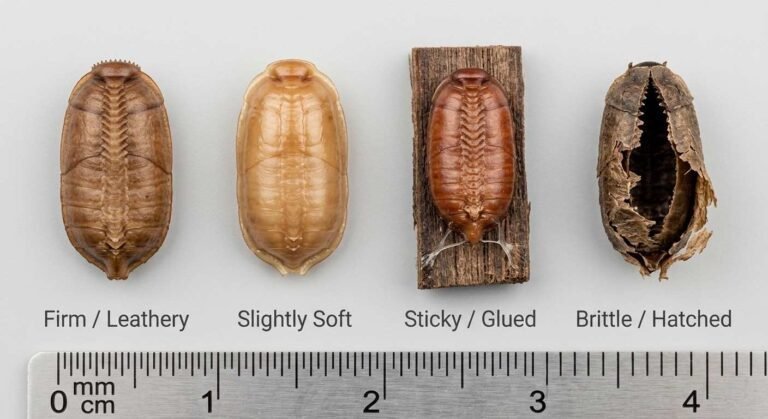
28 July 2026 · Identification
Texture is one of the fastest ways to separate a real egg case from a look-alike. What each feel actually tells you.
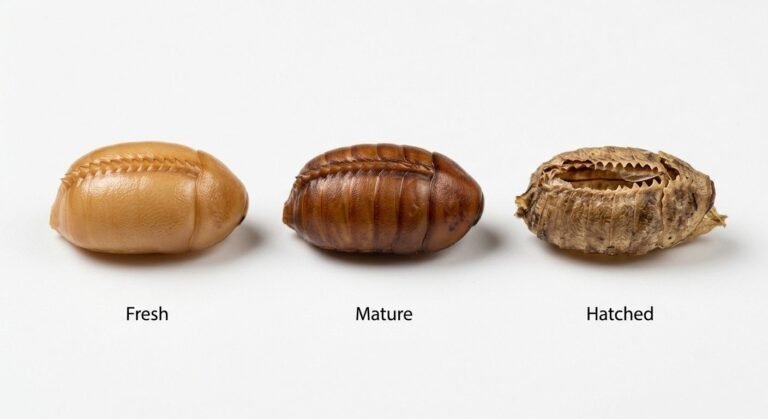
15 July 2026 · Identification
Colour changes as embryos develop, so the shade you’re looking at tells you roughly how long you have.
Why trust RoachEggs.com
RoachEggs.com covers one subject and nothing else: cockroach eggs. That narrow focus is the point — it lets us go deeper than a general pest site can.
Sourced, not guessed
Every guide draws on entomological research, university extension publications and pest management industry data, cited so you can check it.
Nothing to sell you
We don’t offer pest control services. We have no reason to talk you into a treatment you don’t need, or out of calling a professional when you should.
Kept current
Guides are revisited as new research, products and species data appear. Each page shows when it was last reviewed.
Roach egg FAQs
It depends entirely on species. German roaches pack the most, up to 48 embryos per case. American roaches average 14 to 16. Oriental and brown-banded roaches fall in between, usually 12 to 18.
This is why identifying the species matters so much: a single German ootheca can produce nearly three times the offspring of an American one.
Yes. Egg cases run 5 to 13 mm long — roughly a grain of rice up to a small dried bean — so no magnification is needed. The difficulty isn’t size, it’s placement. Roaches wedge cases into dark, tight crevices behind appliances, inside wall cracks and under furniture, so you’ll want a flashlight and patience.
Usually, yes. The hardened protein shell acts as a barrier that keeps common surface sprays and aerosols from reaching the embryos. This is one of the main reasons infestations come back: you kill every visible adult and nymph, then a fresh generation hatches weeks later from cases the spray never touched.
Pest professionals combine physical removal with insect growth regulators and desiccant dusts for that reason.
German roach eggs hatch in about 28 days. American cases take 44 to 60 days under normal conditions. Warm, humid air speeds development up; cooler air slows it down.
Practically, this means you should keep treating and monitoring for at least six to eight weeks after finding eggs, to catch late hatchers.
Remove the case with a paper towel or vacuum, seal it in a bag, and put it in an outdoor bin right away. Then inspect the surrounding area carefully with a flashlight — where there’s one case, there are usually more nearby.
After removal, work boric acid or diatomaceous earth into crevices, set sticky monitors, and consider an IGR to stop the development of any cases you missed.
Colour tracks both species and stage. German cases are light tan or amber when fresh and darken before hatching. American cases start reddish-brown and turn nearly blackish-brown as embryos mature.
A very dark, dried-out looking case has often already hatched — check for a split along the top seam.
Fast enough that a small problem becomes a large one quickly. One female German roach produces 4 to 8 cases in her lifetime at up to 48 eggs each, so a single female can account for close to 400 offspring. In warm, humid conditions with food available, a German roach can go from egg to breeding adult in about six weeks.
It’s possible, though not common. Brown-banded roaches glue their cases to surfaces with a sticky secretion, and a freshly deposited case can adhere to shoes, bags, cardboard or clothing. This is one of the main ways infestations move between buildings.
Worth checking grocery bags, second-hand furniture, delivered packages and luggage — especially after a hotel stay.
An individual case doesn’t. But heavy egg-laying activity means a large population, and roaches collectively give off a musty, oily odour from the pheromones they secrete.
A musty smell in cabinets, under sinks or behind appliances — especially alongside dark droppings that look like ground pepper — is a strong sign of an active infestation with eggs hidden nearby.
Extreme temperatures work, but the thresholds are demanding. Sustained heat above 130 °F (54 °C) for at least 30 minutes kills the embryos, which is the principle behind professional heat treatment. Freezing needs several hours below 0 °F (−18 °C), because the case insulates what’s inside.
For most households, physical removal plus IGRs is more practical and more reliable than attempting a temperature kill yourself.
Disclaimer: the information on this page is for educational purposes only. For a severe infestation, we recommend consulting a licensed pest control professional.