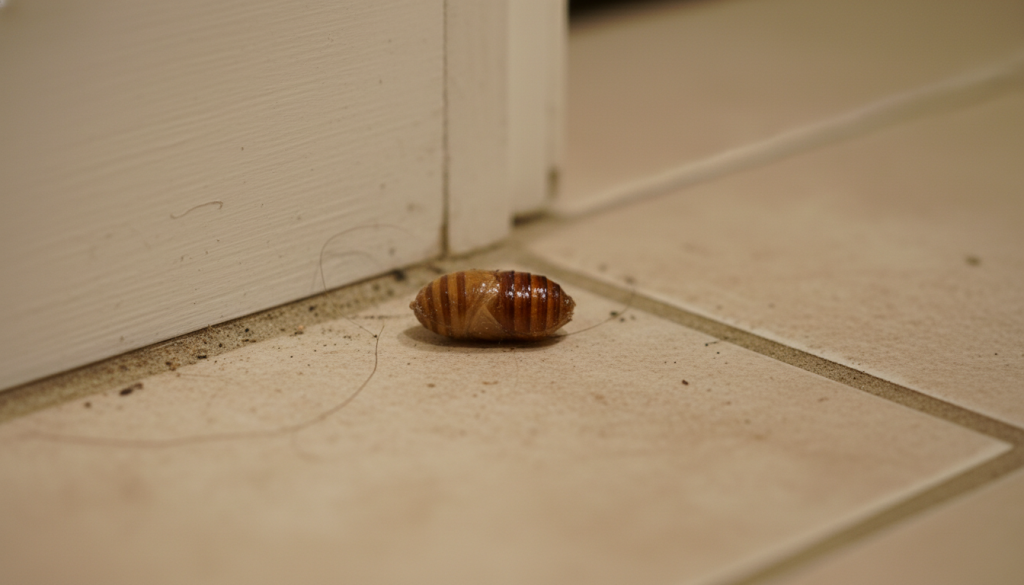
You found a small, dark object in your kitchen or bathroom, and now you need to know what it is. Is it a roach egg case, or is it roach droppings? The distinction matters. Roach eggs mean cockroaches are breeding indoors, while roach droppings mean cockroaches are actively feeding nearby. Both are warning signs, but each points to a different stage of an infestation and a different next step.
This guide gives you a reliable, four-attribute method to tell roach eggs apart from roach droppings; species-by-species detail; a room-by-room inspection map; safe removal steps; and a treatment truth table showing what actually works on each.
The Quick Answer: Is It an Egg Case or Droppings?
A roach egg is a hard, leathery capsule called an ootheca. It is purse-, bean-, or pill-shaped, measures about 5–13 mm (roughly 1/4 to 1/2 inch), and has visible ridges or a seam along one edge. An ootheca is a single, uniform object that holds many embryos inside.
Roach droppings are waste, also called frass. Droppings appear as tiny black specks resembling ground coffee or black pepper (small species like the German cockroach) or as small, ridged pellets with blunt ends (large species like the American cockroach). Droppings are scattered in clusters, rather than deposited as a single capsule.
The fastest rule: if the object is a single, structured, brown, rigid capsule, it is an egg case. If it is many scattered dark specks, pellets, or smears, it is droppings.
The 4-Attribute ID Method (Size · Shape · Texture · Pattern)
Use these four attributes to identify any dark object you find. Check them in order.
| Attribute | Egg case (ootheca) | Droppings (frass) |
| 1. Size | One larger object, 5–13 mm (~1/4–1/2 in); about a grain of rice to a small bean | Many smaller units, specks <1 mm or pellets ~2–3 mm (~1/16–1/8 in) |
| 2. Shape | A single uniform capsule: purse, bean, or pill-shaped | Irregular specks, cylinders, or smears; no consistent shape |
| 3. Texture | Hard, leathery, glossy; ridged sides; a seam or keel along one edge | Matte, granular; crumbles when dry; no seam |
| 4. Pattern/location | Found alone or in small numbers, glued or dropped in a hidden, protected spot | Scattered in clusters along travel routes: corners, hinges, baseboards, drawer interiors |
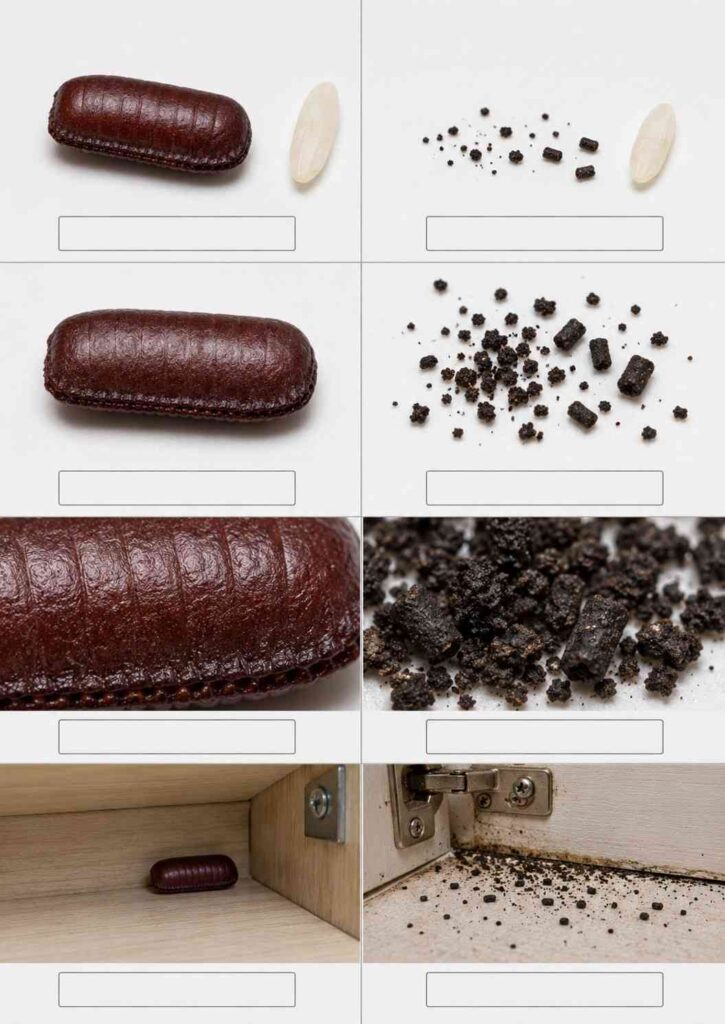
Decision shortcut: Structured and rigid = egg. Scattered and crumbly = droppings.
What Roach Eggs (Oothecae) Look Like
A roach egg is not a single exposed egg. Cockroaches lay their eggs inside a hardened protective case called an ootheca. The ootheca is made of a tanned protein shell that shields the embryos inside from drying out, from predators, and from most chemical sprays. Each ootheca holds multiple embryos arranged in two rows.
Most household roach egg cases measure 5 to 13 mm long (about 1/4 to 1/2 inch). That is roughly the size of a grain of rice to a small dried bean. Fresh oothecae are tan, amber, or light reddish-brown. They darken as the embryos mature, often turning dark brown or nearly black before hatching.
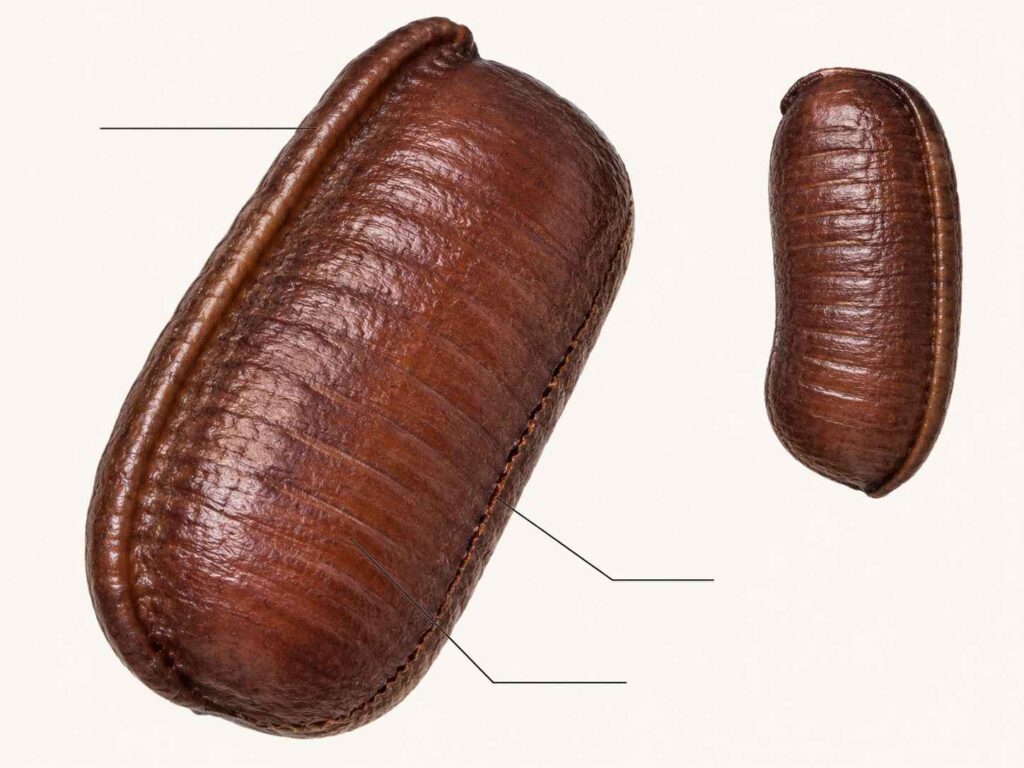
Anatomy of an Ootheca: Keel, Operculum, Ridges
Three visible features define an ootheca:
- The keel: a raised ridge running along one edge of the case.
- The operculum (seam): the “lid” or sealed line along the keel. Nymphs push this seam open to hatch.
- The ridges (segment lines): faint horizontal lines marking the compartments where individual eggs sit inside.
The University of Florida describes the German cockroach ootheca as 8 mm long, 3 mm high, and 2 mm wide, with each segment containing two eggs and a total of 30 to 40 eggs per case (UF/IFAS EDIS The German Cockroach, IN028). When embryos are nearly mature, a blue-green line shows through the case that is the developing eyes of the nymphs, signaling hatch within about one to two days.
Viable vs. Empty Egg Cases
Not every egg case you find is still a live threat. An empty (hatched) ootheca is evidence of past reproduction, while a viable ootheca is a pending hatch. Use this checklist to tell them apart.
| Feature | Viable (live) ootheca | Empty (hatched) ootheca |
| Shape | Plump, full, rounded | Deflated, crumpled, or flattened |
| Seam | Closed and intact | Split open along the keel |
| Color | Glossy; may show blue-green eyeliner near the hatch. | Faded, dull, often lighter brown |
| Meaning | Hatch pending removal and treat | Already hatched search for nymphs |
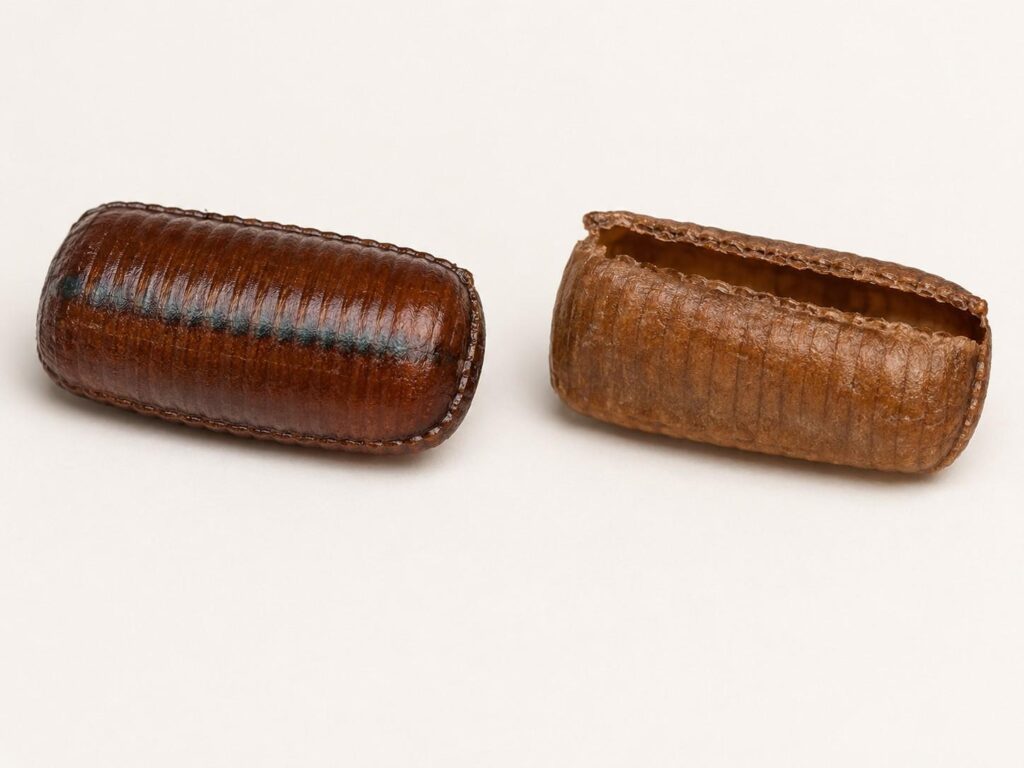
If you find a split, deflated case, the nymphs have already emerged and are hiding nearby. Finding a plump, intact case means hatching is approaching, and you have a short window to remove it.
Why You Rarely See German Roach Egg Cases Loose
Most species drop or glue their egg cases in hidden spots. The German cockroach is the exception. A gravid (egg-carrying) German female carries her ootheca attached to the tip of her abdomen until just 24 to 48 hours before it hatches (NC State Extension Biology and Behavior of the German Cockroach). She selects and maintains ideal conditions by moving with the case.
This means a loose German egg case you find has usually either just hatched or was dropped right before hatching. Because females carry most cases to term, you will see fewer loose German oothecae than American or brown-banded ones, but each German case holds more eggs.
What Roach Droppings (Frass) Look Like
Roach droppings are the feces cockroaches leave behind as they travel and feed. In pest management, droppings are called frass. They are one of the most reliable signs of cockroach activity, because roaches defecate frequently wherever they go.
Droppings vary by the size of the roach that produced them. They are consistently dark black to dark brown and matte, not glossy. The key is that they are irregular and scattered, never a single structured capsule.
Specks, Pellets, and Smears: Three Dropping Types
Cockroach droppings take three recognizable forms depending on species, size, and moisture:
- Black specks (small species). German cockroach droppings resemble ground black pepper or coffee grounds. Individual specks measure under 1 mm. They appear in corners, along drawer slides, and inside cabinet hinges.
- Ridged pellets (large species). American and Oriental cockroaches leave small dark cylinders about 2–3 mm long with blunt ends and ridged sides. They can look like dark grains of rice.
- Smear marks (high moisture). Where water is abundant, roaches produce dark, irregular brown smears along walls and at wall-floor junctions. These smear marks are a strong sign of heavy, damp-conditions activity (Western Exterminator Signs of a Cockroach Infestation).
Key fact: Droppings stay consistently dark and matte. Fresh droppings may look slightly glossy, but they dry out, crumble, and never form a ridged capsule. If you can crush the object into powder, it is droppings, not an egg case.
What Droppings Tell You About Infestation Severity
The amount and spread of droppings read like a map of roach activity. A few isolated specks suggest early scouting. Small, clustered deposits mean many roaches are moving through the area. Heavy, layered droppings with a musty, oily odor indicate an established, large infestation.
Droppings also serve a biological function for the roaches: they deposit aggregation pheromones in their feces, which attract more roaches to the same area. That is why droppings cluster where roaches harbor; the waste itself draws the colony back.
Egg Cases vs. Droppings: Side-by-Side Comparison Table
| Attribute | Roach egg case (ootheca) | Roach droppings (frass) |
| What it is | Protective protein case holding embryos | Excreted waste |
| Size | 5–13 mm (~1/4–1/2 in) | <1 mm specks to ~3 mm pellets |
| Color | Tan → reddish-brown → dark brown/near black (darkens with age) | Consistently dark brown to black; matte |
| Shape | One uniform purse, bean, or pill capsule | Irregular specks, cylinders, or smears |
| Texture | Hard, leathery, glossy | Granular, matte; crumbles when dry |
| Seam/ridge | Distinct keel and operculum seam | No seam |
| Quantity found | Usually one to a few; hidden | Scattered in clusters along travel routes |
| Smear behavior | None | Leaves dark brown smears in moist areas |
| What it means | Roaches are breeding indoors | Roaches are active and feeding |
| Removal | Physically remove, seal, dispose; follow with IGR + bait | HEPA vacuum + disinfectant wipe |
| Urgency | Hatch window act before nymphs emerge | Actively feed, clean, and treat the harborage |
Diagnostic rule of thumb: Finding an egg case is a reproductive emergency. Finding droppings is an activity warning. Finding both together confirms an established breeding infestation.
Roach Egg Cases by Species (Comparison Table)
Egg cases differ by species in size, color, egg count, and whether the female carries or deposits them. Matching the egg case to the species tells you where to look and how fast to act.
| Species | Size | Color | Eggs per case | Carried or deposited? | Hatch time | Typical deposit site |
| German (Blattella germanica) | 6–8 mm (~1/4 in) | Light brown/tan, slightly translucent | 30–40 (up to 50) | Carried until 24–48 h before hatch | ~28 days (range 14–35) | Rarely loose: under sink, cabinet hinges, drawer slides, behind fridge |
| American (Periplaneta americana) | ~8 mm (~3/8 in) | Reddish-brown → near black within 1–2 days | 14–16 | Glued/deposited within 1–2 days | ~45–60 days | Humid hidden spots: behind appliances, near pipes, basements |
| Oriental (Blatta orientalis) | 8–10 mm (~3/8 in) | Dark reddish-brown → near black, slightly inflated | 16–18 | Dropped in debris | ~60 days | Cool, damp: basements, drains, crawl spaces |
| Brown-banded (Supella longipalpa) | ~5 mm (~3/16 in) | Light reddish-brown, less ridged | 10–18 (up to ~24) | Glued to surfaces | 50–75 days | Dry, warm, elevated: furniture seams, behind pictures, inside electronics |
The University of Florida reports that the American cockroach egg case contains 14 to 16 eggs and that one female produces 9 to 10 cases in her lifetime (University of Florida Entomology American Cockroach). Missouri Cooperative Extension notes that female cockroaches place 18–30 eggs within an ootheca and may produce 4–20 oothecae over a lifetime (University of Missouri Extension Cockroaches, G07384).
Why species matters: German cockroaches breed fastest and carry their cases, so loose cases are rare, but each holds up to 50 eggs. Brown-banded cockroaches glue tiny cases to dry, elevated surfaces like furniture and electronics, which is how eggs end up in living rooms and bedrooms, not just kitchens.
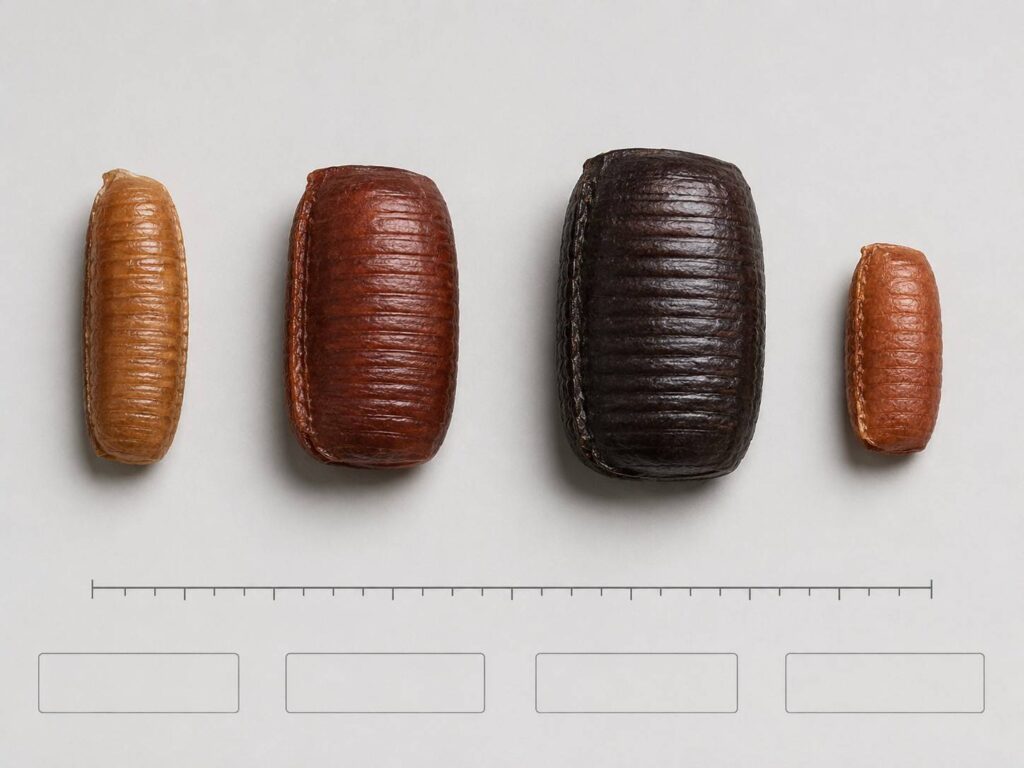
“It’s Not a Roach Egg”: Common Look-alikes
Many objects get mistaken for roach eggs or roach droppings. Before you treat, confirm you are not looking at a seed, a shed skin, or a different pest’s sign. Cornell University’s Integrated Pest Management program advises collecting a sample and confirming identification through an unbiased source such as a Cooperative Extension office, since social media and casual IDs are often unreliable (Cornell CALS IPM Cockroaches).
Mouse/Rodent Droppings (pointed vs. blunt)
Mouse droppings are the most common cause of confusion with large roach droppings. The shape of the ends tells them apart. Mouse droppings are larger (3–8 mm, about 1/8–1/3 inch), rod-shaped, and pointed at both ends. Roach droppings are smaller and have blunt ends. Mouse droppings are also smooth and solid when fresh, while roach droppings feel granular and crumbly.
Shed Skins (Exuvia) and Dead Roaches.
As cockroach nymphs grow, they molt, shedding their exoskeletons up to eight or more times before adulthood. A shed skin (exuvia) is hollow, flattened, translucent, and roach-shaped. It is not capsule-shaped like an ootheca. A shed skin looks like a translucent ghost of a roach, not a bean or purse.
Seeds, Spice Pods & Other Household Debris
Some seeds and dried plant debris resemble small brown capsules. Real oothecae have visible ridge lines and a distinct seam along one edge. Seeds typically lack that purse shape and keel. If the object has no seam, no ridge pattern, and no uniform capsule form, it is likely plant material or debris.
Bedbug Eggs, Spider Egg Sacs & Other Insect Eggs
- Bed bug eggs are tiny (about 1 mm), white or translucent, and are not bundled in a dark capsule.
- Spider egg sacs are rounder, often silky or papery, and usually white or tan.
- Roach oothecae are elongated, brown-to-black, leathery, and ridged, distinct from both.
| Lookalike | Size & shape | Key difference from a roach egg |
| Mouse dropping | 3–8 mm rod, pointed ends | Blunt ends + smaller = roach |
| Shed skin (exuvia) | Hollow, flattened, roach-shaped | Capsule-shaped, solid = roach egg |
| Seed/spice | Round or teardrop, no seam | Keel + ridges = roach egg |
| Bedbug egg | ~1 mm, white, individual | Brown, ridged, multi-egg capsule = roach egg |
| Spider egg sac | Round, silky/papery, white-tan | Elongated leathery capsule = roach egg |
Where You’ll Find Each Sign (Room-by-Room Map)
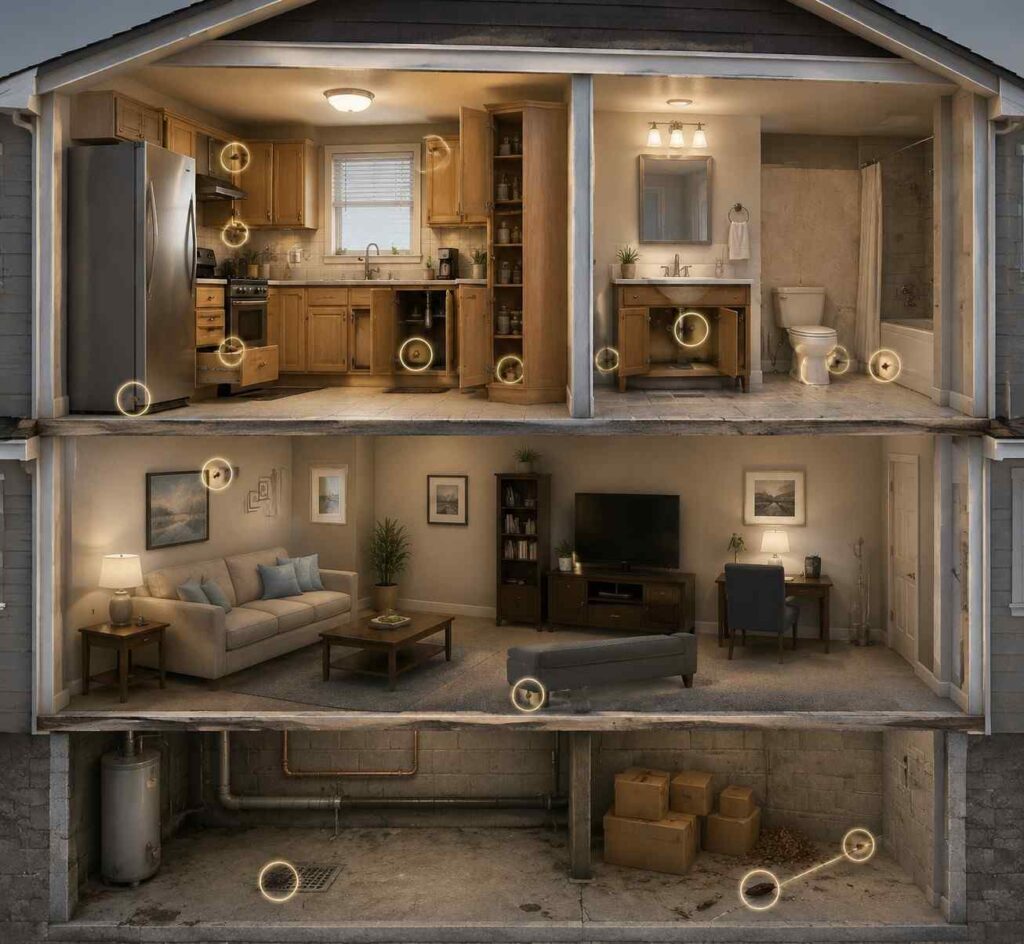
Cockroaches hide in tight, dark, warm spaces near food and water. Where you find an egg case or droppings tells you which species is likely present and how established the infestation is. Use a bright flashlight and inspect the high-probability zones below.
| Area | Likely sign | Likely species | Specific hotspots |
| Kitchen | Droppings (specks/pellets) + egg cases | German, American | Behind/under fridge & stove, inside cabinet hinges, under sink, drawer slides, pantry corners |
| Bathroom | Droppings + smears | German, Oriental | Under sink, around pipes, behind toilet, cabinet interiors |
| Living areas/bedrooms | Glued egg cases | Brown-banded | Furniture seams, behind picture frames, inside electronics, and upper cabinets |
| Basement/garage / crawl space | Egg cases dropped in the debris | Oriental, American | Along foundation, near drains, in cardboard boxes, mulch-adjacent entry points |
Inspection tip: Start within about 10 feet (3 meters) of the kitchen sink. Roaches need water frequently, so this zone concentrates activity. Check every crack, hinge, and gap in that radius first, then expand outward.
Cardboard boxes are a special hotspot. Roaches feed on the glue and shelter in the corrugated layers. Discarded boxes in a garage or basement often harbor both droppings and egg cases.
How Serious Is It? What Each Sign Means
The two signs carry different meanings, and finding both changes the urgency.
- Droppings alone = active feeding. Roaches are present and foraging, but you have not confirmed reproduction. Clean up, set sticky traps, and reduce food and water.
- An egg case alone = reproduction occurring. Roaches are breeding indoors. Even one viable ootheca can release dozens of nymphs.
- Both together = established infestation. This is a breeding, feeding colony. It will grow without intervention.
Critical risk fact: A single female German cockroach can produce 5 to 8 oothecae in her lifetime, a total of 200 to 250 eggs, and under ideal indoor conditions, her offspring can multiply into the thousands within a year (NC State Extension Biology and Behavior of the German Cockroach). Finding even one egg case is not a small problem.
Health and Allergen Risk
Cockroach droppings, shed skins, saliva, and body fragments contain potent allergens. These allergens are a major trigger for asthma, especially in children. The CDC and ATSDR report that cockroach allergens may increase a child’s risk of developing asthma, with cockroach sensitization rates around 36% among inner-city asthmatic children (CDC/ATSDR Environmental Triggers of Asthma). The EPA notes cockroach allergens are detectable in a large share of U.S. homes.
Droppings and contaminated surfaces can also carry bacteria such as Salmonella and E. coli, which cockroaches pick up as they travel through drains, garbage, and sewers. This is why proper cleanup matters not just for appearance but for health.
Safe Removal: What to Do Once You’ve ID’d It
Removing the evidence correctly protects you and prevents the problem from spreading.
Removing an Egg Case (physical removal + disposal)
- Put on gloves. Avoid bare-hand contact.
- Vacuum it up with a HEPA-filter vacuum or pick it up with a tissue/tool. Physical removal is the most reliable way to neutralize a viable ootheca, because most sprays cannot penetrate the shell.
- Seal it in a plastic bag immediately. A viable case can still hatch if simply swept into a trash can.
- Dispose of the sealed bag in an outdoor trash bin. Alternatively, freeze the sealed case for several days to kill the embryos before disposal.
- Treat the area afterward with an IGR and bait to catch nymphs that hatch from any cases you missed.
Safety note: Do not crush an egg case bare-handed or on an open surface. Crushing can scatter material and, if the case is viable, does not guarantee the embryos are neutralized. Vacuum or seal-and-freeze instead.
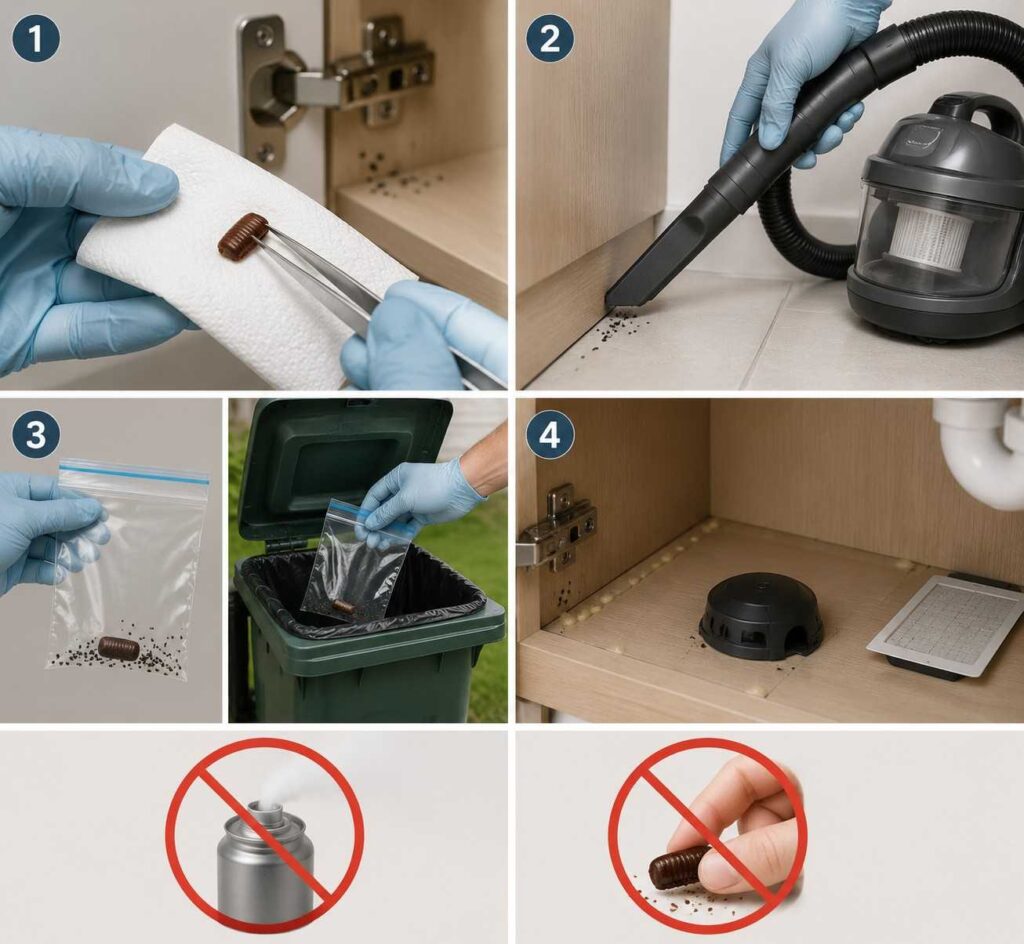
Cleaning Up Roach Droppings Safely (HEPA + disinfectant)
- Do not dry-sweep or vacuum without a HEPA filter. Dry sweeping and standard vacuums aerosolize allergen-laden dust, which you then inhale.
- Use a HEPA-filter vacuum to collect droppings and shed skins.
- Wipe the surface with soap and water, then with a disinfectant. On food-contact surfaces like counters and drawer interiors, use a food-safe disinfectant and follow the label contact time.
- Wash your hands and any tools afterward.
- Dispose of the vacuum contents in a sealed bag.
What NOT to Do
- Do not use total-release foggers (“bug bombs”) for egg cases. NC State University research found bug bombs produce no significant reduction in cockroach populations, and the aerosol mist cannot penetrate the ootheca’s protein shell or reach the deep cracks where cases sit.
- Do not mix pesticides. Combining products can create toxic fumes and is unsafe.
- Do not apply insecticides to food-contact surfaces. Food-prep counters, dishes, and utensils are off-limits unless the product label explicitly allows it.
- Do not sprinkle boric acid in thick piles or open areas. Roaches avoid piles, and loose powder creates inhalation and ingestion hazards for children and pets. Apply only as a thin, barely visible dust in hidden voids, or use formulated baits.
- Do not assume one treatment is enough. The ootheca’s shell protects embryos, so nymphs hatch over weeks. Follow-up plan.
Treatment Truth Table: What Works on Eggs vs. Droppings vs. Roaches
A core truth drives cockroach control: no single product eliminates both the roaches and their eggs. The ootheca’s hardened protein shell defeats most conventional insecticides. Effective control combines methods that target each life stage differently.
| Method | Kills adult roaches? | Affects eggs/ootheca? | Affects nymphs? | Notes |
| Contact spray (pyrethroids, etc.) | Yes (minutes) | No, cannot penetrate the shell. | Yes, on contact | Does not address colony or eggs |
| Total-release fogger (bug bomb) | Minimal | No | Minimal | NC State: no significant population reduction |
| Gel bait | Yes (24–72 h, colony impact via transfer) | Indirectly stops future egg-laying | Yes | Place near harborage; avoid repellent sprays nearby |
| Insect Growth Regulator (IGR) | No | Yes, it disrupts embryo development, and it can cause premature ootheca drop. | Yes, it sterilizes/deforms nymphs. | Pyriproxyfen is effective; apply as crack-and-crevice treatment |
| Boric acid (dust/bait) | Yes (ingestion/contact) | No, it does not penetrate the shell | Yes, it kills newly hatched | Apply as thin dust in hidden voids only |
| Diatomaceous earth (desiccant) | Yes (slow) | Compromises casing over time | Yes | Keep dry; use in voids |
| Heat treatment | Yes | Yes, it denatures the protein shell | Yes | Professional-grade, high temperatures |
| Freezing | Yes | Yes, it kills embryos in removed cases | Yes | Seal and freeze collected cases for several days |
| Physical removal | N/A | Yes, removes viable cases | N/A | Most reliable first step for eggs |
Why sprays and bug bombs fail on the ootheca: The egg case is a sealed, sclerotized protein capsule. Contact insecticides sit on the outer surface and cannot reach the embryos inside. Only methods that disrupt development hormonally (IGRs), dehydrate the casing over time (desiccants), denature the protein (heat), or freeze the embryos (cold) have documented effects on egg viability (UF/IFAS Assessment-Based Pest Management of German Cockroaches, IN1190).
IGRs are especially valuable because a gravid female reduces her feeding while carrying a case, making her harder to bait. IGRs cause the ootheca to release prematurely, returning the female to normal foraging so she finds and eats the bait (UF/IFAS IN1190). For deeper coverage of what kills roaches and their eggs, see our guide on What Kills Roaches and Their Eggs and whether Do Roach Eggs Die in Heat.
How to Stop More Eggs and Droppings (Prevention & Monitoring)
Removing what you found is only the first step. Prevention means making your home less suitable for egg-laying and feeding. Integrated Pest Management (IPM) rests on three pillars: sanitation, exclusion, and moisture control.
Sanitation · Exclusion · Moisture Control
- Sanitation: Remove food sources. Clean crumbs and grease daily, store food in sealed containers, take out trash regularly, and wash dishes promptly. Roaches feed on grease, starches, sweets, and even paper glue.
- Exclusion: Seal cracks and crevices around baseboards, pipes, and cabinets with caulk. Close gaps under doors. Eliminate the cardboard boxes that shelter roaches and their egg cases.
- Moisture control: Fix leaks, dry sinks at night, and ventilate damp areas. Roaches need water; reducing moisture removes a core survival need, especially for Oriental and American species.
Sticky Traps & a Hatch-Window Follow-Up Calendar
Sticky traps (glue boards) monitor activity and confirm where roaches travel. Place them under sinks, behind appliances, and along baseboards. Check them weekly. Traps tell you whether your treatment is working before you see another roach.
Because the ootheca protects embryos for weeks, a single treatment will not end an infestation. Plan follow-up across the hatch window:
| Week | Action |
| Week 0 | Remove egg cases; vacuum droppings (HEPA); apply gel bait + IGR in harborages |
| Week 1–2 | Recheck sticky traps, refresh bait as consumed, and monitor for new droppings |
| Week 3–4 | The first wave of nymphs may hatch from any missed cases; confirm bait/IGR coverage |
| Week 6–8 | Continue monitoring; re-treat harborages if activity persists |
| Week 8–12 | For German roaches, especially, sustained treatment through multiple hatch cycles. |
For the basics of what roach eggs are, see What Are Roach Eggs?. If eggs are appearing in living spaces or closets, read Do Roaches Lay Eggs in Clothes? And Can Cockroach Eggs Live on Clothes?. For the black specks question, see Are Black Dots Roach Eggs?.
When to Call a Licensed Pest Control Professional
DIY methods work for mild, early infestations caught before reproduction spreads. Some situations require a licensed pest control professional.
Call a professional when:
- You find multiple egg cases, especially from German cockroaches, indicating active breeding.
- You see roaches during the day (a sign of heavy pressure, since roaches are nocturnal).
- The problem is recurring after you have treated it thoroughly.
- You live in a multi-unit building (apartment, duplex) where roaches move between units and require coordinated treatment.
- The infestation involves sensitive occupants, children, people with asthma, or immunocompromised household members, where allergen exposure raises the stakes.
A professional brings products and equipment most homeowners cannot access safely, including IGR formulations, targeted crack-and-crevice application, and heat treatment for severe cases. For apartment tenants, document the signs (photos of egg cases and droppings) and notify your landlord or property manager in writing.
Bottom line: One egg case found and removed early is a manageable DIY task. Multiple cases, daytime sightings, or a recurring problem in a shared building are signs to bring in a professional.
Frequently Asked Questions
How do I tell a roach egg from roach droppings?
A roach egg is one hard, leathery capsule (an ootheca) about 5–13 mm long, purse- or bean-shaped, with visible ridges and a seam. Roach droppings are many small, dark, irregular specks, pellets, or smears that resemble coffee grounds or black pepper and crumble when dry. One structured capsule equals an egg; scattered dark debris equals droppings.
Are black specks roach eggs?
No. Black specks are almost always roach droppings, not eggs. Roach eggs are enclosed in a single brown, ridged capsule, not loose black dots. German cockroach droppings in particular look like ground black pepper or coffee grounds under 1 mm in size. For confirmation, see Are Black Dots Roach Eggs?.
What do German cockroach droppings look like
German cockroach droppings resemble ground black pepper or dark coffee grounds. Individual specks are tiny, under 1 mm, and often appear as dark smears or ink-like spots along corners, cabinet hinges, and drawer slides in kitchens and pantries. They are matte, not glossy, and cluster where roaches travel.
Does finding an egg case mean I have an infestation
Yes. An egg case means cockroaches are breeding indoors, which is a stronger sign of an established infestation than droppings alone. Droppings show active feeding, but an ootheca confirms reproduction. Even one viable case can release dozens of nymphs, so treat the area promptly and monitor.
How big is a cockroach egg case
Most cockroach egg cases measure 5 to 13 mm long, about 1/4 to 1/2 inch, roughly the size of a grain of rice to a small dried bean. German cases are around 6–8 mm, American about 8 mm, Oriental 8–10 mm, and brown-banded about 5 mm. Each holds 10 to 50 embryos, depending on species.
Do roaches lay eggs where they poop?
Often yes, but not always in the same spot. Roaches deposit droppings along their travel routes and harbor in cracks near food and water. Females often glue or drop egg cases in the same protected harborage areas where they rest and defecate. Finding both signs together confirms an established colony.
Can a roach egg case be empty?
Yes. A hatched, empty ootheca looks deflated, crumpled, or split open along its seam, with a faded, dull color. A viable case is plump, glossy, and intact and may show a blue-green eye-line near hatching. An empty case means the nymphs have already emerged and are hiding nearby.
Will bug spray kill roach eggs?
No. Most contact sprays cannot penetrate the ootheca’s hardened protein shell, so they do not kill the embryos inside. Only insect growth regulators, desiccant dusts applied over time, heat treatment, and freezing of removed cases reliably affect egg viability. Baits and IGRs stop future egg-laying and kill hatching nymphs.
Are mouse droppings the same as roach droppings
No. Mouse droppings are larger (3–8 mm), rod-shaped, and pointed at both ends. Roach droppings are smaller and have blunt ends, appearing as specks or ridged pellets. Mouse droppings are smooth and solid when fresh; roach droppings are granular and crumbly. The end shape is the clearest difference.
Are cockroach droppings dangerous to touch or breathe
Yes, they can be. Cockroach droppings contain allergens that trigger asthma and allergic reactions, especially in children, and can carry bacteria like Salmonella and E. coli. Dry droppings break into fine particles that become airborne when disturbed. Always use a HEPA vacuum and gloves, and avoid dry sweeping.
Should I vacuum roach eggs and droppings?
Yes, but use a HEPA-filter vacuum only. Vacuuming physically removes egg cases and droppings without aerosolizing allergens. Seal the vacuum contents in a plastic bag and dispose of them outdoors. For viable egg cases, freezing the sealed bag for several days ensures the embryos die before disposal.
When should I call a professional about roach eggs
Call a licensed pest control professional if you find multiple egg cases, see roaches during the day, have a recurring problem, or live in a multi-unit building. Severe, breeding, or apartment-wide infestations usually need coordinated, professional treatment with IGRs, targeted application, and possible heat treatment.
Key Takeaways
Roach eggs and roach droppings are different signs of the same underlying problem. An egg case, the ootheca, is a hard, ridged, purse-shaped capsule that means cockroaches are breeding indoors. Droppings, or frass, are scattered dark specks, pellets, and smears that mean cockroaches are actively feeding. Finding both confirms an established infestation.
Your practical next step is straightforward: identify the sign with the four-attribute method, remove egg cases physically and seal them for disposal, clean droppings with a HEPA vacuum and disinfectant, and then treat harborages with gel bait and an insect growth regulator across the hatch window. Reduce food, water, and shelter through sanitation, exclusion, and moisture control.
If the problem is severe, recurring, or in a shared building, contact a licensed pest control professional. Acting before the next ootheca hatches is what turns a small find into a solved problem.
For your next step, read our complete guide on What Kills Roaches and Their Eggs to build a full treatment plan around the methods proven to work on every life stage.
This article is for educational purposes and reflects evidence-based pest management practices. Always read and follow pesticide product labels. The label is the law. Do not mix pesticides or apply insecticides to food-contact surfaces. For severe, recurring, or multi-unit infestations, consult a licensed pest control professional.