

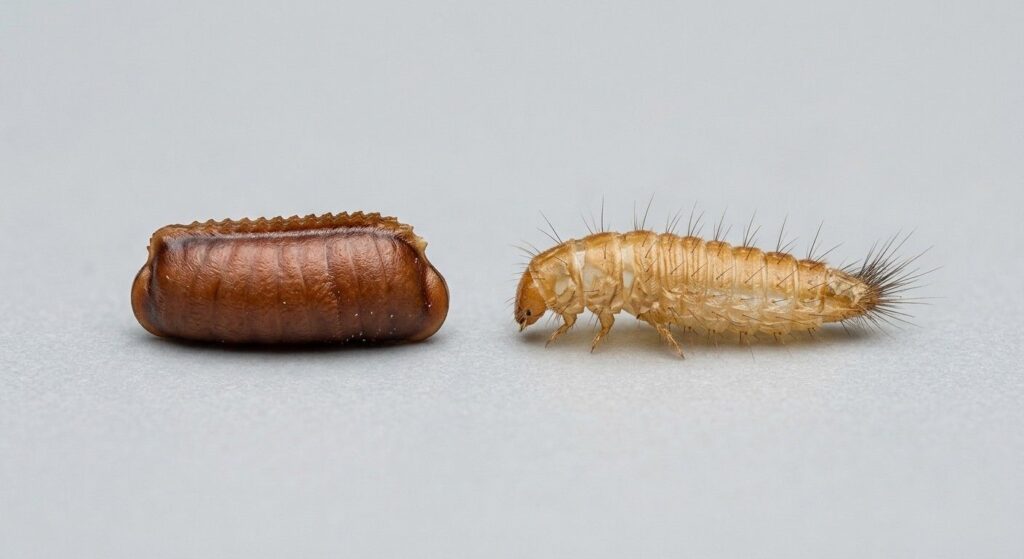
Roach eggs and carpet beetle larvae shells are different pest evidence. Roach eggs are usually found inside a brown capsule-shaped egg case called an ootheca, while carpet beetle larvae shells are dry, hollow, hairy shed skins left behind when carpet beetle larvae molt.
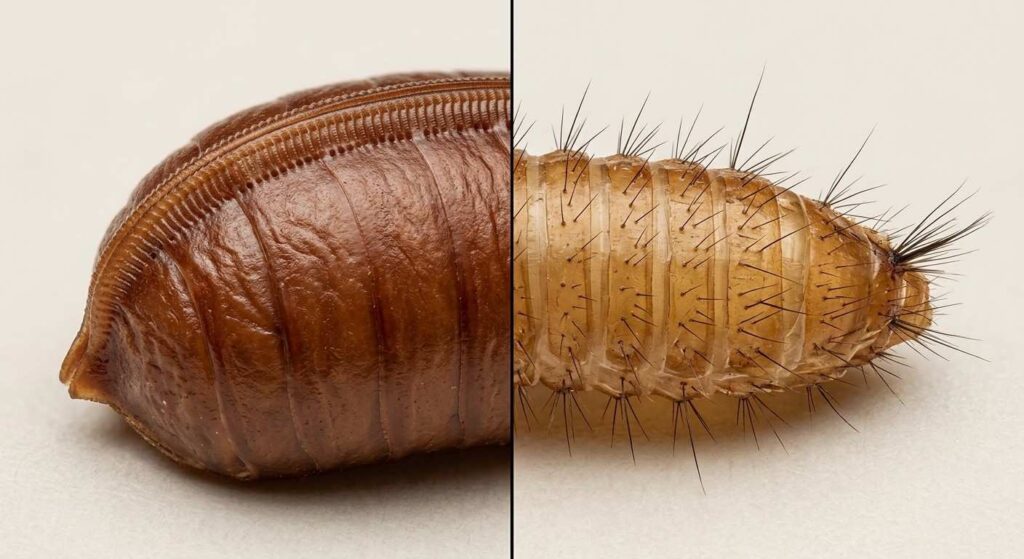
The fastest way to tell them apart is texture and shape. A roach egg case looks like a small brown capsule, bean, purse, or pill. A carpet beetle larvae shell looks like a tiny fuzzy or bristly larva-shaped husk, often light brown, amber, tan, or striped, with visible hairs or a tail-like tuft.
Correct identification matters because the source is different. Roach egg cases usually point to cockroach breeding near food, water, warmth, and dark cracks. Carpet beetle larvae shells usually point to fabric pests feeding on wool, fur, feathers, pet hair, lint, dead insects, or animal-based materials in closets, carpets, furniture, drawers, vents, or storage areas.
Quick Comparison: Roach Eggs vs Carpet Beetle Larvae Shells
| Feature | Roach Eggs / Oothecae | Carpet Beetle Larvae Shells |
| What it is | A protective egg case containing developing roaches | A shed larval skin, not an egg |
| Main structure | Firm capsule called an ootheca | Dry, hollow, bristly exoskeleton |
| Typical size | About 5–10 mm long depending on species | Often a few millimeters long; some larval skins may be up to about 13 mm, depending on species |
| Color | Tan, brown, reddish-brown, dark brown, or blackish | Tan, amber, light brown, reddish-brown, golden brown, or striped |
| Shape | Capsule-shaped, purse-shaped, bean-shaped, or pill-like | Larva-shaped, fuzzy, segmented, carrot-shaped, cigar-shaped, or tapered |
| Texture | Firm, smooth to leathery, sometimes ridged with a seam | Dry, brittle, hollow, hairy, bristly, or fuzzy |
| Hair or bristles | No visible hairy covering | Usually has hairs, bristles, or tail-like hair tufts |
| Common locations | Kitchens, bathrooms, appliance gaps, sinks, drains, cabinets, basements, cardboard | Closets, woolens, rugs, under furniture, baseboards, drawers, upholstery, vents, pet hair/lint buildup |
| Main warning sign | Active roach reproduction nearby | Active or past carpet beetle larval feeding nearby |
For a complete visual guide to cockroach oothecae, see our article on what roach eggs look like.
Roach Eggs Are Usually Brown Oothecae
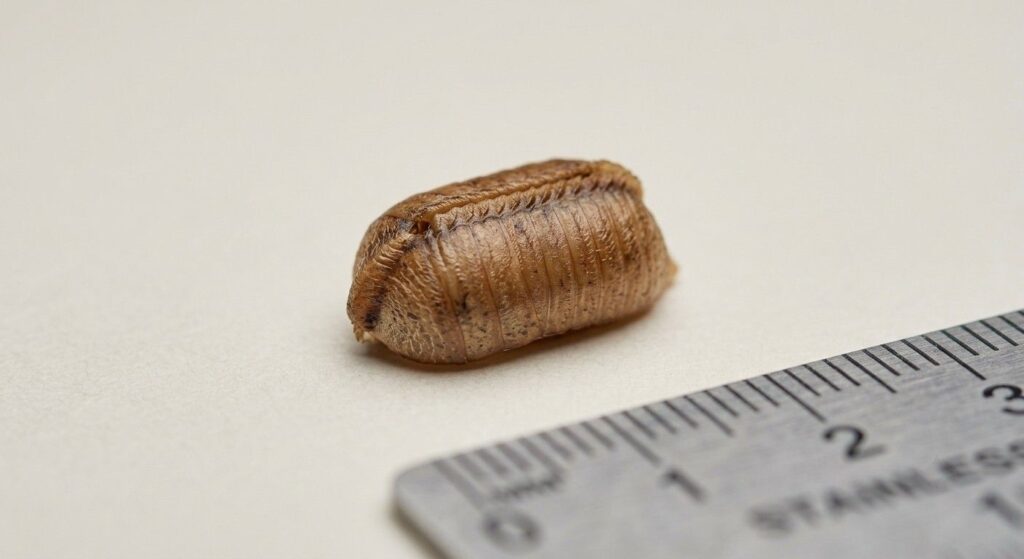
Roach eggs are usually protected inside a hardened egg case called an ootheca. A cockroach ootheca is a capsule that holds multiple developing embryos inside one visible structure.
Most people do not find loose individual cockroach eggs around the home. They find the ootheca, which can look like a small brown purse, bean, seed, pill, or capsule. The exact size, color, and shape depend on the cockroach species.
A roach egg case usually has these identifying features:
- Brown color: tan, amber, reddish-brown, dark brown, or nearly black depending on species and age.
- Capsule structure: purse-like, bean-like, pill-like, or slightly rectangular with rounded ends.
- Firm casing: leathery or hardened exterior that protects embryos inside.
- Seam or ridge: many oothecae have a visible ridge where nymphs emerge.
- Hidden placement: common in warm, dark, protected locations near food and water.
If you need the biology behind the egg case, read our guide on what roach eggs are.
Carpet Beetle Larvae Shells Are Shed Skins, Not Eggs
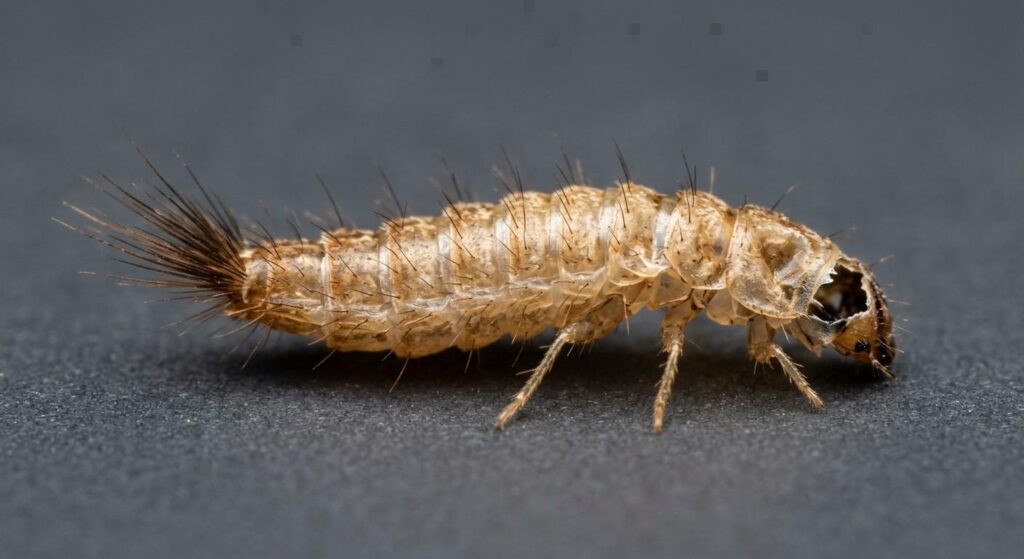
Carpet beetle larvae shells are not eggs. They are shed skins left behind when carpet beetle larvae molt as they grow.
Colorado State University Extension explains that dermestid beetle larvae, including carpet beetles, repeatedly shed their skins as they grow, often a dozen times or more. These discarded skins retain the general shape of a larva and may accumulate around infested materials Colorado State University Extension.
University of Maryland Extension also notes that carpet beetle larvae molt or shed their skins, and that light-colored shed skins may be seen in infested material during heavy infestations University of Maryland Extension.
A carpet beetle larvae shell usually looks like a small dry husk. It may resemble a tiny fuzzy worm, bristly grain husk, dried caterpillar skin, or hollow larva-shaped casing. Unlike a roach ootheca, it is not a smooth capsule and does not contain developing embryos.
Size Difference: Roach Egg Cases Are Compact Capsules, Shed Skins Are Larva-Shaped
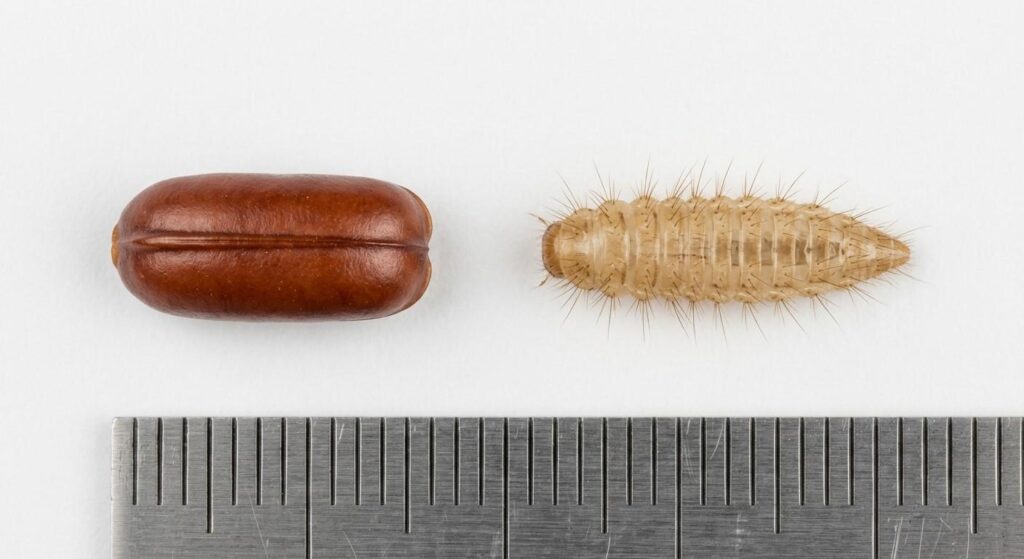
Roach egg cases and carpet beetle larvae shells can overlap in general size, but their proportions are different. A roach egg case is compact and capsule-like. A carpet beetle larvae shell is usually longer, thinner, segmented, and larva-shaped.
Common roach ootheca sizes include:
- German roach eggs: about 6–9 mm long.
- American roach eggs: about 8–10 mm long.
- Oriental roach eggs: about 8–10 mm long.
- Brown-banded roach eggs: about 5 mm long.
Carpet beetle larvae vary by species. Rutgers NJAES states that black carpet beetle larvae can be up to 1/2 inch, or about 13 mm, while varied, furniture, and common carpet beetle larvae are often around 1/5 inch, or about 5 mm, when mature Rutgers NJAES. University of Maryland Extension describes black carpet beetle larvae as 3–7 mm long and carrot-shaped University of Maryland Extension.
Simple Size Rule
If the object is a compact brown capsule with a firm outline, it is more likely a roach egg case. If the object is a hollow, fuzzy, segmented husk shaped like a tiny larva, it is more likely a carpet beetle shed skin.
Color Difference: Roach Eggs Are Brown Capsules, Carpet Beetle Shells Are Hairy Tan or Brown Husks
Roach egg cases are usually brown and smooth compared with carpet beetle larvae shells. Carpet beetle shed skins are often lighter, hairier, more translucent, or striped.
Roach egg cases may appear:
- Light tan
- Amber
- Brown
- Reddish-brown
- Dark brown
- Nearly black when old or species-specific
Carpet beetle larvae shells may appear:
- Pale tan
- Amber
- Light brown
- Golden brown
- Reddish-brown
- Striped light and dark brown
- Dusty, dry, or translucent after shedding
Color alone is not enough. An old roach ootheca and a carpet beetle shell can both look brown. Use texture, hair, shape, and location to confirm the difference.
Shape Difference: Roach Eggs Look Like Capsules, Carpet Beetle Shells Look Like Fuzzy Larvae
Shape is one of the most reliable differences. Roach egg cases look like tiny capsules. Carpet beetle larvae shells look like the outer skin of a small hairy larva.
Roach Egg Shape Clues
A roach egg case often has:
- A bean-like or purse-like body
- Rounded ends
- A firm, capsule-like outline
- A seam or ridge along one side
- Little to no visible hair or fuzz
- A smooth or slightly ridged surface
Carpet Beetle Larvae Shell Shape Clues
A carpet beetle larvae shell often has:
- A hollow larva-shaped body
- Visible segmentation
- Hairy or bristly surface
- A tapered or carrot-shaped body
- A tail-like tuft of hairs in some species
- A dry, brittle, shed-skin appearance
Rutgers NJAES describes black carpet beetle larvae as carrot-shaped, golden to dark brown, and marked by a tail of long hairs. Rutgers also describes varied carpet beetle larvae as shorter, densely bristled, and hairy at the sides and end of the body Rutgers NJAES.
Texture Difference: Roach Oothecae Are Firm, Carpet Beetle Shells Are Brittle and Bristly
Texture separates these two objects quickly. A roach ootheca is a protective casing. A carpet beetle larvae shell is an empty exoskeleton.
A roach ootheca usually feels firm, leathery, or hard. It may resist light pressure and keep its capsule shape. A carpet beetle larvae shell is usually dry, brittle, fragile, and hollow. It may crumble when touched or move like a lightweight husk.
The hair difference is especially important. Roach egg cases are not fuzzy. Carpet beetle larvae shells commonly have hairs or bristles because the live larvae are hairy. These hairs can irritate sensitive skin in some people, so avoid rubbing shed skins with bare hands.
Location Difference: Roach Eggs Are Near Food, Water, Warmth, and Dark Cracks
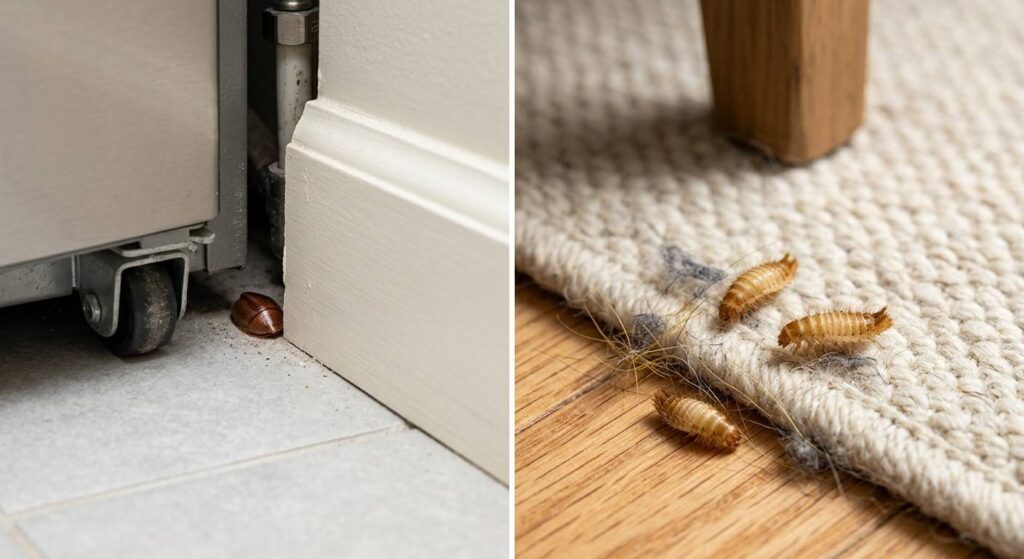
Roach egg cases are usually hidden in protected spaces close to food and water. Kitchens and bathrooms are the most common indoor inspection areas, especially for German cockroaches.
Look for roach oothecae in these locations:
- Behind refrigerators, stoves, dishwashers, and microwaves
- Under kitchen sinks and bathroom sinks
- Inside cabinet corners, hinges, and drawer tracks
- Around pipes, drains, and plumbing gaps
- Along baseboards and wall cracks
- Inside cardboard boxes and paper bags
- Near garbage cans and recycling areas
- Behind or inside appliances and electronics
- In basement, laundry, or utility-room corners
Rutgers NJAES explains that German cockroaches are mostly found in kitchens and bathrooms where food and water are available, especially around stoves, refrigerators, cabinets, drawers, and sinks Rutgers NJAES German cockroach fact sheet.
If the suspected egg case is in a kitchen, use our step-by-step guide on how to find cockroach eggs in the kitchen.
Location Difference: Carpet Beetle Shells Are Near Fabrics, Pet Hair, Lint, and Dead Insects
Carpet beetle larvae shells are usually found where larvae have been feeding or wandering. These locations are often dry, dark, undisturbed, and rich in animal-based material or organic debris.
Look for carpet beetle larvae shells in these locations:
- Closets with wool, silk, fur, leather, or felt items
- Storage boxes with old clothing or blankets
- Under beds, sofas, and seldom-moved furniture
- Along carpet edges and baseboards
- Inside drawers and little-used storage areas
- In upholstered furniture folds and seams
- Near pet beds, pet hair buildup, and lint accumulations
- Around air vents, ducts, and floor registers
- In attics, basements, and dark storage rooms
- Near dead insects, old spider webs, bird nests, wasp nests, or rodent nests
University of Florida IFAS states that carpet beetle larvae tend to avoid light and actively feed in dark cracks, crevices, or folds, commonly in closets, drawers, or upholstered furniture University of Florida IFAS. Rutgers NJAES also notes that adult females may lay eggs on lint around baseboards, carpet edges, cracks, ducts, mouse carcasses, and similar situations Rutgers NJAES.
Simple Location Rule
A brown capsule behind a refrigerator or under a sink usually points toward roaches. A fuzzy shed skin near wool clothing, rug edges, pet hair, lint, or under furniture usually points toward carpet beetles.
Roach Eggs vs Carpet Beetle Larvae Shells: Evidence Around the Object
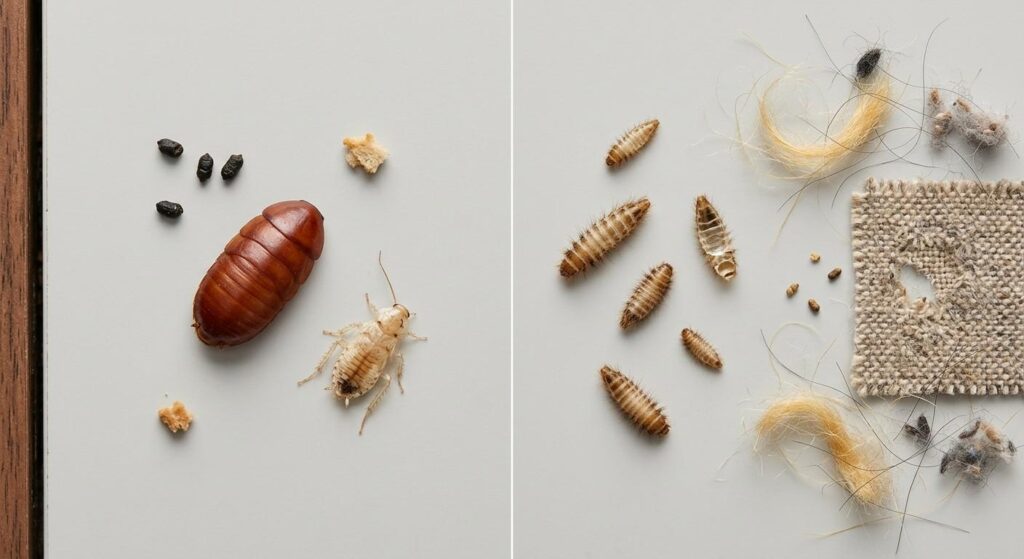
The surrounding evidence often confirms the identification. Roach egg cases and carpet beetle shells rarely appear alone without other clues.
Signs That Support Roach Eggs
A suspicious capsule is more likely a roach ootheca if you also find:
- Live roaches at night
- Small roach nymphs near cracks or appliances
- Pepper-like droppings or dark cylindrical droppings
- Shed roach skins near harborages
- Musty or oily odor in cabinets or under sinks
- Egg cases in warm, humid, food-adjacent areas
- Grease, crumbs, cardboard, or water sources nearby
If you found black specks and are unsure whether they are eggs, read our guide: Are black dots roach eggs?
Signs That Support Carpet Beetle Larvae Shells
A suspicious husk is more likely a carpet beetle shed skin if you also find:
- Irregular holes in wool, silk, fur, feathers, or felt
- Thin grazed patches on rugs or upholstery
- Small bristly larvae in dark areas
- Multiple dry shed skins clustered near fabric damage
- Tiny fecal pellets around damaged materials
- Adult carpet beetles near windowsills or light sources
- Pet hair, lint, dead insects, or old nests nearby
University of Florida IFAS states that carpet beetle larvae can be detected by shed skin fragments and fecal pellets around feeding areas University of Florida IFAS. Rutgers NJAES notes that carpet beetle larvae leave shed skins and do not produce webbing like webbing clothes moths Rutgers NJAES.
Carpet Beetle Shells vs Roach Shed Skins
Carpet beetle larvae shells can also be confused with roach shed skins. The difference is body type.
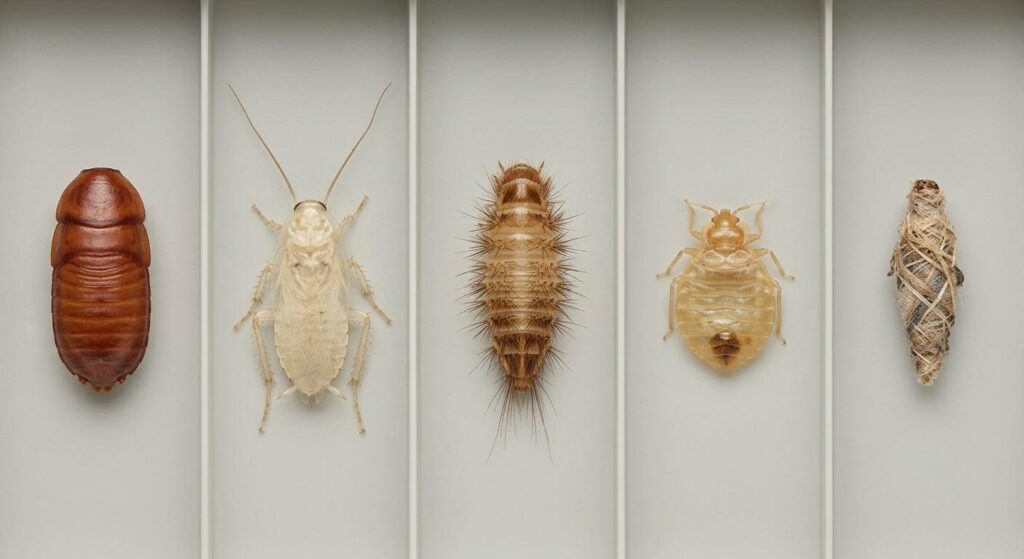
Roach shed skins look like pale or tan versions of a roach nymph. They have a roach-shaped body with legs, antennae, and a flattened insect outline. Carpet beetle larvae shells look hairy, bristly, tapered, and larva-shaped, not roach-shaped.
Use this quick check:
- Capsule with no legs or hairs: possible roach egg case.
- Flat roach-shaped skin with legs and antennae: possible roach molt.
- Hairy, bristly, worm-like husk: likely carpet beetle larvae shell.
- Silky webbing with larvae: more consistent with clothes moths or pantry moths than carpet beetles.
Carpet Beetle Larvae Shells Are Not Bed Bug Shells
Carpet beetle larvae shells are often mistaken for bed bug evidence because both can appear near beds. The difference is that carpet beetle shells are hairy and larva-shaped, while bed bug shells are smooth, flat, and bed bug-shaped.
Carpet beetle larvae may live under beds if lint, pet hair, wool rugs, feathers, or dead insects are present. They do not bite, but their hairs and shed skins can irritate skin in some people. Bed bugs feed on blood and leave different signs, including dark fecal spots, blood stains, live bugs near mattress seams, and shed skins shaped like bed bugs.
If the object is fuzzy or bristly, think carpet beetle first. If the object is smooth, flat, oval, and found with dark spotting on mattress seams, bed bug evidence is more likely.
What to Do If You Find Roach Eggs
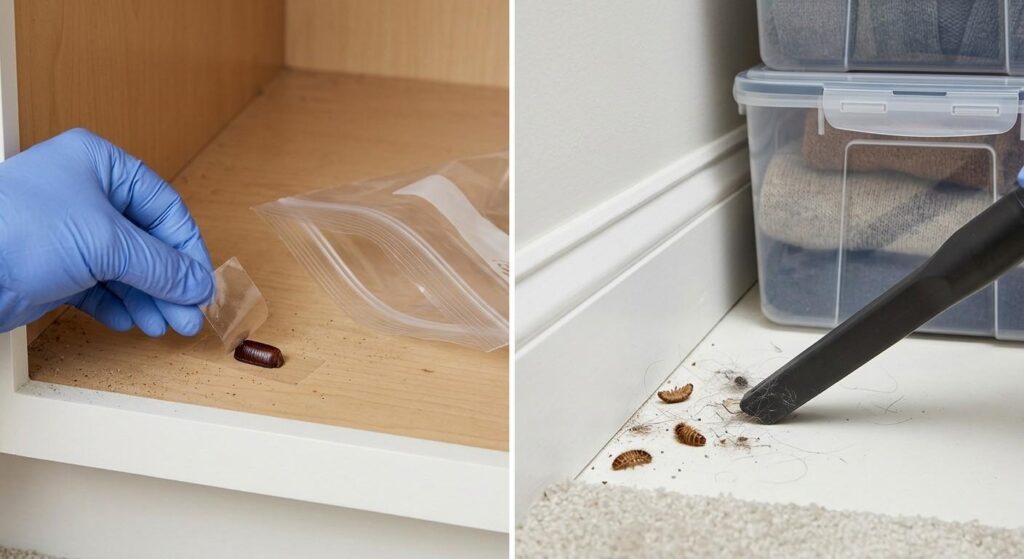
If you find a roach egg case, remove it carefully and inspect nearby harborages. One ootheca can contain many developing roaches, and more cases may be hidden nearby.
Use this roach response plan:
- Photograph the object first so you can compare size, shape, and color.
- Pick it up with tape, gloves, or a paper towel instead of crushing it into the surface.
- Seal it in a plastic bag and dispose of it outdoors.
- Vacuum nearby cracks, cabinet corners, appliance gaps, and baseboards.
- Remove crumbs, grease, cardboard, moisture, and clutter.
- Place sticky monitors near suspected roach harborages.
- Use roach baits and insect growth regulators where appropriate.
- Continue monitoring for several weeks because hidden oothecae may still hatch.
For treatment options, read our full guide on what kills roaches and their eggs. If the case is light tan and you suspect German cockroaches, read our German roach eggs guide.
What to Do If You Find Carpet Beetle Larvae Shells
If you find carpet beetle larvae shells, locate the feeding source. Removing shed skins alone will not solve the infestation if larvae are still feeding nearby.
Use this carpet beetle response plan:
- Photograph the shed skins and damaged material before cleaning.
- Inspect wool, silk, fur, feathers, felt, leather, rugs, pet beds, and upholstered furniture.
- Check under furniture, along baseboards, inside closets, drawers, vents, and storage boxes.
- Vacuum slowly and thoroughly to remove larvae, shed skins, fecal pellets, lint, pet hair, and dead insects.
- Dispose of the vacuum contents outdoors in a sealed bag.
- Wash, hot-launder, dry-clean, or heat-treat washable items when fabric instructions allow.
- Freeze delicate non-washable items if appropriate for the material.
- Discard heavily infested items that cannot be cleaned or salvaged.
- Store cleaned natural-fiber items in airtight containers or garment bags.
- Remove bird nests, wasp nests, rodent nests, and dead insects where safely accessible.
Rutgers NJAES recommends finding the source, inspecting dark storage rooms, lint-laden corners, ducts, attics, basements, furniture backs, and seldom-used sofas, then using cleaning, laundering, freezing, and sanitation as control methods Rutgers NJAES. University of Maryland Extension also recommends thorough vacuuming along carpets, baseboards, under furniture, and in closets, with disposal of the vacuum bag outdoors University of Maryland Extension.
Can Carpet Beetle Shells Mean an Old Infestation?
Yes. Carpet beetle larvae shells can remain after larvae have moved, pupated, died, or completed development. A single old shell does not always prove an active infestation.
However, multiple fresh-looking shed skins near damaged wool, pet hair, lint, or organic debris suggest ongoing or recent larval activity. Look for live larvae, new fabric damage, fecal pellets, and adult beetles near windows to determine whether the problem is active.
A useful rule is to clean the area thoroughly, remove the source, and monitor for new shells or larvae over the next few weeks. New shed skins after cleaning suggest larvae are still present.
Can Roach Egg Cases Be Empty?
Yes. A roach egg case can be empty after nymphs hatch. Empty oothecae may look split, flattened, lighter, brittle, or hollow.
An empty roach egg case still matters because it proves roach reproduction happened nearby. If nymphs already emerged, you may need to inspect surrounding cracks, appliance gaps, cabinets, and plumbing areas for small roaches.
Do not ignore an empty ootheca. Treat it as evidence of a breeding site and inspect the surrounding area carefully.
Common Mistakes When Comparing Roach Eggs and Carpet Beetle Larvae Shells
Misidentification usually happens when people focus only on color. Both objects can look brown, but they have very different textures, shapes, and locations.
Mistake 1: Calling Every Brown Husk a Roach Egg
A brown object is not automatically a roach egg case. If the object is fuzzy, hollow, bristly, segmented, and larva-shaped, it is more likely a carpet beetle shed skin.
Mistake 2: Calling Carpet Beetle Shells “Eggs”
Carpet beetle larvae shells are not eggs. They are molted exoskeletons. Finding them means larvae were present, not that those shells will hatch.
Mistake 3: Treating Carpet Beetles Like Roaches
Roach control focuses on food, water, cracks, baits, and egg-case monitoring. Carpet beetle control focuses on fabric sources, animal fibers, pet hair, lint, dead insects, nests, vacuuming, laundering, and storage.
Mistake 4: Ignoring Hidden Fabric Sources
Carpet beetle larvae often feed in dark, undisturbed areas. A few shed skins near a bed or baseboard may come from wool rugs, stored blankets, feather pillows, pet hair buildup, old insect carcasses, or attic nests.
Mistake 5: Assuming No Live Pest Means No Problem
Both roach egg cases and carpet beetle larvae shells can be evidence of hidden activity. Roaches hide in cracks. Carpet beetle larvae hide in fabrics and debris. Inspection matters more than what is visible in the open.
Final Verdict: How to Tell the Difference Fast
Roach Eggs vs Carpet Beetle Larvae Shells can be separated quickly by structure, texture, and location. Roach eggs are usually brown oothecae: firm capsule-shaped cases about 5–10 mm long, hidden near kitchens, bathrooms, appliances, drains, cabinets, cardboard, and warm cracks. Carpet beetle larvae shells are dry, hollow, bristly shed skins shaped like tiny fuzzy larvae, usually found near wool, fur, feathers, pet hair, lint, rugs, upholstery, closets, drawers, baseboards, or storage areas.
If the object is brown, smooth, firm, capsule-shaped, and found near food, water, or appliances, treat it as a possible roach egg case. If the object is hairy, brittle, hollow, segmented, and found near fabrics, pet hair, lint, or under furniture, treat it as a likely carpet beetle larvae shell.
The key difference is treatment focus. Roach eggs require cockroach lifecycle control around harborages. Carpet beetle larvae shells require source removal, deep cleaning, fabric treatment, and storage protection.
Frequently Asked Questions
Are carpet beetle larvae shells roach eggs?
No. Carpet beetle larvae shells are shed skins left behind after larvae molt. Roach eggs are usually inside a protective capsule called an ootheca.
Do carpet beetle larvae shells hatch?
No. Carpet beetle larvae shells do not hatch because they are empty exoskeletons. They are evidence that larvae were present, but the shell itself is not alive.
Are roach eggs fuzzy or hairy?
No. Roach egg cases are not fuzzy or hairy. They are usually smooth, leathery, capsule-shaped, and brown. A fuzzy or bristly husk is more consistent with carpet beetle larvae shells.
Why do carpet beetle larvae shells look like bugs?
Carpet beetle larvae shells look like bugs because they are the old outer skins of larvae. The shed skin keeps the larva-like shape, hairs, segments, and sometimes tail-like bristles.
Where are carpet beetle larvae shells usually found?
Carpet beetle larvae shells are usually found in closets, drawers, under furniture, along baseboards, inside rugs, in upholstered furniture, near pet hair, around vents, and near wool, fur, feathers, or dead insects.
Where are roach egg cases usually found?
Roach egg cases are usually found in kitchens, bathrooms, basements, cabinets, appliance gaps, pipe openings, drains, cardboard, wall cracks, and dark protected places near food and water.
Can carpet beetle larvae shells cause skin irritation?
Yes. Carpet beetle larval hairs and shed skins can irritate sensitive skin in some people. Avoid rubbing shed skins with bare hands, and vacuum with care when cleaning heavy infestations.
What looks like a carpet beetle larvae shell but is not?
Lint, fabric fibers, dried insect parts, moth cases, roach shed skins, dead larvae, and debris can resemble carpet beetle shed skins. Hairy, bristly, segmented, larva-shaped husks near fabric damage strongly suggest carpet beetles.
What looks like a roach egg but is not?
Seeds, mouse droppings, beetle cases, roach droppings, pantry pest debris, and carpet beetle shed skins can be mistaken for roach eggs. A true roach ootheca usually has a brown capsule shape and may show a seam or ridge.
Can roaches and carpet beetles be in the same house?
Yes. Roaches and carpet beetles can infest the same home because they use different food sources. Roaches seek food residue, water, and warmth, while carpet beetle larvae feed on animal fibers, lint, pet hair, dead insects, and stored natural materials.