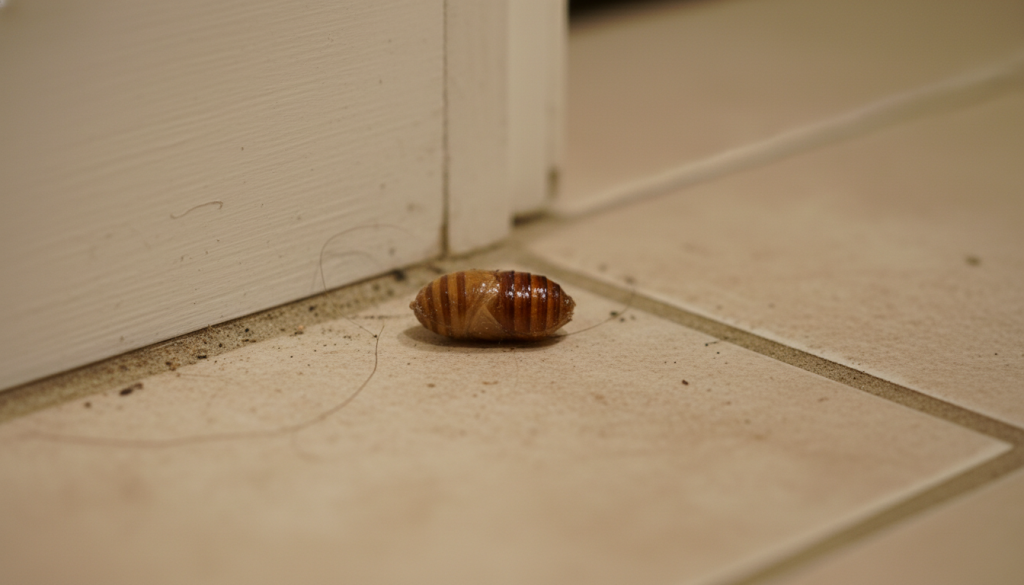
You spot a cockroach. You react the way most people do; you stomp on it. But then a nagging thought stops you cold: Did I just make things worse?
The idea that stepping on roaches spreads eggs is one of the most persistent myths in household pest control. It circulates on social media, gets whispered between neighbors, and causes genuine anxiety for people already stressed about a roach problem. And when you're dealing with an infestation, the last thing you need is bad information driving your decisions.
So let's settle this once and for all with real biology, real pest management science, and the kind of practical guidance that actually helps you eliminate a cockroach problem instead of accidentally feeding one.
Here's exactly what happens when you step on a cockroach, what the science says about egg survival, and what you should be doing instead.
The Myth Explained: Where Does This Fear Come From?
Before we get into the biology, it's worth understanding why this myth exists in the first place, because it doesn't come from nowhere.
The fear is rooted in a kernel of biological truth: female cockroaches do carry eggs. A gravid female (a reproductive female carrying a developing egg case) walks around with her ootheca, which is either attached to her abdomen or deposited in a nearby harborage site. When people see a cockroach scurrying across the kitchen floor, they assume it could be pregnant. And if it is pregnant, they worry that crushing it might somehow release or scatter those eggs.
That logic feels reasonable. But it misunderstands the biology of how cockroach reproduction actually works.
Key Takeaway: The myth persists because it contains a half-truth: female roaches do carry eggs. But the conclusion people draw from that truth that stepping on them spreads eggs is not supported by the biology of how oothecae develop, survive, or hatch.
What Actually Happens When You Step on a Cockroach
Let's be direct about this: stepping on a cockroach does not spread eggs in any meaningful, infestation-worsening way.
Here is what actually happens, broken down by the biological realities involved.
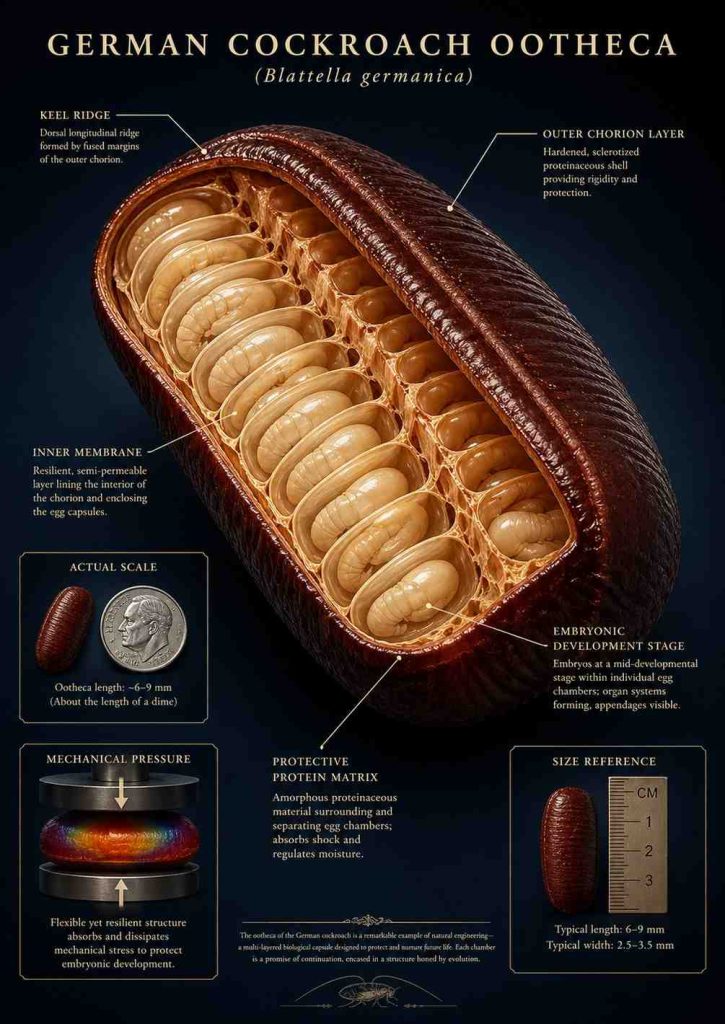
The ootheca is designed for protection, not for scattering.
The cockroach egg case, the ootheca, is a hardened, protein-shelled capsule that houses multiple embryos in individual egg chambers. It is not a fragile sac that ruptures on impact and scatters dozens of ready-to-hatch eggs across your floor.
The ootheca's structure is specifically engineered to protect developing embryos from:
- Physical pressure
- Desiccation (drying out)
- Moderate chemical exposure
- Environmental disturbance
When you crush a cockroach, you crush the cockroach. What happens to any ootheca present depends on whether she was actually carrying one and where it was in the reproductive cycle.
Most Cockroaches You Step On Are Not Gravid Females
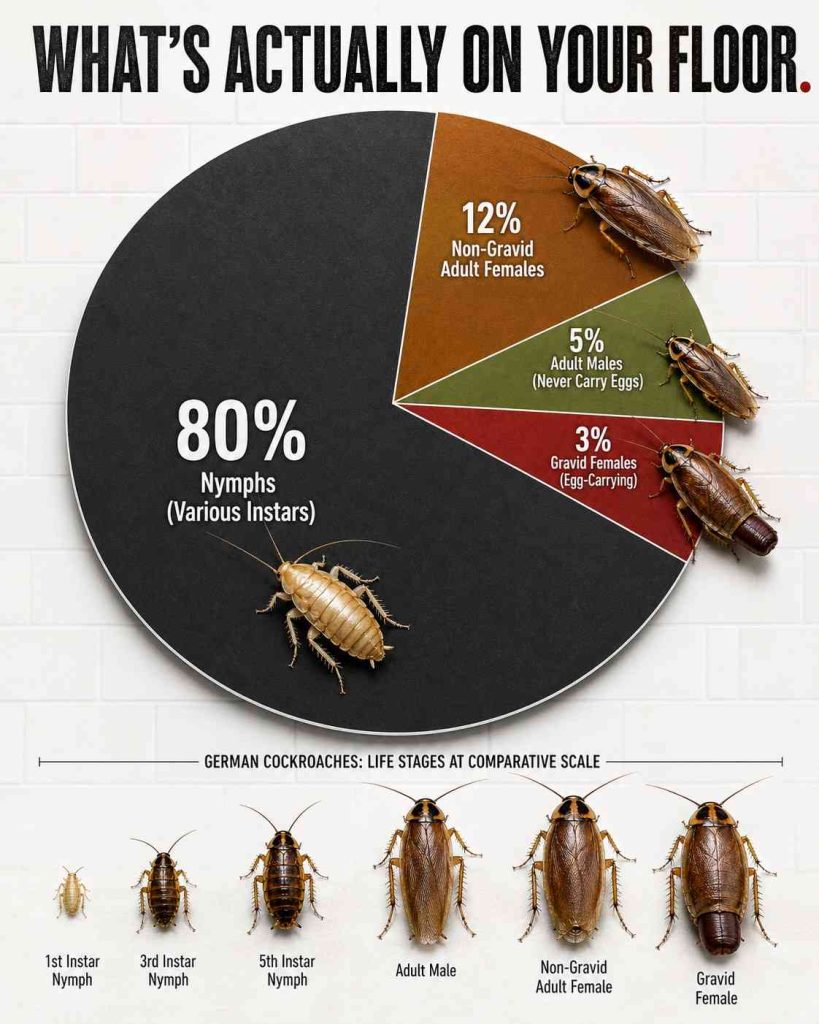
This is a statistical reality that the myth completely ignores. A cockroach colony consists of the following:
- Adult males (who never carry eggs ever)
- Adult females (only gravid during specific reproductive phases)
- Nymphs at various instar stages (immature cockroaches that cannot reproduce)
In a typical German cockroach (Blattella germanica) population, research estimates that nymphs make up approximately 80% of the colony at any given time. The roach running across your floor is statistically far more likely to be a nymph or a non-gravid adult than a gravid female actively carrying an ootheca.
What Happens If You Do Step on a Gravid Female
If the cockroach you crush does happen to be a gravid female carrying an ootheca, the outcome depends heavily on species and reproductive stage.
German Cockroach: The Carrier Species
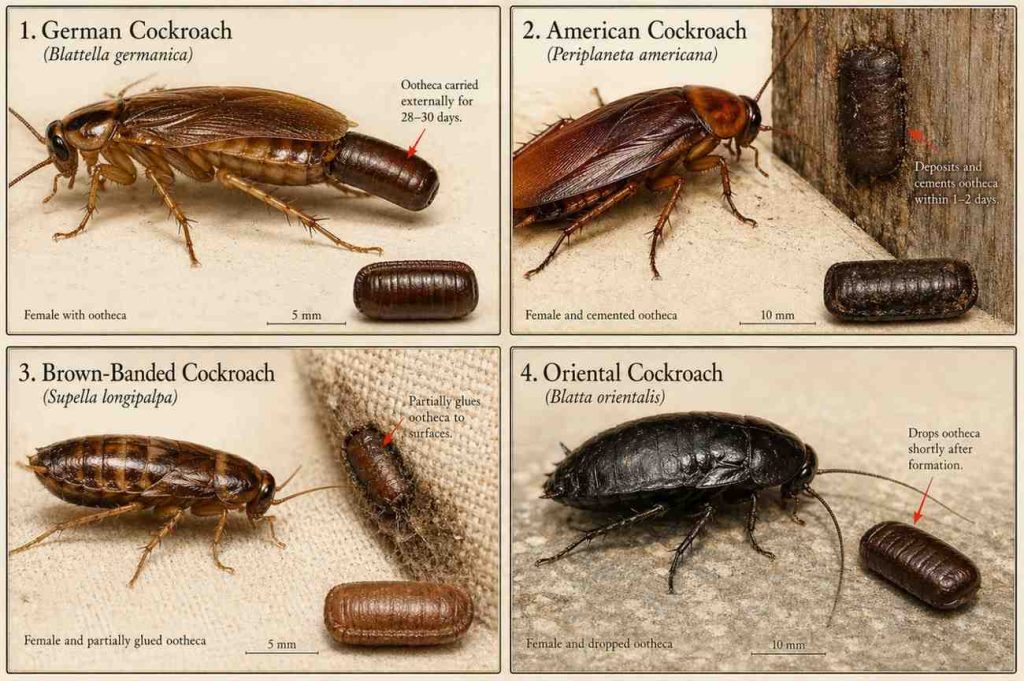
The German cockroach is the species most commonly associated with indoor infestations, and she exhibits oothecophore behavior; she carries her ootheca externally attached to her abdomen for nearly the entire incubation period of 28 to 30 days, only dropping it 1 to 2 days before hatching.
If you step on a gravid German cockroach:
The crushing force will likely destroy both the female and the ootheca together
Even if the ootheca is separated from the female by the impact, a detached ootheca has significantly reduced hatching success, particularly in early and mid-incubation stages
The ootheca requires the female's body warmth and positioning near suitable harborage to maintain optimal incubation conditions
A detached ootheca lying on a hard floor in an open environment faces desiccation and temperature stress that substantially reduce viability
The scenario where crushing a German cockroach "releases" dozens of viable, ready-to-hatch eggs is biologically implausible under normal household conditions.
American Cockroach: The Depositor Species
The American cockroach (Periplaneta americana) behaves differently. The female deposits her ootheca within 1 to 2 days of forming it, cementing it to a protected surface using an adhesive secretion. By the time you encounter an American cockroach walking across your floor, she almost certainly is not carrying an ootheca; she deposited it elsewhere, likely in a dark crack or crevice days or weeks ago.
Stepping on her does not affect the egg cases she has already deposited. Those are separate entities in separate locations.
Brown-Banded Cockroach: The Fabric Hider
The brown-banded cockroach (Supella longipalpa) carries her ootheca briefly before gluing it to surfaces, often furniture, cardboard, or fabric in warm, dry locations. Again, by the time she's mobile and visible to you, the ootheca is typically already deposited.
Oriental Cockroach: The Dropper
The Oriental cockroach (Blatta orientalis) drops its ootheca in protected locations rather than firmly cementing it. But like other depositor species, she is typically not carrying it when encountered in the open.
Can a Roach Egg Sac Survive Being Crushed?
This question gets to the heart of another layer of the myth: even if the ootheca is somehow dislodged or separated during stepping, can the eggs inside still hatch?
The answer is it depends, but generally, the survival rate drops significantly.
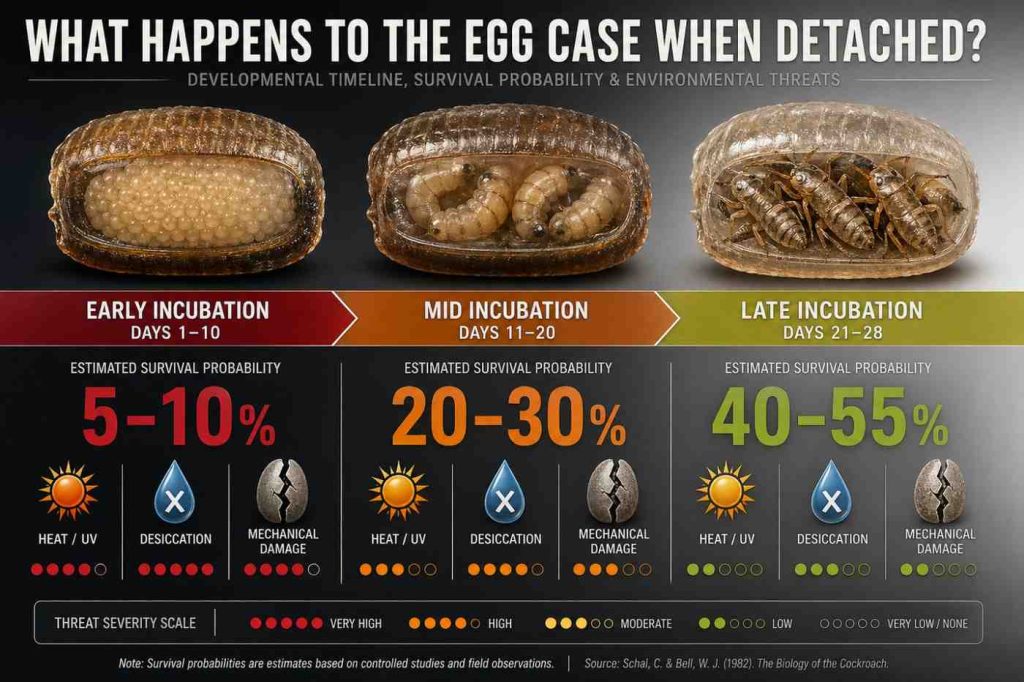
Physical Crushing of the Ootheca Itself
If the ootheca is directly crushed under a shoe, the embryos inside are destroyed. The pressure required to crush a cockroach is more than sufficient to compromise the ootheca's structure and kill the developing embryos inside.
The ootheca is protective, but it is not indestructible. It is designed to resist environmental hazards, not direct mechanical destruction.
A Partially Separated or Intact Ootheca on the Floor
This is the scenario most relevant to the myth. If a gravid female is stepped on and the ootheca separates from her body without being directly crushed, can it still hatch?
In early to mid incubation: Viability drops sharply. The embryos depend on stable warmth, humidity, and protected positioning to develop properly. An ootheca on a hard floor in the open loses thermal stability and faces desiccation.
In late incubation (close to hatching): A detached ootheca near the end of its incubation period has a higher, though still reduced, chance of producing some viable nymphs. This is the closest the myth gets to biological reality.
German cockroach-specific note: Because the German cockroach carries her ootheca until 1 to 2 days before hatching, the rare scenario where a late-term gravid female is crushed, and her ootheca survives intact, represents a very narrow window of genuine (if small) risk.
Important Note: Even in the most favorable scenario for the myth, a late-term gravid German cockroach is stepped on, ootheca surviving intact, you are dealing with a single egg case containing 30 to 40 eggs. Your infestation almost certainly already contains dozens or hundreds of previously deposited oothecae in hidden harborage sites. The marginal risk of this single event is negligible compared to the existing infestation dynamic.
Can Roach Eggs Stick to Your Shoes and Spread to Other Rooms?
This is a separate but related concern, and it deserves a direct answer.
Can roach eggs stick to shoe soles? Theoretically, yes. Is it a meaningful infestation spread mechanism? In practice, almost never.
Here's why:
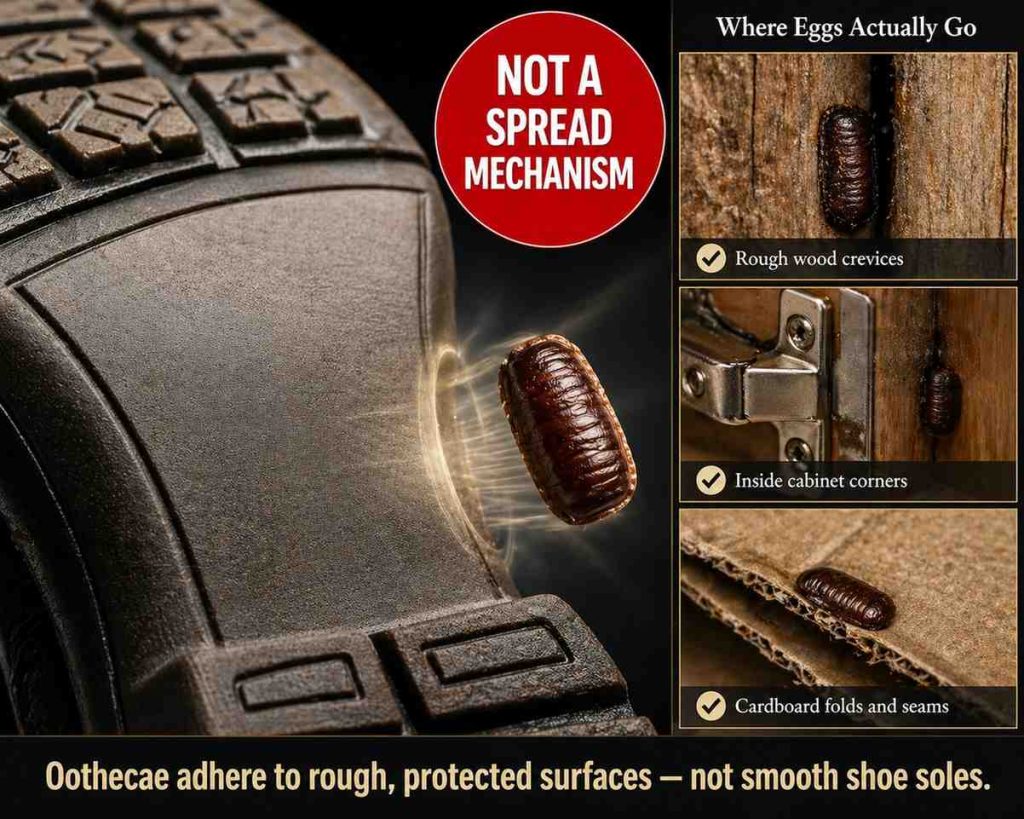
1. Oothecae are not lightweight. They don't float, drift, or attach easily to smooth shoe soles. Their adhesive properties are designed for substrate surfaces like rough walls, wood, cardboard, and fabric, not the smooth rubber or leather of shoe soles.
2. Direct crushing destroys the ootheca. If you've stepped directly on an ootheca, it's been crushed. An intact ootheca would need to be beside the roach, not under the shoe, to potentially survive.
3. Roach egg deposition happens in hidden, protected locations. You are unlikely to be walking directly over active egg deposition sites in normal household movement.
The shoe-sole transfer of roach eggs is not a meaningful pathway for infestation spread within a home. The far more significant spread mechanisms are the following:
Cockroaches walk between rooms and deposit eggs in new harborage sites
Infested secondhand furniture, cardboard boxes, or appliances are being brought into the home
Cockroaches are traveling through wall voids, utility penetrations, and shared plumbing spaces in multi-unit buildings
Does Killing One Roach Make an Infestation Worse?
Another layer of this myth suggests that killing cockroaches by any method somehow worsens an infestation. Let's address this directly.
No. Killing cockroaches does not make an infestation worse.
What can make an infestation worse:
- Using aerosol sprays that repel cockroaches rather than kill them, causing the population to scatter and redistribute to new harborage areas throughout the home
- Ignoring the source of the infestation, addressing visible roaches while leaving harborage sites, food sources, and moisture issues untouched
- Failing to address egg cases in existing harborage locations, allowing new nymphs to hatch continuously and replenish the population
Stepping on a roach and killing it removes one individual from the colony. It does not scatter eggs, does not attract more roaches in any meaningful way beyond the pheromones already present in the infestation environment, and does not worsen your problem.
Pro Tip: The most dangerous pest control mistake is not stepping on a roach; it's reaching for an aerosol spray can. Broad-spectrum aerosol repellents cause cockroaches to scatter into new areas of the home, potentially spreading the infestation from one room to several. Targeted gel baits and insect growth regulators are far more effective and far less disruptive.
What Crushed Roaches Actually Do: The Real Risks
While the egg-spreading myth is not supported by biology, crushed cockroaches do present some legitimate concerns worth understanding.
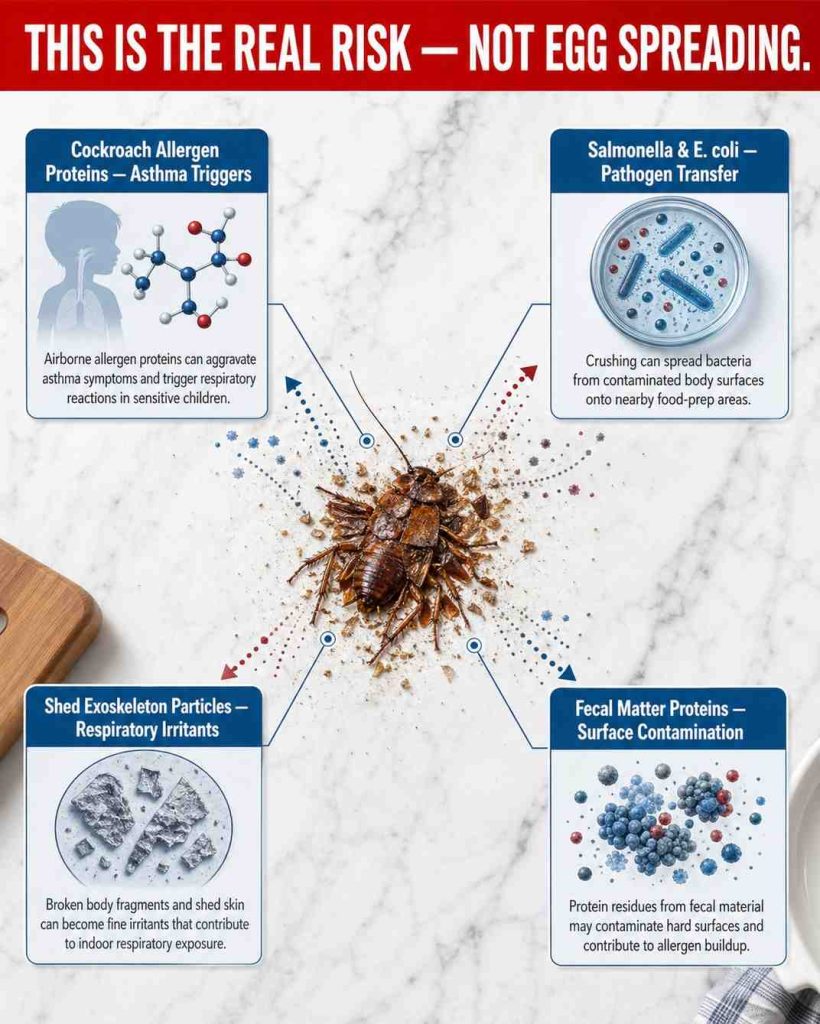
Allergens and Pathogen Exposure
Cockroaches are documented public health pests and significant allergen sources. Their bodies contain proteins derived from:
- Feces and droppings: fecal spotting left on surfaces
- Cast skins (shed exoskeletons) from molting through nymph instars
- Saliva and digestive secretions
- Body proteins from crushed individuals
These proteins are established asthma triggers and allergen sources, particularly for sensitized individuals and children in urban environments. Research published in the Journal of Allergy and Clinical Immunology has documented the link between cockroach allergen exposure and pediatric asthma morbidity.
When you crush a cockroach on a kitchen counter, floor, or food-preparation surface, you are spreading these biological materials across that surface. This is a legitimate sanitation concern.
Bacteria and Pathogen Contamination
Cockroaches carry and mechanically transmit bacteria, including Salmonella, E. coli, and other pathogens, on their body surfaces, legs, and digestive systems. A crushed roach on a food-contact surface is a contamination event.
What to do after crushing a cockroach:
1. Do not use a bare hand to clean up the remains
2. Use a paper towel or disposable material to collect the crushed body
3. Discard in a sealed bag in an outdoor bin
4. Clean the surface thoroughly with a disinfectant cleaner
5. Wash your hands
Can Crushed Roaches Attract More Roaches?
There is some evidence that certain cockroach species respond to the chemical signals (including specific fatty acids) released from crushed conspecifics. However, this effect is minor compared to the aggregation pheromones already present in any active infestation environment.
In a home with an existing infestation, the pheromone environment is already established. The incremental signal from a single crushed individual is not a meaningful driver of additional roach attraction.
Where Cockroaches Actually Lay Eggs: The Real Infestation Concern
Understanding where oothecae are actually deposited is far more valuable than worrying about what happens when you step on a roach. This is where real infestation management begins.
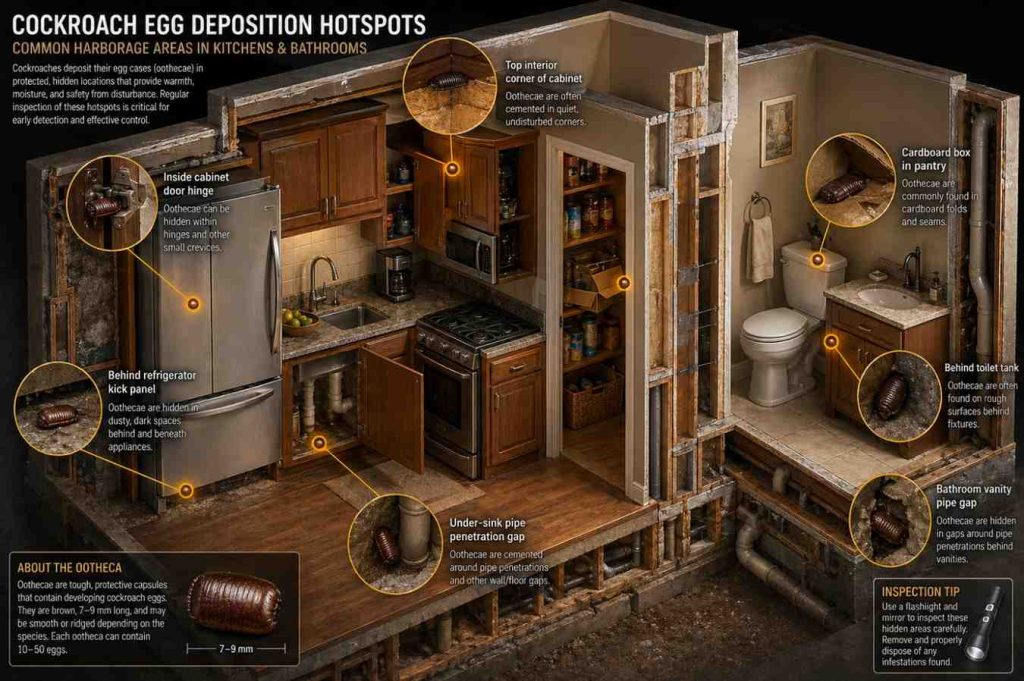
Common Egg Deposition Sites by Habitat
Kitchen:
- Behind and beneath the refrigerator (especially the kick panel area)
- Inside and behind the stove and oven
- Inside cabinet hinges and door frame gaps
- Under the sink, especially around pipe penetrations
- Inside cardboard boxes and paper bags stored in the pantry
- Along the tops of cabinet interiors where the wall meets the ceiling
Bathroom:
- Behind and beneath the toilet tank
- Under vanity cabinets around plumbing penetrations
- Inside wall voids accessed through gaps around pipes
- Behind loose baseboards
Throughout the home:
- Inside wall voids
- Behind electrical outlet boxes and switch plates
- Inside furniture seams and upholstery folds
- In cardboard clutter and storage boxes
- Inside electronics with warm motor compartments
What Cockroach Eggs Look Like
Knowing how to identify an ootheca is essential for effective inspection and removal.
- Shape: Elongated, purse-shaped, or rectangular capsule
- Color: Dark brown to reddish-brown; lighter tan when older or empty
- Size: 5mm to 12mm, depending on species
- Texture: Smooth to slightly leathery surface with a distinctive ridged seam (keel) along one edge
- Location: Tucked into cracks, corners, fabric folds, or glued to rough surfaces
- Empty casings: Collapsed, lighter in color, open along the keel, indicating nymphs have already emerged
How to Actually Get Rid of Roach Eggs and Stop an Infestation
Now that we've separated myth from fact, let's focus on what genuinely works. This is where the real value lies and where most people need clear, actionable guidance.
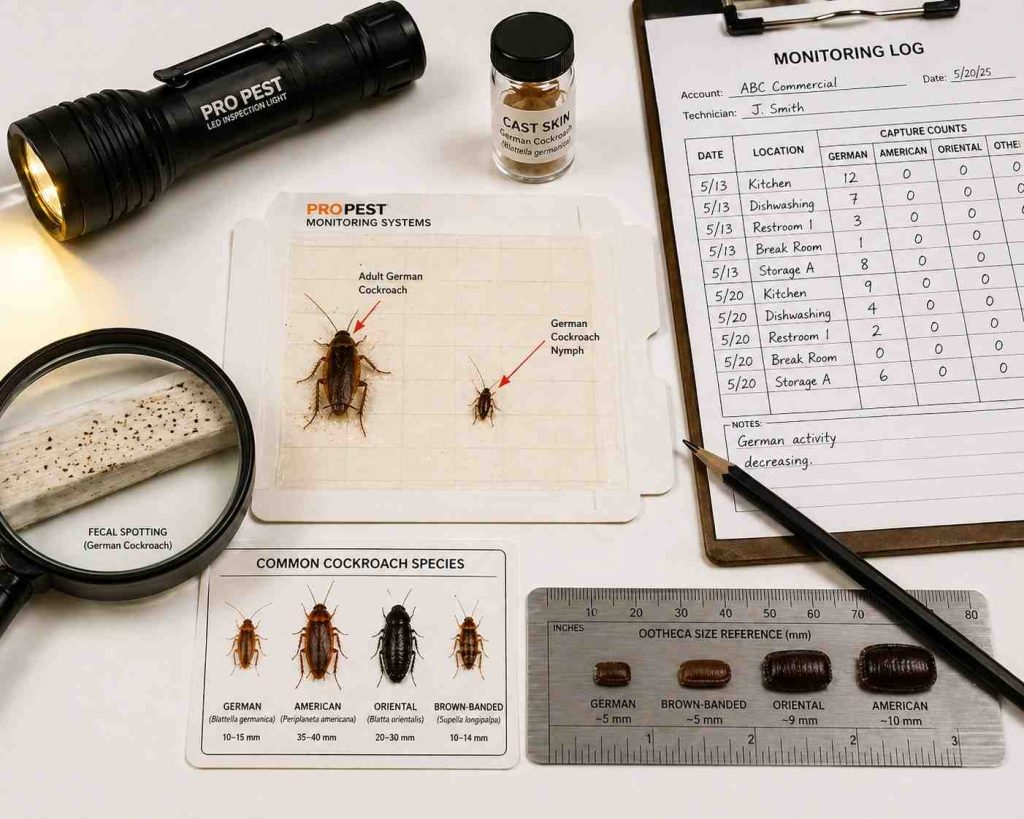
Step 1: Inspection and Monitoring
Before treating anything, you need to know what you're dealing with.
- Place glue boards (sticky traps) in high-activity areas: under the refrigerator, inside cabinet corners, under the sink, and along baseboards
- Check traps after 24 to 48 hours to assess population level and species identity
- Inspect harborage sites with a flashlight, looking for live roaches, nymphs, cast skins, fecal spotting (dark smear marks), and oothecae
- Use a monitoring plan to track population changes over the course of treatment
Step 2: Sanitation: Eliminate What Sustains the Infestation
Cockroaches survive because your home provides food, water, warmth, and harborage. Eliminate those resources, and you remove the foundation that supports the infestation.
Sanitation priorities:
Store all food in sealed containers: no open bags, boxes, or food residue on counters
Clean beneath and behind appliances regularly; food debris accumulates in refrigerator kick panels, under stoves, and around toasters
Fix leaking pipes and faucets. Moisture sources are critical attractants
Eliminate cardboard clutter; cockroaches use it as both harborage and food
Take out garbage regularly and use bins with sealed lids
Clean grease from stove surfaces, range hoods, and backsplashes
Step 3: Physical Egg Case Removal
Do not leave oothecae in place hoping they won't hatch. Remove them.
Protocol for egg case removal:
1. Use a HEPA vacuum to physically remove oothecae from surfaces. HEPA filtration ensures that allergen particles and any dislodged egg contents are captured rather than redistributed into the air
2. Immediately seal the vacuum bag in a plastic bag and dispose of it in an outdoor bin
3. After vacuuming, apply a targeted treatment to the harborage area (see below)
4. Do not use a standard vacuum without HEPA filtration; this can redistribute allergens and biological material throughout the home
Pro Tip: A HEPA vacuum is one of the most underused tools in residential cockroach management. It physically removes eggs, cast skins, fecal matter, and allergens in a single step, something no spray or bait can do. If you're serious about resolving a roach problem, invest in one.
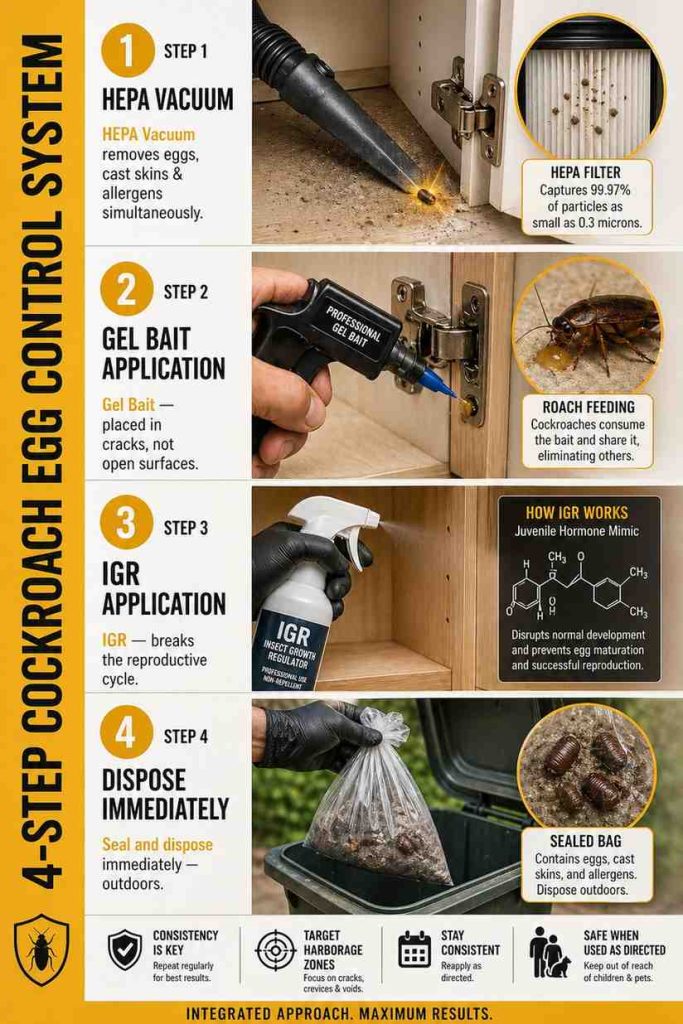
Step 4: Targeted Treatment Baits, Dusts, and IGRs
Gel bait is the gold standard of cockroach control for indoor infestations. Applied in small dabs directly into cracks and crevices near harborage sites, it allows cockroaches to self-dose and carry the active ingredient back to the colony through secondary poisoning via fecal contamination.
Effective application points:
- Inside cabinet hinges
- Along the tops of cabinet interiors
- Behind the refrigerator kick panel
- Under-sink pipe penetrations
- Along the inside base of the stove
Insect growth regulators (IGRs) such as hydroprene or pyriproxyfen are critical for breaking the reproductive cycle. IGRs mimic juvenile hormones, preventing nymphs from developing into reproductive adults. They do not kill eggs directly, but they ensure that nymphs that hatch from surviving oothecae cannot mature and reproduce.
Combined bait + IGR treatment is the backbone of professional integrated pest management (IPM) for cockroach infestations.
Insecticidal dusts, including boric acid, diatomaceous earth, and silica gel, are applied to void spaces, behind wall outlets, and in areas inaccessible to gel bait. They work through physical abrasion and absorption of the cockroach's waxy exoskeleton, causing death by desiccation. Dusts have long residual activity and are particularly effective in wall voids and cabinet interiors.
Crack-and-crevice treatment with residual insecticide or dust targets harborage sites where eggs are deposited, and nymphs congregate.
Step 5: Exclusion: Close the Pathways
Preventing reinfestation requires sealing the entry points cockroaches use to access and move through your home.
Priority exclusion points:
- Pipe penetrations through walls and floors (seal with silicone caulk or copper mesh)
- Gaps around drain lines under sinks
- Cracks in baseboards, wall junctions, and cabinet backs
- Gaps around electrical outlets and switch plates
- Door sweeps and threshold gaps
Step 6: Follow-Up Monitoring
A single treatment cycle is rarely sufficient for established infestations. Oothecae deposited before treatment began will continue to hatch over the coming weeks, producing new nymphs that need to encounter bait before reaching reproductive maturity.
- Check glue board traps weekly during the active treatment phase
- Replenish gel bait as it is consumed (fresh bait remains attractive; dried bait does not)
- Reassess at 4 weeks and 8 weeks post-treatment
- If the population remains high at 4 weeks, consider engaging a licensed pest management professional for a comprehensive inspection and treatment program
Signs of Cockroach Eggs in Your Home: What to Look For
You don't need to wait until you see a live roach to know you have a problem. Cockroach egg cases and the signs that accompany an active infestation are detectable before the population becomes visible.
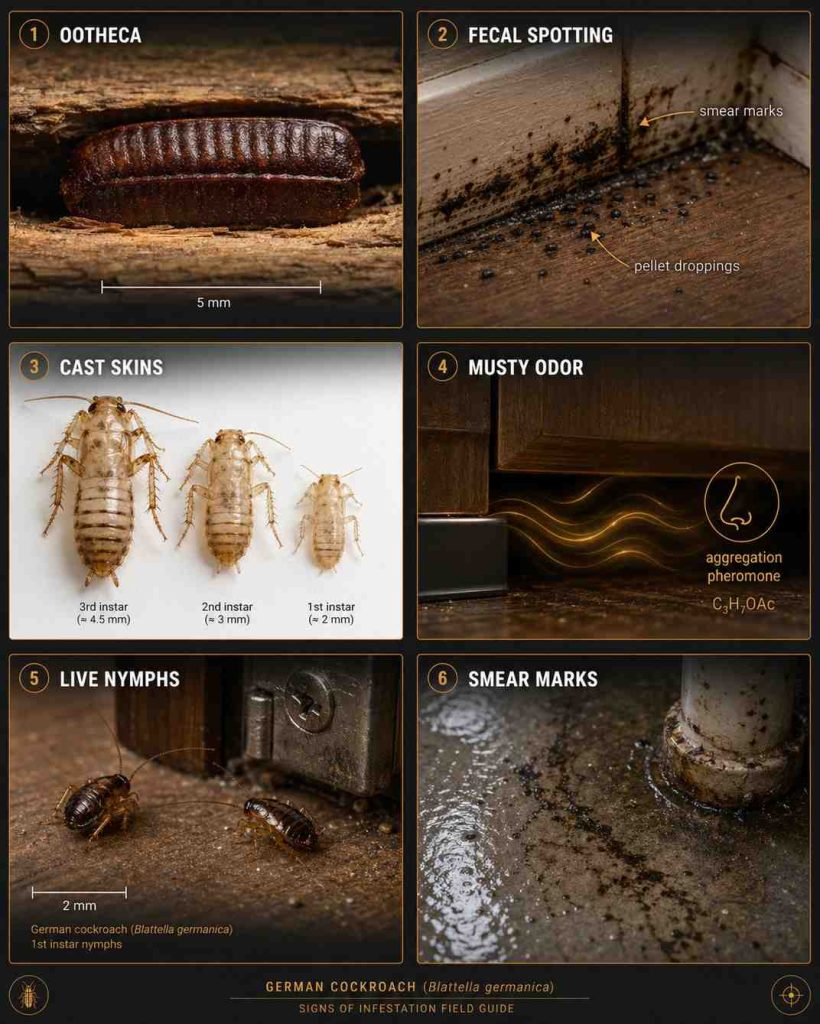
Signs of active egg deposition and infestation:
- Oothecae in harborage sites: small, dark, ridged capsules in cracks, corners, and hidden spaces
- Fecal spotting: dark brown smear marks or small pellets along baseboards, inside cabinet corners, and on surfaces near harborage
- Cast skins: pale, translucent shed exoskeletons from molting nymphs
- Musty odor: a distinctive, oily, musty smell produced by cockroach aggregation pheromones; intensifies with larger populations
- Live nymphs are small, fast-moving cockroaches, significantly smaller than adults, often seen near harborage sites
- Roach smear marks dark, irregular smears on horizontal surfaces in high-moisture areas
If you are observing multiple signs simultaneously, you are likely dealing with a mature infestation with active egg deposition occurring in multiple harborage sites throughout your home.
Should You Step on a Cockroach? The Honest Answer
Given everything covered above, here is the straightforward answer:
Stepping on a cockroach is not dangerous in the ways the myth suggests, but it's also not your best pest control strategy.
Here's the honest breakdown:
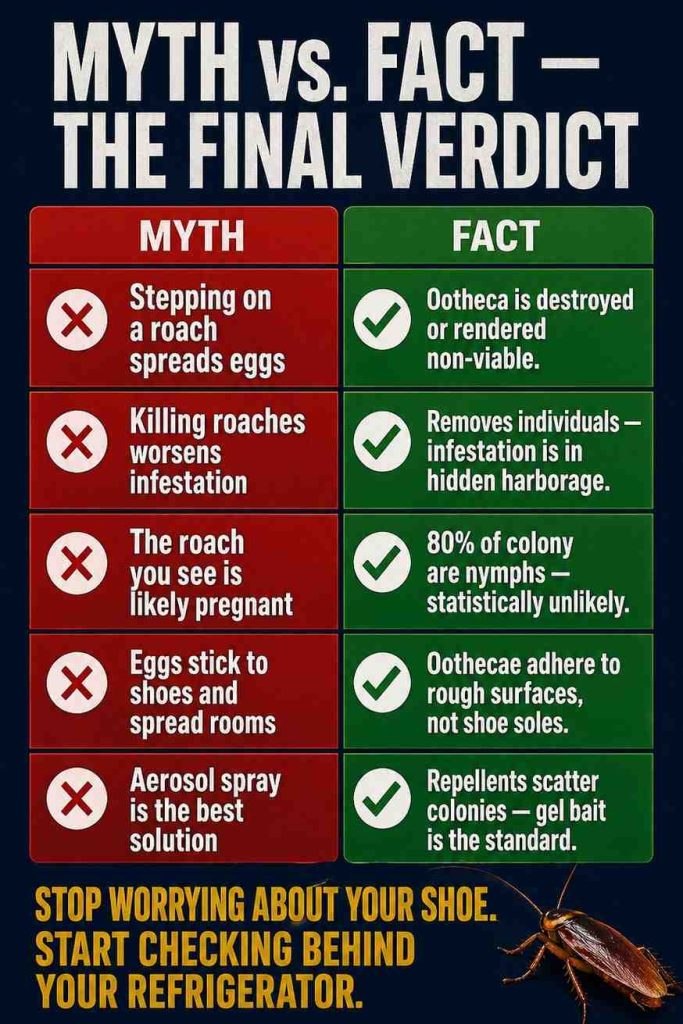
| Action | Reality |
| Stepping on a roach spreads eggs | False – not a meaningful risk under normal conditions |
| Stepping on a roach makes the infestation worse | False – removing one individual does not worsen a colony |
| Stepping on a roach solves your problem | False – visible roaches represent a fraction of the population |
| Stepping on a roach contaminates the surface | True – allergens and bacteria require surface disinfection |
| Killing roaches with aerosol spray worsens the spread | Potentially true – repellent aerosols can scatter the population |
The real problem with stepping on cockroaches as a pest control strategy isn't that it spreads eggs; it's that it addresses a symptom while the underlying infestation continues untreated in hidden harborage sites throughout your home.
Conclusion
The myth that stepping on roaches spreads eggs is exactly that: a myth. Does stepping on roaches spread eggs? The biology is clear: it doesn't, at least not in any way that meaningfully worsens an infestation. The ootheca is a hardened, protective capsule that doesn't rupture and scatter ready-to-hatch eggs when a cockroach is crushed. Most cockroaches you encounter are not gravid females. And even in the rare cases where they are, a detached ootheca on a hard floor faces conditions that drastically reduce its viability.
What should concern you is not what happens to the roach you just stepped on; it's what's happening in the hidden harborage sites you can't see behind your refrigerator. Inside your cabinet are hinges under your sink. That's where the oothecae are, that's where the nymphs are hatching, and that's where your pest management effort needs to be focused.
Inspect. Sanitize. Bait with gel. Apply IGRs. Vacuum with HEPA filtration. Seal entry points. Monitor consistently. And if the infestation is beyond what these measures can address, call a licensed pest management professional because the cost of professional extermination is always lower than the cost of a mature, unchecked infestation.
Stop worrying about the roach under your shoe. Start addressing what's behind your walls.
FAQ
Does stepping on a cockroach spread eggs?
No, stepping on a cockroach does not spread eggs in any meaningful way. The ootheca (egg case) is a hardened capsule that does not rupture and scatter viable eggs when crushed. Most cockroaches encountered are not carrying an egg case, and even if they are, a crushed or detached ootheca has dramatically reduced viability under open household conditions.
What happens if you step on a pregnant cockroach?
If you crush a gravid female cockroach, the ootheca she is carrying will likely be destroyed along with her body. In the unlikely event the ootheca separates intact, its viability depends on incubation stage, temperature, and humidity. A detached ootheca in the open loses the thermal stability and protection it needs, significantly reducing the chance of successful hatching.
Can roach eggs stick to shoes and spread to other rooms?
This is not a meaningful infestation spread mechanism. Cockroach oothecae are not lightweight or structured to adhere to smooth shoe soles. Crushing a roach destroys the egg case directly beneath your foot. The far more significant spread mechanisms are cockroaches walking between rooms, shared appliances, infested cardboard boxes, and building shared wall voids.
Can a cockroach egg case hatch after the mother dies?
Yes, under the right conditions. Oothecae are self-contained incubation chambers that do not require the mother's presence to complete development except in German cockroaches, where the female carries the egg case, and her body heat contributes to development. A detached or deposited ootheca in a warm, humid harborage site can hatch independently, which is why removing egg cases from harborage sites is essential.
What do cockroach eggs look like, and where are they found?
Cockroach eggs are enclosed in a dark brown, purse-shaped capsule called an ootheca, measuring 5mm to 12mm with a distinctive ridged seam along one edge. They are found in dark, protected harborage sites inside cabinet hinges, behind refrigerators, under sinks around pipe gaps, inside cardboard boxes, along baseboards, and in wall voids.
How do I get rid of cockroach egg cases in my home?
Use a HEPA vacuum to physically remove oothecae from harborage sites, then seal the vacuum contents in a bag and dispose of them outdoors. Apply gel bait and insect growth regulators (IGRs) to harborage areas to kill hatching nymphs. Seal cracks and crevices to eliminate future deposition sites. Follow up with monitoring traps to assess treatment effectiveness.
Does killing cockroaches make an infestation worse?
Killing individual cockroaches does not worsen an infestation. What can worsen it is using broad-spectrum aerosol repellent sprays, which scatter the population to new areas of the home. Targeted gel baits, IGRs, insecticidal dusts, and sanitation improvements are an effective approach to eliminating the population rather than redistributing it.