

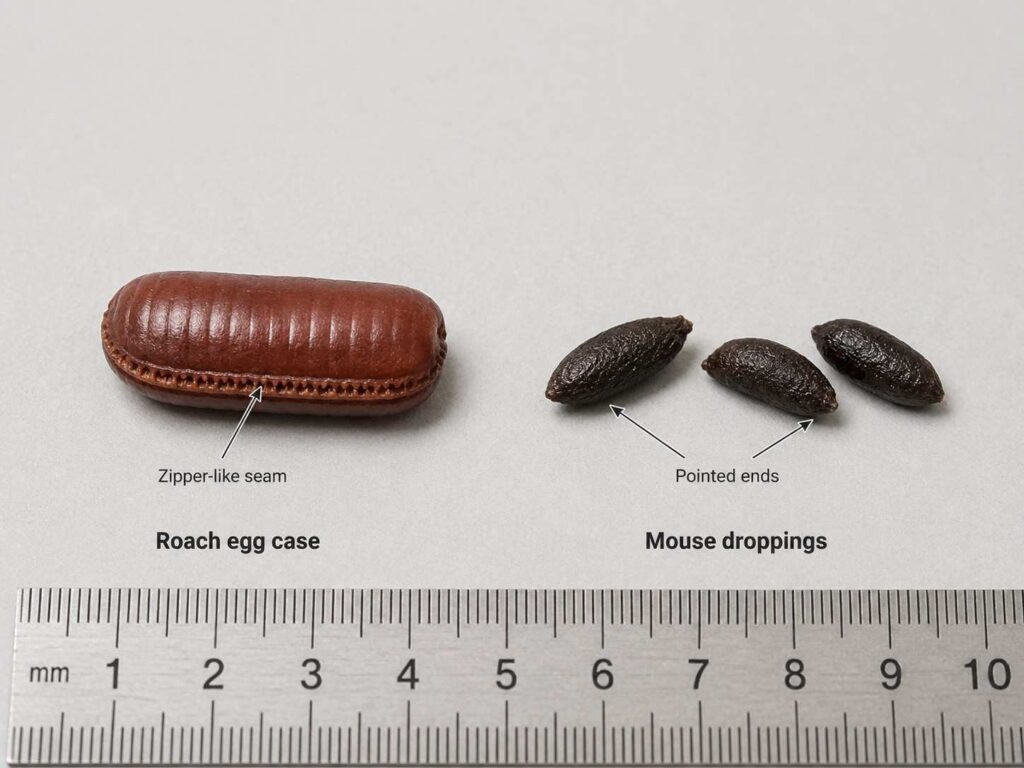
You found a small, dark, rice-sized object in your kitchen, drawer, or basement. Now you need to know: is it a roach egg case or a mouse dropping? The two are confused constantly because both are brown to black and roughly the size of a grain of rice. But they are completely different things; one is a developing egg case (an ootheca) and the other is rodent waste.
This visual comparison guide tells them apart with tables, a five-second ID test, and a room-by-room map. Getting the ID right matters: a roach egg case means cockroaches are breeding indoors, while mouse droppings mean a rodent is active and each requires different cleanup and treatment.
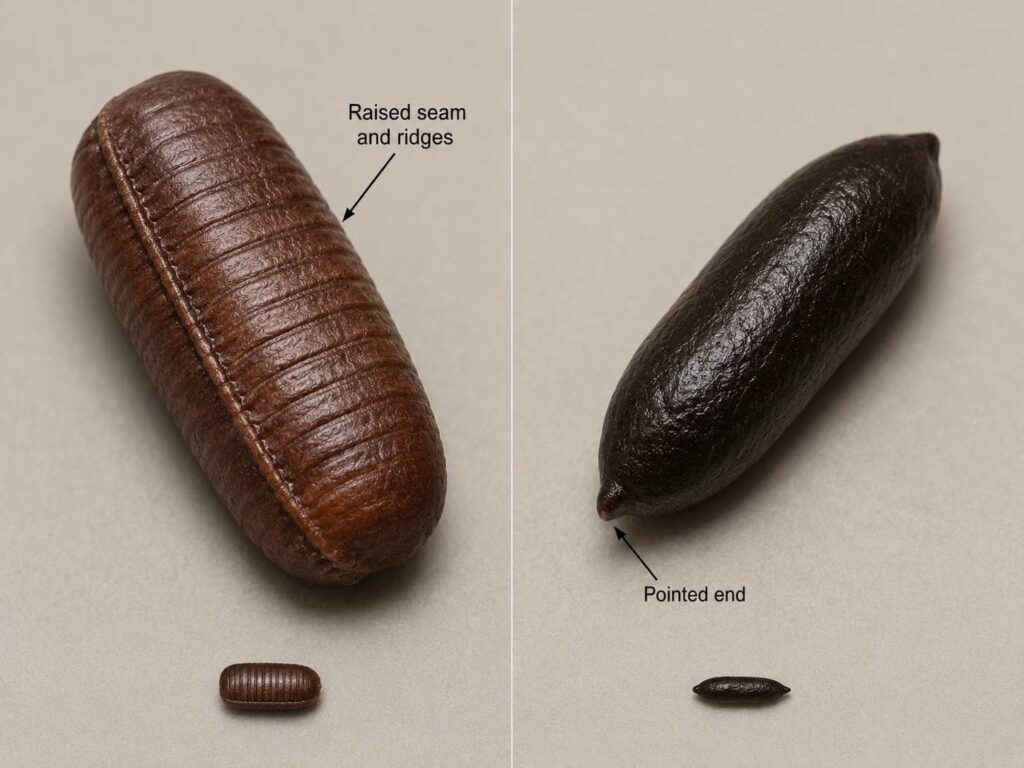
Featured answer: A roach egg (ootheca) is a hard, leathery capsule with a ridged seam along one edge, 5–13 mm long, usually found as a single glued or hidden object. A mouse dropping is solid rodent waste, rod- or rice-shaped with pointed ends, about 3–6 mm long, found scattered in groups along walls. If the object has a seam and ridges, it is a roach egg. If it is a smooth pellet with pointed ends, it is a mouse dropping.
At-a-Glance: Roach Egg vs Mouse Dropping
Start here. This master table covers the differences you can see with a flashlight and a magnifying glass.
| Attribute | Roach egg case (ootheca) | Mouse dropping |
| What it actually is | A protective protein case holding cockroach embryos | Solid waste (feces) from a rodent |
| Size | 5–13 mm (~1/4–1/2 in); grain of rice to small bean | 3–6 mm (~1/8–1/4 in); close to a grain of dark rice |
| Shape | One uniform capsule: purse, bean, or pill shape | Rod-shaped or rice-shaped pellet |
| The ends | Sealed by a raised seam (the keel); no taper | Pointed or tapered at one or both ends |
| Surface | Hard, leathery, glossy; horizontal ridges/segment lines | Smooth, uniform; fresh = shiny, old = dull |
| Color | Tan → reddish-brown → dark brown/near black (darkens as it matures) | Black/dark brown when fresh; fades to gray-brown when old |
| Texture when pressed | Hard, does not crumble (wear gloves if testing) | Crumbles or powders when dry; soft/moist when fresh |
| Contents | Embryos inside; no hair | Digested waste; may contain tiny embedded hairs from grooming |
| How many you find | Usually one to a few; hidden | Many at once; a single mouse leaves 50–75 droppings per day |
| Pattern | Glued or dropped in a single protected spot | Scattered along travel routes, often in lines along walls |
| What it means | Roaches are breeding indoors | A rodent is active and feeding/nesting nearby |
The single fastest clue: look at the ends. Pointed ends = mouse dropping. A seam or ridge = roach egg case. This one feature resolves the great majority of cases.
The 5-Second ID Test
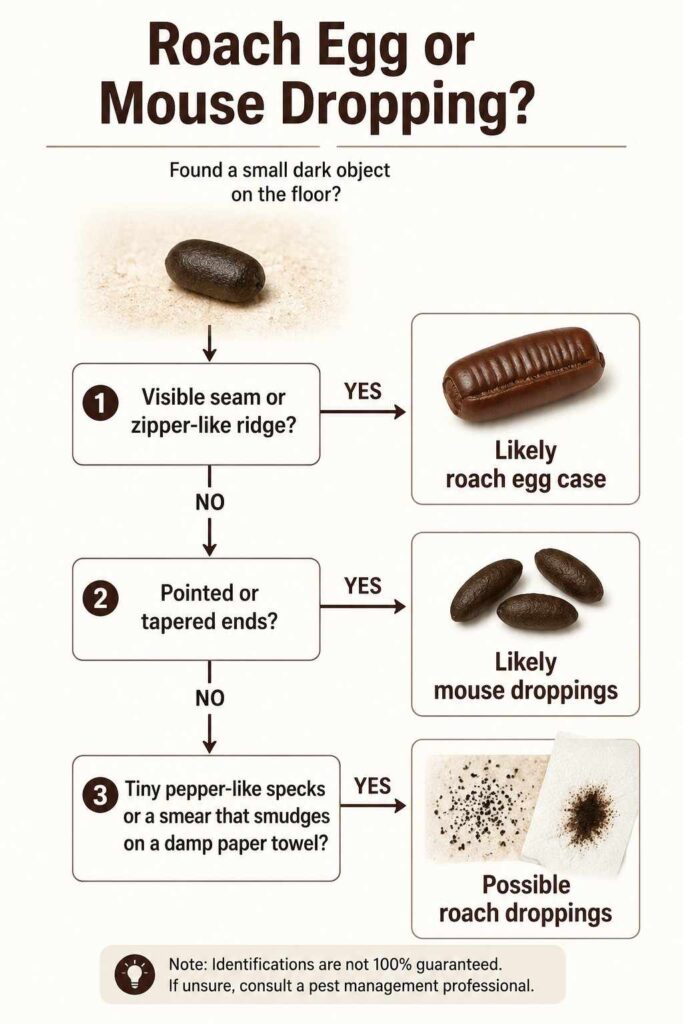
Use this quick decision table the moment you spot the object.
| Question | If YES → | If NO → |
| Does it have a visible seam, ridge, or “zipper” line along one edge? | Roach egg case | Go to the next row |
| Are the ends pointed or tapered? | Mouse dropping | Likely not mouse; check for a seam again |
| Is it one structured capsule (not a loose pellet)? | Roach egg case | Mouse dropping or other debris |
| Are there many of them scattered along a wall or baseboard? | Mouse droppings | A lone hidden capsule = roach egg |
| Does a damp paper towel wipe it into a smear (no real shape)? | Roach droppings (not an egg see three-way table below) | Solid pellet = mouse dropping |
Don’t Forget the Third Lookalike: Roach Droppings
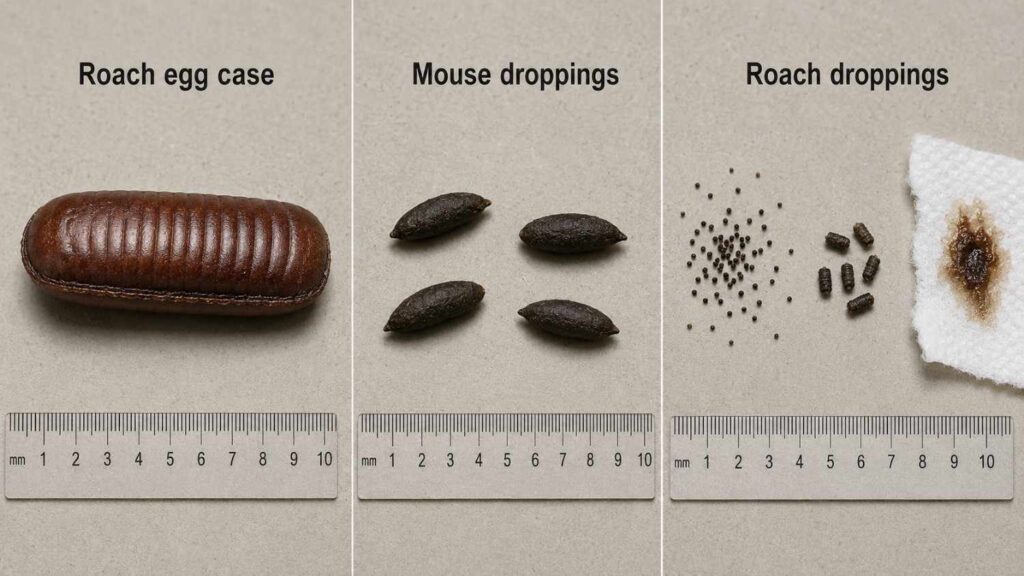
Many people actually have three dark objects to sort: a roach egg, a mouse dropping, and roach droppings (frass). This three-way table clears it up at once.
| Feature | Roach egg (ootheca) | Mouse dropping | Roach dropping (frass) |
| Size | 5–13 mm | 3–6 mm | <1 mm specks to ~2–3 mm pellets |
| Shape | Capsule (purse/bean/pill) | Rod/rice pellet | Specks, cylinders, or smears |
| Ends | Seam/keel (no taper) | Pointed | Blunt |
| Surface | Ridged, glossy | Smooth | Ridged (pellets) or powdery (specks) |
| Quantity | One to a few | Many (50–75/day) | Numerous specks/pellets |
| Smear test | No (it is a solid case) | No (solid pellet) | Yes smears like dark ink |
| Means | Roaches breeding | Rodent active | Roaches feeding |
Pro tip (smear test): with gloves on, wipe the object with a damp paper towel. If it smears into a dark brown/black stain, it is roach droppings, not an egg, and not mouse waste. A real egg case and a mouse pellet both hold their shape.
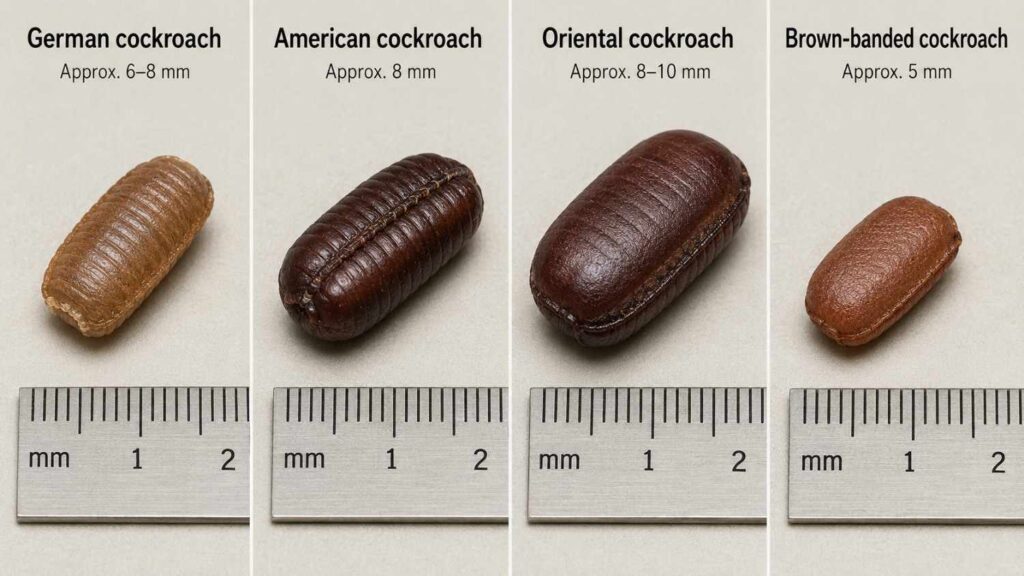
Roach Egg Cases by Species
Not every roach egg case looks the same. Matching the case to the species tells you where else to look.
| Species | Egg case size | Color | Eggs inside | Carried or deposited? | Where you find it |
| German (Blattella germanica) | 6–8 mm (~1/4 in) | Light brown/tan, slightly translucent | 30–40 (up to 50) | Carried by female until 24–48 h before hatch | Rarely loose; under sink, cabinet hinges, drawer slides, behind fridge |
| American (Periplaneta americana) | ~8 mm (~3/8 in) | Reddish-brown → near black within 1–2 days | 14–16 | Glued/deposited within 1–2 days | Behind appliances, near pipes, basements (humid spots) |
| Oriental (Blatta orientalis) | 8–10 mm (~3/8 in) | Dark reddish-brown → near black | 16–18 | Dropped in debris | Basements, drains, crawl spaces (cool, damp) |
| Brown-banded (Supella longipalpa) | ~5 mm (~3/16 in) | Light reddish-brown, less ridged | 10–18 | Glued to surfaces | Furniture seams, behind pictures, inside electronics |
The University of Florida reports each German ootheca holds 30–40 eggs in two rows inside an 8 mm case (UF/IFAS EDIS The German Cockroach, IN028). A single female produces 5–8 oothecae in her lifetime (NC State Extension Biology and Behavior of the German Cockroach). The American cockroach egg case holds 14–16 eggs, with one female producing 9–10 cases (University of Florida Entomology American Cockroach).
Why this matters: German cockroach cases are rarely found loose because females carry them so a loose case is more often American, Oriental, or brown-banded. American cases turn near-black quickly and are the most likely to be confused with a dark mouse pellet.
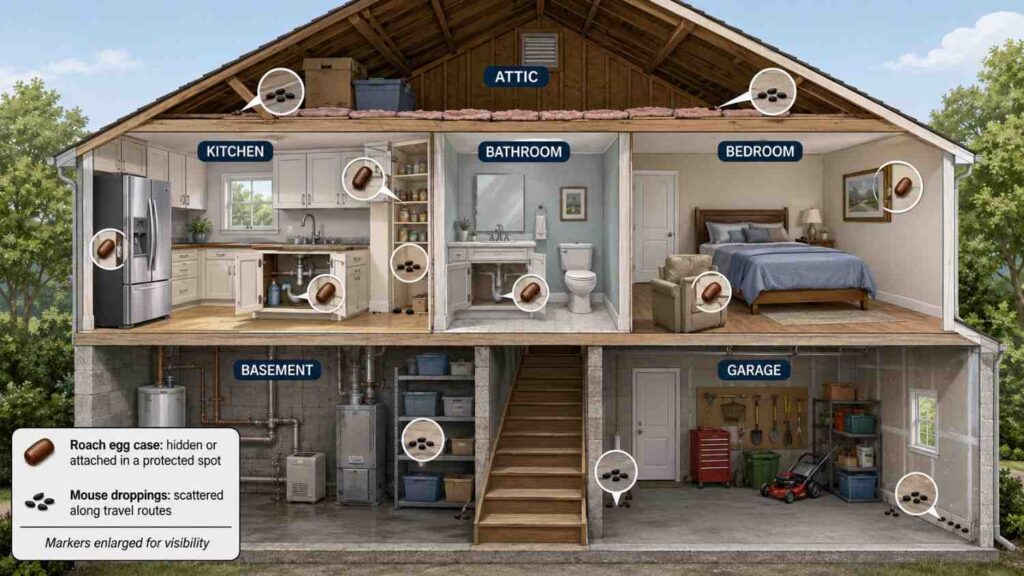
Where You’ll Find Each Sign (Room-by-Room Map)
Location is a strong secondary clue. Mice and roaches prefer different zones.
| Area | If it’s a roach egg case | If it’s mouse droppings |
| Kitchen | Behind/under fridge & stove, inside cabinet hinges, under sink, drawer slides | Inside drawers, behind/under appliances, inside pantry, along baseboards |
| Bathroom | Under sink, around pipes, cabinet interiors | Under sink, behind toilet, along vanity baseboards |
| Living areas / bedrooms | Brown-banded cases glued to furniture seams, behind pictures, in electronics | Along baseboards, inside closets, under furniture, in storage boxes |
| Basement / garage / attic | American/Oriental cases near pipes, drains, in cardboard | Along walls, in stored boxes, near nesting material, in attics |
| Pattern across the home | A few hidden capsules in protected spots | Scattered “trails” along walls and travel routes |
Inspection tip: Mice travel along edges and walls, so droppings form lines and clusters near baseboards. Roach egg cases are tucked into single protected crevices. If the objects are strung out along a wall, think mouse. If it is one capsule wedged in a crack, think roach egg.
How Serious Is It? What Each Sign Means
The two signs point to different pests and different urgency.
| Sign | What it confirms | Severity read |
| Roach egg case (ootheca) | Cockroaches are breeding indoors | One viable case can release dozens of nymphs; population will multiply |
| Mouse droppings | A rodent is active | A single mouse leaves 50–75 droppings/day; many droppings = active infestation |
| Both found together | Dual infestation | You have both a rodent and cockroaches treat both, and call a professional |
Severity quick-read for mouse droppings:
- A few isolated pellets → early or a single wandering mouse.
- Dozens of pellets along walls → active, established mouse.
- Fresh, shiny, dark pellets (vs. old gray crumbly ones) → activity within the past 24–48 hours.
Health Risk Comparison
Both signs carry health risks, but the risks differ in type and how you must clean them up.
| Risk | Roach egg case | Mouse droppings |
| Primary hazard | Drives cockroach infestation → allergens and bacteria | Hantavirus, LCMV, Salmonella, parasites |
| Allergy/asthma | Emerging roaches spread allergens that trigger asthma, especially in children (CDC/ATSDR Environmental Triggers of Asthma) | Rodent urine/droppings also carry allergens |
| Aerosolization danger | Low from the case itself | High sweeping or vacuuming dry mouse droppings can release virus particles you inhale |
| Who is most at risk | Children, people with asthma | Anyone; pregnancy risk with LCMV; severe respiratory illness with hantavirus |
Critical safety rule: Never sweep, dust, or vacuum dry mouse droppings. Disturbing them can aerosolize harmful viruses. Always wet them first with a disinfectant, then wipe them up.
Safe Cleanup: Roach Egg vs Mouse Droppings
The cleanup method differs because the hazards differ. Follow the correct protocol for what you found.
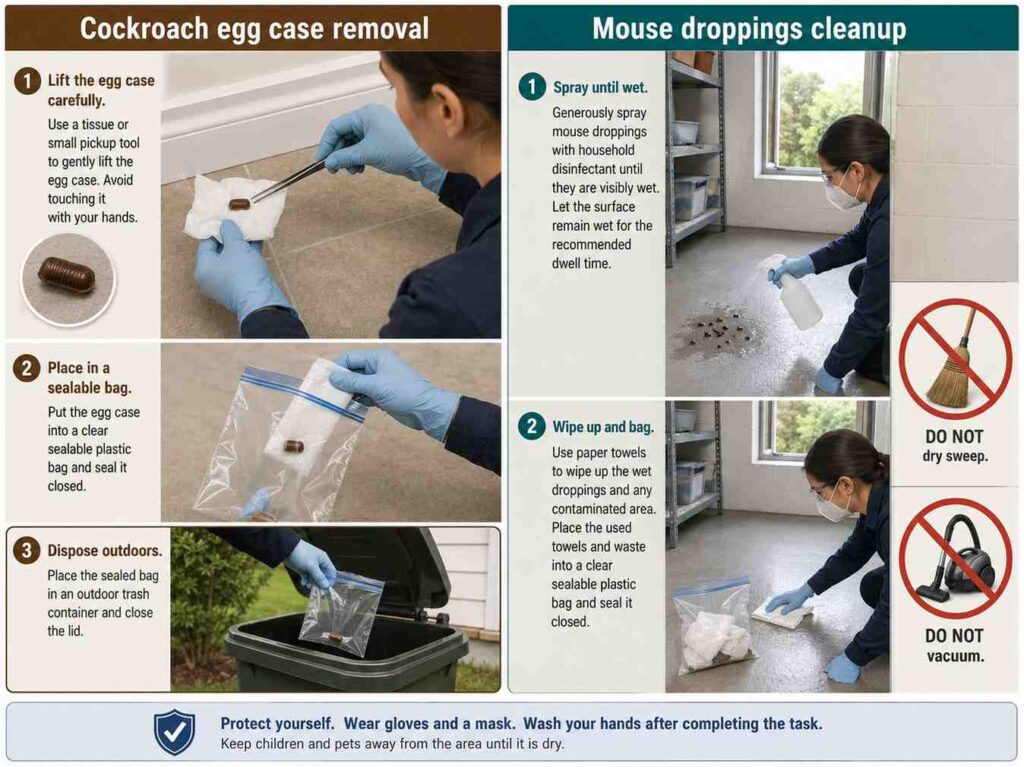
Removing a roach egg case
- Wear gloves. Avoid bare-hand contact.
- Vacuum with a HEPA-filter vacuum, or lift it with a tissue/tool. Physical removal is the most reliable way to neutralize a viable case, because most sprays cannot penetrate the shell.
- Seal it in a plastic bag at once. A viable case can still hatch if merely swept into a bin.
- Freeze the sealed bag for several days to kill the embryos before disposal, or throw it in an outdoor trash bin.
- Do not crush it bare-handed or on an open surface.
- Treat the area afterward with gel bait and an insect growth regulator (IGR) to catch nymphs that hatch from any cases you missed.
Cleaning up mouse droppings
- Ventilate the area by opening windows for at least 30 minutes before you start.
- Wear gloves and a mask. Do not touch droppings with bare hands.
- Spray droppings with a disinfectant a 10% bleach solution (1 part bleach to 10 parts water) or a commercial disinfectant until they are fully wet. Never dry-sweep or vacuum.
- Wipe up with paper towels after the recommended contact time on the label.
- Seal all waste, paper towels, and gloves in a plastic bag, then dispose of it in an outdoor trash bin.
- Wash your hands thoroughly afterward.
- Mop or disinfect the surface again once the waste is removed.
Why the difference matters: Roach eggs are removed physically and frozen/disposed. Mouse droppings must be wetted before wiping to stop pathogens from going airborne. Treating one like the other can expose you to harm.
What NOT to Do
- Do not dry-sweep or standard-vacuum mouse droppings this aerosolizes harmful particles.
- Do not crush a roach egg case bare-handed or on food surfaces.
- Do not spray mouse droppings with insecticide it does not disinfect and does not solve a rodent problem.
- Do not assume one roach egg is harmless a single viable ootheca can release up to 40–50 nymphs.
- Do not use bug bombs (foggers) for roach eggs the mist cannot penetrate the ootheca’s protein shell.
- Do not mix chemicals or apply pesticides to food-contact surfaces.
When to Call a Professional
DIY works for early, single-sign situations. Some cases need a licensed pest control professional.
| Situation | Recommended action |
| One roach egg case, no other signs | Remove it; monitor with sticky traps; DIY treatment |
| A few mouse droppings, single area | Clean up safely; set traps; seal gaps |
| Multiple roach egg cases + droppings | Cockroaches are breeding consider a professional |
| Many fresh mouse droppings across rooms | Active, possibly multi-mouse consider a professional |
| Both signs present (dual infestation) | Call a professional; coordinate roach + rodent control |
| Apartment or multi-unit building | Notify the landlord/property manager; coordinated treatment is usually required |
| Occupants with asthma, children, or pregnancy | Higher health stakes bring in a professional sooner |
Frequently Asked Questions
How do I tell a roach egg from a mouse dropping?
Look at the shape and ends. A roach egg (ootheca) is a hard, glossy capsule with a ridge or seam along one edge. A mouse dropping is a smooth, rod-shaped pellet with pointed ends and no seam. If it has a seam and ridges, it is a roach egg; if it is a smooth pellet with points, it is a mouse dropping.
Are roach eggs and mouse droppings the same size?
They overlap but are not identical. Roach egg cases run 5–13 mm (about 1/4–1/2 inch). Mouse droppings run 3–6 mm (about 1/8–1/4 inch). The American roach case (about 8 mm) and a large mouse dropping are close in length, which is why people confuse them, but the ends and surface differ.
Do mouse droppings have pointed ends?
Yes. Mouse droppings are tapered or pointed at one or both ends, like a grain of dark rice. Roach egg cases and roach droppings do not have pointed ends roach droppings are blunt, and egg cases have a sealed seam. The pointed end is the single most reliable clue for a mouse.
What does a roach egg case look like next to a mouse dropping?
Side by side, the egg case is a structured, leathery, brown capsule with visible ridges and a seam, while the mouse dropping is a smooth, dark pellet with pointed ends. The egg case holds together when pressed; the mouse pellet crumbles or powders when dry and may contain tiny embedded hairs.
Does finding a roach egg case mean I have cockroaches?
Yes. An egg case means cockroaches are breeding indoors, which is a stronger sign of an established infestation than droppings alone. Each case can release dozens of nymphs, so remove it, dispose of it safely, and treat the surrounding area with bait and an insect growth regulator.
Does finding mouse droppings mean I have mice?
Yes. Mouse droppings confirm a rodent is active. A single mouse produces 50–75 droppings per day, so even a moderate number means ongoing activity. Clean up the droppings safely (never dry-sweep), set traps along walls, and seal entry points to stop the rodent.
Are mouse droppings dangerous?
Yes. Mouse droppings can carry Hantavirus, lymphocytic choriomeningitis virus (LCMV), and Salmonella. The main danger is inhaling particles when dry droppings are swept or vacuumed. Always wet them with a disinfectant first, wear gloves and a mask, and wipe them up with paper towels.
Can I vacuum mouse droppings?
Not with a dry vacuum, and not before wetting them. Vacuuming dry mouse droppings can aerosolize harmful viruses. Spray them with a disinfectant or 10% bleach solution until wet, wipe with paper towels, and seal everything in a bag for outdoor disposal. Only a HEPA vacuum is appropriate, and only after wetting.
Will bug spray kill a roach egg case?
No. Most contact sprays and foggers cannot penetrate the ootheca’s hardened protein shell, so they do not kill the embryos inside. Remove the case physically and seal it, then use gel bait and an insect growth regulator (IGR) to stop future egg-laying and kill hatching nymphs.
Do mouse droppings and roach droppings look the same?
No. Mouse droppings are larger, rod-shaped, smooth, and pointed at the ends. Roach droppings are smaller, blunt-ended, and look like black pepper, coffee grounds, or ridged cylinders. A quick smear test helps: roach droppings smear like dark ink on a damp towel, while a mouse pellet holds its shape.
Should I call a professional for roach eggs or mouse droppings?
Call a licensed pest control professional if you find multiple roach egg cases, many fresh mouse droppings across several rooms, both signs at once, or you live in a multi-unit building. Households with children, asthma, or pregnancy should also seek professional help sooner due to the higher health stakes.
Key Takeaways
A roach egg case and a mouse dropping look similar at a glance but are entirely different. The roach egg (ootheca) is a hard, ridged capsule with a seam that means cockroaches are breeding. The mouse dropping is a smooth, pointed pellet that means a rodent is active. The fastest way to tell them apart: pointed ends mean mouse; a seam or ridge means roach egg.
- For a roach egg: remove it physically, seal and freeze it, then treat with bait and an IGR.
- For mouse droppings: wet them with disinfectant first (never dry-sweep), wipe and seal them, then trap and exclude the rodent.
- When in doubt: check for the seam, the pointed ends, and the pattern (one hidden capsule vs. a scattered trail along walls).
If the problem is severe, recurring, or in a shared building, contact a licensed pest control professional. For the next step on the cockroach side of this comparison, read our complete guide on What Kills Roaches and Their Eggs.
This article is for educational purposes and reflects evidence-based pest management practice. Always read and follow pesticide product labels the label is the law. Never sweep or vacuum dry rodent droppings; always disinfect before cleanup. For severe, recurring, or multi-unit infestations, consult a licensed pest control professional.